When Dixie Dean dropped deep to sink Cork at the Mardyke
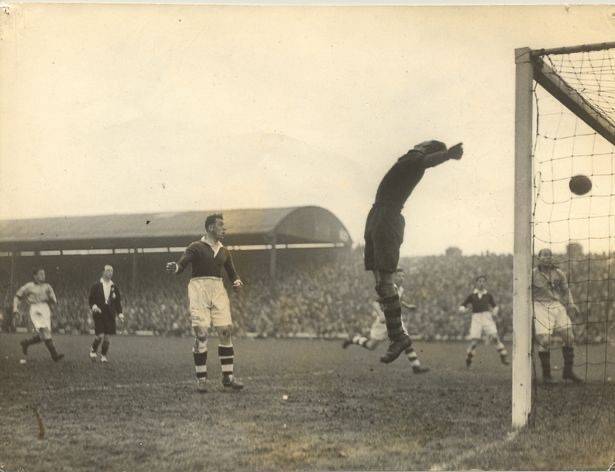
Dixie Dean heads the winning goal for Sligo Rovers at Dalymount Park in the 1939 FAI Cup final Picture courtesy of Sligo Rovers Heritage Group
With a league title out of the question after their recent poor run of form, Sligo Rovers travelled south to Cork for the first round of the FAI Cup a week later. It was their third road trip in two and a half weeks, covering all points east, west and south that the senior domestic game in Ireland had to offer. Given what would have been an expensive run of games for any Irish club, the Sligo hierarchy will at least have been buoyed by the impact on attendances that Dixie Dean was having. And they would end up more than pleased on that showery, cold February Sunday, as yet another record crowd turned out at Cork City’s Mardyke home to see Dixie play.
As ever, the exact crowd was difficult to pin down – but according to reports, the attendance was somewhere between 11,000 and 20,000 spectators – with and the plumping for the former, while the went for the higher figure (proving that out of sight wasn’t out of mind when it came to Dixie Dean and the English public). Whatever the number, the gate receipts were a handsome £455 (€33,000), half of which Sligo would take home, once the game’s expenses had been cleared.
The FAI Cup was Rovers’ only hope now of securing silverware, and a good run and good crowds would go a long way to justifying the investment in their English star.
But while the newspapers might not have agreed on the attendance, the performance of Sligo’s centre-forward drew gushing praise from all as the westerners ran out 2-1 winners in what was a classic, breathless cup tie.
"Dixie Dean had a lot to say in Sligo Rovers’ 2-1 victory over Cork, at Cork, in the Eire Cup. His presence was the means of attracting 11,000 spectators. Dixie played a great game throughout, although he did not score," reported the Belfast Telegraph. (Interestingly, the Telegraph also mentioned that there was a rumour that Dean would be returning to Nottingham after the game, hinting that his time with Sligo was already at an end. However, while the player was indeed returning home, it was just to see his family. Rumours and newspapers – the football media really hasn’t changed too much over the years!)
Meanwhile, the Birmingham Mail was more ebullient in its short report. "Sligo Rovers, with their attack led by Dixie Dean, beat Cork City by two goals to one in the first round of the Eire Challenge Cup at the Mardyke, Cork, yesterday. A record crowd of 20,000 watched the game, and Dean was mainly responsible for swelling the attendance. He was accorded a wonderful reception and signed hundreds of autographs before and after the match. Dean led the Sligo forwards in brilliant fashion, and engineered the movement which resulted in Monaghan scoring the winning goal. Sligo went ahead with a penalty through [William] Hay, and [Tommy] Davis, ex-Oldham Athletic, equalised early in the second half. Dean was seen to great advantage during the second period, and before making the goal for Monaghan, he struck the woodwork twice. At the conclusion of the game, he was carried shoulder high to the pavilion."
The ‘special correspondent’ was succinct in his praise of Dean, writing simply ‘He was brilliant.’ Meanwhile, the was left in little doubt that with Dixie Dean, as with all great players, form is temporary, but class is permanent.
"A fortnight ago Dixie Dean came to Sligo Rovers and since then soccer enthusiasts in the West were wondering if he would fulfil expectations. They know now, and Cork fans know to their cost as it was through his ingenuity that Cork were knocked out."
However, it’s the more considered piece printed in the following Saturday that’s of most interest, giving us as it does a fine insight into the all-round quality of Dean’s display on the day.
It’s easy to think of him as just a goalscoring machine. The reports from the Shelbourne and Bray games illustrated that he still maintained that deadeye for goal, even if, as yet, the prolific nature of his prior record was yet to be displayed. And those watching and those who had invested had already learned that he was as physically committed to the game and to his employers as ever. But the Mardyke match turned out to be an exhibition of the fuller range of his abilities as a footballer, as Dean led his team, oozing class, guile and skill. And crucially this time, his team-mates appeared to be less awestruck, responding more positively to his presence.
Volt (most journalists of the time wrote under pen names) in the Champion was blown away, and not just by the stiff Cork breeze. "Over four hundred Sligo Rovers supporters spent fourteen hours on an excursion train last Sunday, in order to see Cork beaten in the first round of the Challenge Cup of Eire. The thrilling game which they witnessed at the Mardyke made the long journey worthwhile. I have yet to see Sligo play better than they did in this gasp-a-minute game which they won on merit but which might easily have been a draw. There can be no doubt that “Dixie” Dean was Rovers’ matchwinner. Without him, I think, Sligo’s Cup hopes would have been shattered. The mark of “class” was branded on everything he did, every flick of his head, every body swerve and pass paved the way for a Sligo attack and fast heartbeats for City’s supporters."
The match was a ding-dong affair and had the home side provided better support for their Irish international forward Tommy Davis, who was outstanding on the day, Cork might have taken something from the tie.
Dean was shadowed by the 18-year-old Johnny McGowan, who would be capped for Ireland later in his career, and it was the battle between the two that caught the Sligo reporter’s eye. The youngster had a fine game; his impressive display helped to keep Dean off the scoresheet. That said, Dean did hit the woodwork twice and gave his young marker and all watching an education on how to exert telling influence on a game whilst being under very keen surveillance.
His movement off the ball and his tactical understanding of the game saw him regularly drop deep, with his shadow in close attendance, creating space time and again for his Sligo colleagues to exploit. It was a lesson to all and sundry. "Clever as Cork’s halves were, they failed in seeing through Dean’s idea of deserting leadership and wandering around the half-way line. McGowan dutifully followed, leaving a gap in the centre in which [Hugh] O’Connor and [William] Johnston had many clear runs."
The deep-lying position Dixie adopted in the Mardyke game was a trademark feature of his play, developed over his career as a response to the increasingly close attention he received from defenders as the opposition sought to counter his lethal goal threat.
Right up to the 1950s, the 2-3-5 or W-M formation was de rigueur across the football world, with the centre-forward always at the point of attack. The great Hungarian side of the 1950s is often considered to have broken that mould, most famously in their 6-3 Wembley win over England in 1953. The game is largely remembered for the confusion and ultimate embarrassment the home side suffered as a result of the deep position taken up by the Hungarian number nine, Nándor Hidegkuti, as directed by their tactical genius of a coach, Gusztáv Sebes. However, similar positional play was noted as far back as the 1927/28 season in which Dean set his record of 60 league goals.
Dixie would often take up such a starting position, befuddling the opposition defenders and breaking their defensive shape. He would regularly drop right back into his own half of the field to direct affairs, before rejoining the Everton attack with devastating effect. It is probably fair to say that the Toffees didn’t build a system of play around Dean’s innovative thinking; however, there’s enough evidence to show that his positional awareness and reading of the game were ahead of their time. And it’s also fair to say that the big crowd in Cork in the second round of the FAI Cup that Sunday in 1939 got a real sense of his genius.
Dean was directly involved in both of the Bit O’Red’s goals. In the 15th minute, he showed his strength and touch, holding up a ball from wing-half William Hay before slipping namesake William Johnston into the penalty area with a perfectly timed pass. As Cork’s defence panicked, the Sligo attacker was upended, and a spot kick was awarded. Hay dispatched the ensuing penalty to put the visitors a goal to the good.
Dean was getting into his stride now and was clearly enjoying himself. A brilliant dummy created an opportunity spurned by left-half James Graham. Minutes later, he drew seemingly every Cork defender to him before a brilliant through ball sent Monaghan, with whom his relationship on the field of play continued to blossom, clear. But again, the opportunity to put Sligo into a more comfortable lead was spurned.
CONNECT WITH US TODAY



Be the first to know the latest news and updates