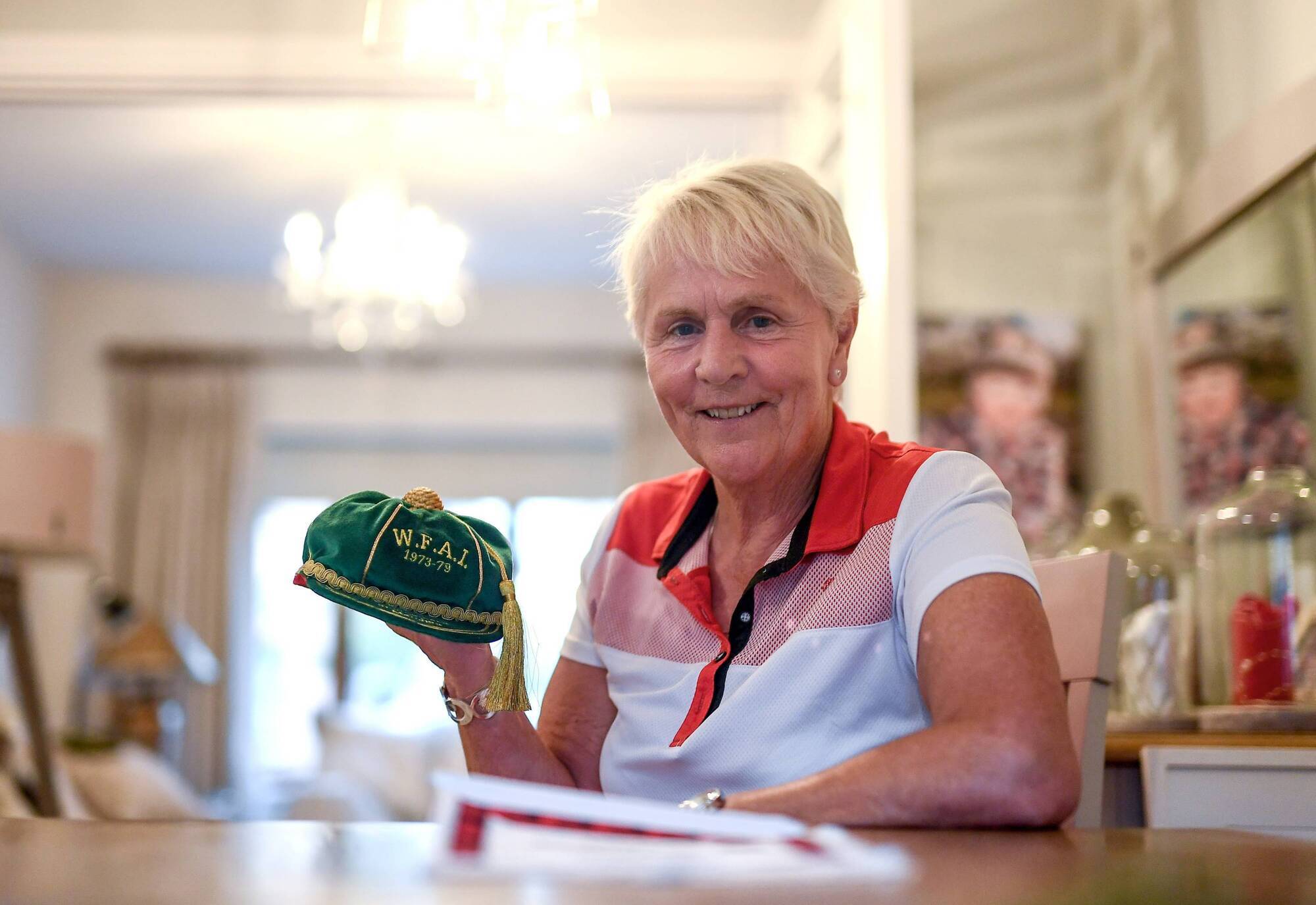
Paula Gorham is flicking through a leather-bound scrapbook that has captured a remarkable sporting life when she is asked if there is a particular clipping or photograph that stands apart from the carefully crafted pages.
There is no shortage of choice. The scope of her story is a vast net that scoops up a myriad of passions. If soccer makes for the bulk of the story known to most of us, then it is just one arm to a tree that branched into Gaelic games, track and field, squash, and badminton.
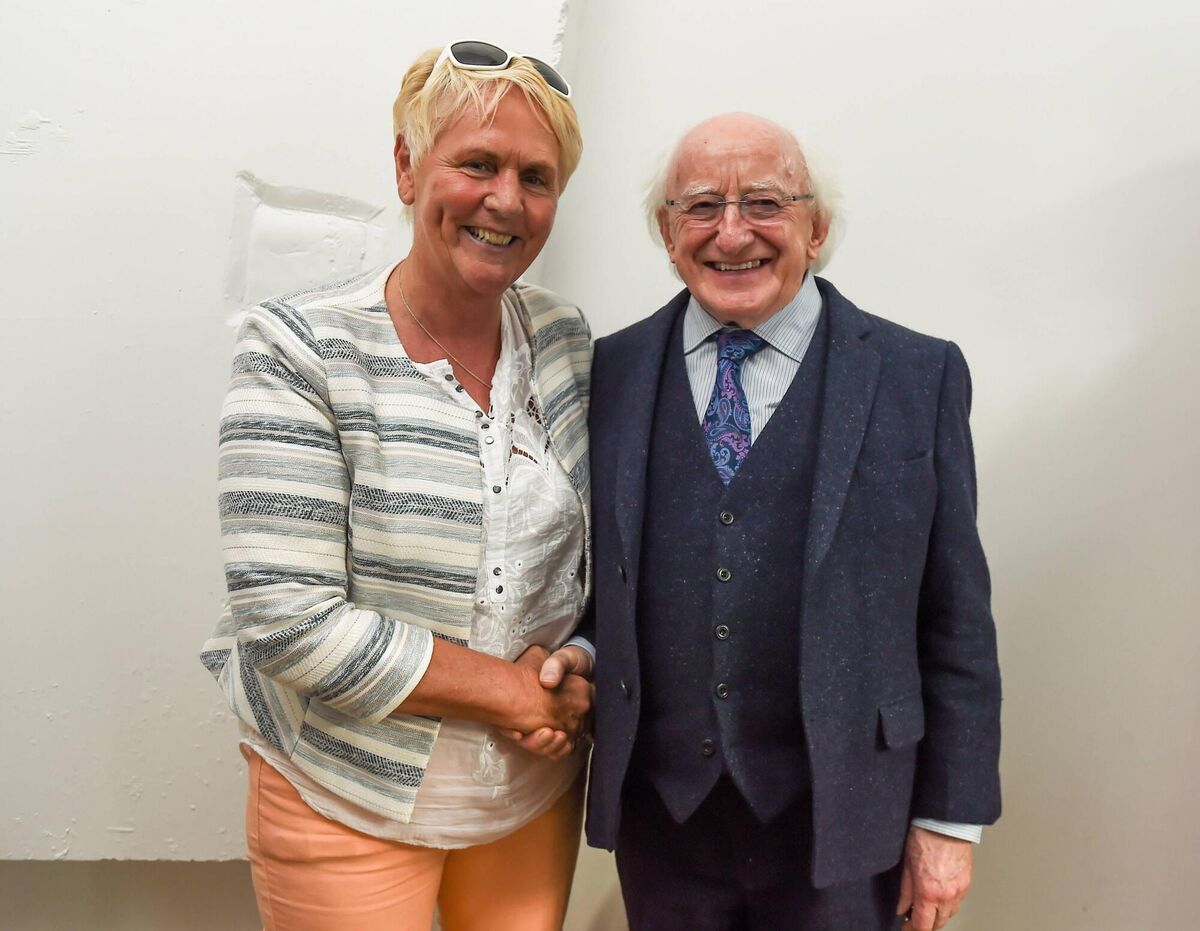
Of all the memories, one pops immediately to mind. It’s a picture of her 16-year old self at the North Louth Sports Awards in the Ballymascanlon Hotel. She is flanked by Noel Carroll, the famous runner, and Hugh Boyle who played for GB & Ireland in the 1967 Ryder Cup.
In all, there were 14 men honoured that evening. Gorham was the only female, the nod coming for her exploits at Ladies football, but it’s the fact that her mother May and father Jim were there in long dress and bow tie that ensures this one burns the brightest.
“It would have been one of the proudest nights I had and the day I remember most is the day I came home from Wales after being the only Dundalk girl on the Ireland team and scoring a hat-trick. My dad was after hearing it off the radio, there were no televisions.
“He got up and shook my hand and for my father to do that was an honour for me. It was unbelievable. It wasn’t something my dad would do. He was a very quiet man and he would take it all in his stride but he was really chuffed about that.”
The album was a 60th birthday present. And what a present. A friend, Colette Murphy, put it together, meshing bits of clippings Gorham had gathered with others sourced fresh from the library’s digital newspaper archives.
The result is not just a treasured personal heirloom — and Murphy put a second one together for her oldest grandchild — but an historical record of a woman whose talents challenged a culture and a time hostile to the very idea of her gender on field or court.
The FAI have belatedly taken note, borrowing the book for a spell not so long ago and inducting Gorham and Johnny Giles into their half of fame for what the press release stated was their “unique contribution to Irish football”.
Both will be presented with their awards at the Aviva Stadium in November when the Republic of Ireland’s men’s team face Portugal.
None of this was signposted. Gorham’s mother enjoyed sport on TV but, with 11 children, this was the height of her involvement. That aside, there were brothers who played some Gaelic football and a few sisters who ran the odd bit.
That was the extent of it. Then along came Paula whose school days invariably ended with a bag chucked into a corner and another kickabout on the cul de sac out front with its rounded stone wall that was tailor-made for honing her skills.
Left foot, right foot. Didn’t matter. Never would. She never had a favourite. It was an obsession.
“I think my mother got the wrong child!” she laughs.
Gorham was still only 11 when her first competitive game dawned in the form of the Dundalk Maytime Festival, a week-long event that threw up everything from bonny baby contests in the Dominican Hall to the Bavarian Choral Concert in the Marxist Grounds.
Indoor football at the Adelphi Ballroom was a staple that drew crowds of up to a thousand people and teams from all over the island. Gorham’s first taste was to be on a women’s side representing the local Blackthorn shoe factory that won the final on penalties.
“It was that massive in the town that they erected screens up at the square because there was no room in the ballroom. It was really massive in those days, in the ‘60s. The balcony in the Adelphi was thronged, all four sides, you could not get in there for the finals.”

By 1970 she was part of a Dundalk ladies team that, long dominant in Ireland’s unofficial national league, travelled to Prestatyn in Wales to face England’s Corinthian Nomads. The scoreline wasn’t pretty but guess who got Dundalk’s only goal?
Two years later there was a first official cap with those three goals against the Welsh.
Ten more appearances followed and her abilities as a centre-forward who could stitch play together as well as she could score goals earned the offer of a professional contract from Stade de Reims when she was still a teenager.
Jim nixed that one.
“If I had been a man I’d have definitely made it in England,” she declares at one point.
Life went on. School gave way to work, marriage and three children but sport never stopped. She was on a flight bound for Paris and a game against France a day after her honeymoon, and three or four months pregnant with her son Karl for a meeting with England.
“His claim to stardom is that he has an international cap,” she jokes.
They weren’t easy to come by. Gorham had no car at the time. That meant lifts to Dublin, or alarms at half-six in the morning to catch a bus or train for trials which, in an echo of Roy Keane, she believes were always weighted against the culchies.
There was no funding, no association providing assistance. Balls and jerseys were sponsored, usually by a small local business. All of this worked against those players who wanted nothing more than the opportunity to play the games they loved.
“They were difficult times for a lot of women in those days. A lot of them were married and with kids and you had to fund your own way most of the time. It wasn’t easy but when you put on the green jersey and heard your anthem being played it was worth it.”
Gorham was married at the time to Stan Brennan who had played Gaelic football to a decent level and so understood and shared the sporting bug. Weekend games were invariably family affairs with picnics packed along with Paula’s boots.
But there was no escaping the sexism beyond that circle.
It was there from the time she started playing football in the street, and it was there beyond the confines of the beautiful game. Even in a sport as shiny and new as squash, which became enormously popular in Ireland in the 1970s and ‘80s.
“There was one club in Dublin where women couldn’t play in it. We used to go to Dublin every second week for the away matches and I remember getting very angry. I couldn’t even understand why women weren’t allowed to play. I couldn’t understand it.”
Ground still needs to be made for women in sport, plenty of it, but the dial is moving in the right direction and this trailblazer has noted with satisfaction the stepping stones, not least the recent announcement that the Republic of Ireland’s women’s team will receive equal pay for appearances as their male counterparts.
Tomorrow night will see her in Tallaght for the friendly between Vera Pauw’s team and Australia, her invitation to take in the game linking a generation that paved so much of the way for today’s players to thrive.
She has seen herself how one brick leads to another. Karl never got capped himself but he too was an intelligent footballer. Another son Mark was scouted by Manchester United and her daughter Orla came close to playing basketball for Ireland.
Her four grandkids — Ewan, Ross, Cillian, and Holly — have carried on the baton, the only girl among them already rocking up to her brother’s training sessions with hurley and sliotar in hand. Holly has yet to turn three.
Her grandmother makes do with a bit of golf these days but only after a roll call of surgeries in recent years brought on, she reckons, by her decades of devotion to her games: a cruciate repaired here, four back operations there, and a hip procedure for good measure.
“I wouldn’t change a minute of my youth for all the money in the world, or to go professional. I wouldn’t change what I had, what I achieved, the life I lived. I never drank, I never smoked.
“I take a wee drink now but while my sisters were getting dolled up to go out to dances I was going to bed early to be ready for training, or whatever I had to do. I’m crippled but, you know what,” she laughs again, “it’s all okay.”
CONNECT WITH US TODAY
Be the first to know the latest news and updates