The coin has fallen for him. Now Pep Guardiola’s reputation is on the line
Manchester City’s owners consider winning the Champions League to be their destiny. They implied as much in 2008, albeit accepting that it would take some time
The coin has fallen for him. Now Pep Guardiola’s reputation is on the line

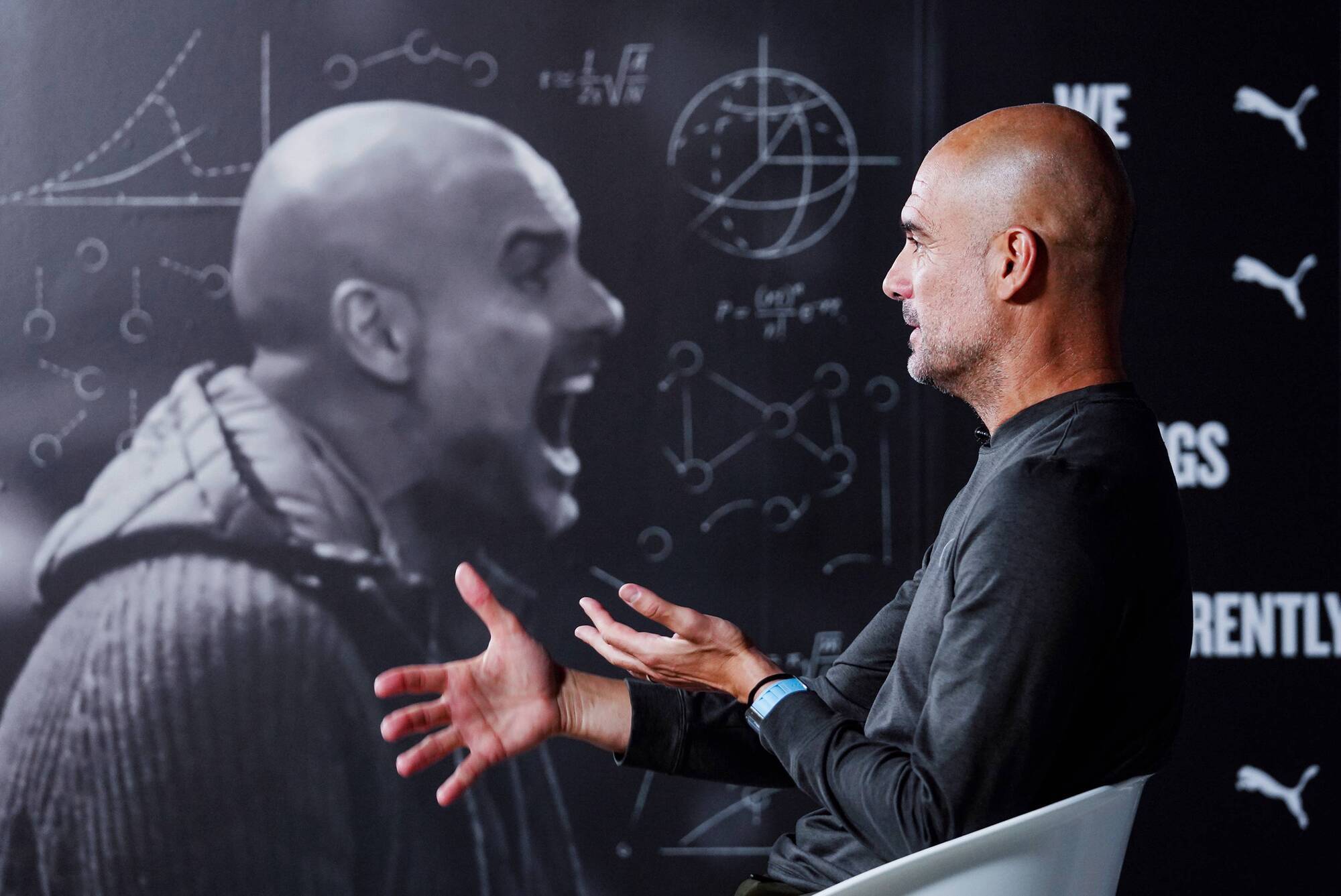
This week, Guardiola was asked about his team’s improvement in Champions League knockout form. His answer? Good luck. “I have to admit it,” Guardiola said. “This year the coin fell down on our side.” Picture: Matt McNulty/Manchester City FC via Getty Images

It says everything about Manchester City’s spending, fantastic wealth, and rabid pursuit of silverware that there is one match that every season ultimately marks the line between their glorious success and the grey tinge of relative failure, and yet this is the first time that they have actually played in it.

There is a common misjudgement that management at a superclub is an easy life. Tell that to a man who has won 30 trophies in 13 years, has just won a sixth domestic title in eight years and yet will face intense scrutiny if his team loses on Saturday evening.

Manchester City’s owners consider winning the Champions League to be their destiny. They implied as much in 2008, albeit accepting that it would take some time while committing to Mark Hughes’ continued presence as manager; the two may have been linked. That relentless chase towards European success was not attempted through sporting interest or altruism, even if it is fair to assume some in the corridors of power have caught the bug since.

The purchase of Manchester City, a high-profile club in the highest-profile league, was a soft power launch to promote Abu Dhabi and its sponsors. Winning the Champions League maximises their exposure.

Perhaps ‘destiny’ is a misnomer. It implies serenity, an innate calmness because the end result is in some way predisposed. In fact, Manchester City’s Champions League journey has been a bunfight that they have barely — until now — looked capable of winning. Post-2008, City took two years to get into the competition, two more years to get past the group stages and two further years to get beyond the last 16. If 2016 did bring a semi-final against Real Madrid, Manuel Pellegrini’s team promptly mustered a single shot on target in each leg. Pellegrini was sacked as a result.

Pep Guardiola was appointed not just to establish a period of domestic dominance (although that was clearly welcome and has broadly been achieved — City are the first team other than Manchester United to win three titles in four years since the 1980s), but because he was their best shot at the Champions League.

City effectively built the club’s hierarchy around a manager who they did not yet employ. The theory worked better than the practice; City suffered a series of self-inflicted stumbles in Europe.

This week, Guardiola was asked about his team’s improvement in Champions League knockout form. His answer? Good luck. “I have to admit it, Guardiola said. “This year the coin fell down on our side.”

You can see his point. City were dominant in the group stage but received a gentle draw at a time when focus could shift to revamping their Premier League season after a slow start. Borussia Monchengladbach was an equally favourable tie; City avoided Barcelona, Atletico Madrid, and RB Leipzig. Jude Bellingham had a goal controversially disallowed in the first leg of their quarter-final against Borussia Dortmund. Paris Saint-Germain failed to fully capitalise on their first-half dominance in the semi-final first leg; City deserve all the credit for their response.

But it was still an intriguing piece of humility given so much of a financially elite club’s operation is to eliminate luck. You buy higher quality players who will create and finish more chances and concede fewer. You pay the highest wages. You buy a backup in every position to cover for injuries. You appoint the best coaches, medical staff, and sports scientists. You build a training ground with the best facilities. You improve the academy to ensure that the most prodigious domestic talent will call your club theirs. Luck is to be
feared and thus extinguished, or at least overshadowed by the control that comes with economic power.

Much of the criticism of Guardiola is misplaced. Harry Redknapp’s old adage about him “going to Dagenham if he wants to prove himself” misses the point that with great budgets come great opportunity and great opportunity reduces the margins of success until only the best will do. It is not any easier or harder at the top than the bottom — one has more pressure, the other more leeway.

But in the Champions League, Guardiola would accept that he has underperformed in Manchester. City have found various — and increasingly bizarre — ways to extricate themselves from promising positions against clubs they should ordinarily have beaten: Monaco, Lyon, Tottenham. There were moments of Guardiola’s coin toss — inexplicable misses, miniscule VAR lines, attacking dominance that didn’t lead to goals — but City were ostensibly undone by defensive sloppiness born out of complacency, a little like that statistic about two-thirds of car accidents happening within five miles of the owner’s home.

The same was not true at Bayern Munich, but the results were roughly the same: Guardiola reached the semi-finals three times but never progressed beyond them. In 2016, the final blow came when Bayern had 53 shots to Atletico Madrid’s 18 over two legs, missed a penalty and were eliminated on away goals. Guardiola, typically calm and charming, was thoroughly drained by the experience: “Maybe it wasn’t enough but in the end, I am satisfied with everything that has happened here. I have done my best, the players know that. I have given my life for this club.”

On Saturday, two of those gaps will be filled. City were the superclub who had never played in the European Cup final they craved. Guardiola was the super coach who had gone a decade without participation and had never done so without Lionel Messi. Wrongs have been righted, at least in part.

And City will start as favourites because Guardiola busily created his second great Manchester City team while we were busy wondering whether he could.

The defence was transformed by the arrival of Ruben Dias but also the recall of John Stones and the use of Joao Cancelo as an inverted full-back who stepped into central midfield. In turn that allowed Ilkay Gundogan to push forward; he was City’s top league goalscorer having never before managed more than six in a league season. Out went the strikers and in came a band of attacking midfielders who took turns to cause a nuisance like a band of Victorian ne’er-do-wells.

But ultimately, as Guardiola knows only too well, these games are decided by fine margins. So too will his reputation despite the trinkets that have preceded Saturday and will surely succeed it.

Lose and City only have a league and cup double. Lose and Guardiola will have over-thought it again and will face mockery from those waiting for him to misplace his step.

Guardiola should — and does — expect no sympathy. He knows the rules. These are the standards City aspired to and invited others to judge them by. Guardiola: Pick your team, prepare the players, study the opposition, decide upon a system. After that, you’re left hoping that your time is now, waiting to see on which side the coin falls.

More in this section

Sport

Newsletter

Latest news from the world of sport, along with the best in opinion from our outstanding team of sports writers. and reporters

Cookie Policy Privacy Policy Brand Safety FAQ Help Contact Us Terms and Conditions

© Examiner Echo Group Limited