After 60 years, St Patrick's Athletic and Shamrock Rovers fight for top again
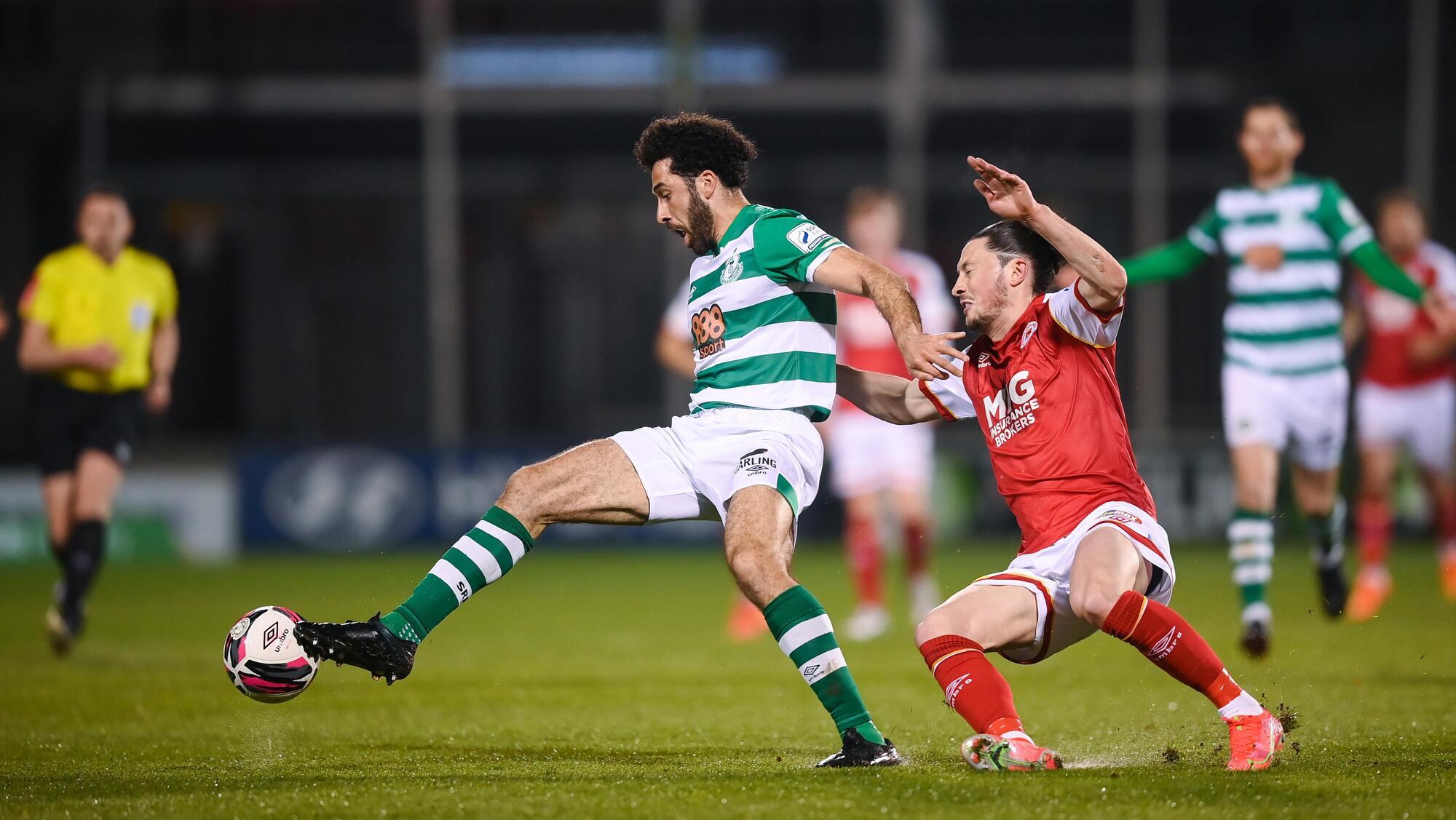
Roberto Lopes of Shamrock Rovers in action against Ronan Coughlan of St Patrick's Athletic during last season's meeting between the sides. This term, the pair are the top two in the country - the first time this has been the case for 60 years.
The build-up to the game was dominated by two things: outrage from the Catholic Church and debates over the merits of League of Ireland players being picked at international level.
This was October 1955.
Yugoslavia were coming to Dalymount Park to face the Republic of Ireland and their arrival had caused a stir in political and football circles for two very different reasons.
“The visit was somehow construed by the Irish Catholic Church as an endorsement of President Tito's communist regime,” Peter Byrne later wrote in the .
“John Charles McQuaid, the Archbishop of Dublin, was responsible for orchestrating the campaign to have the game cancelled. And when the FAI refused to do so, he called on Catholics to boycott the match.
“RTÉ went ahead with plans to broadcast the game, but when members of the sports department refused to co-operate, the programme was abruptly cancelled.”
As the explained, McQuaid’s anger did not resonate. “Close on 200 supporters from Cork travelled for the match. Contrary to general rumour, there were no demonstrations and the only incident out of the ordinary observed was a lone man carrying a Papal flag near the ground.”
Of far more concern to the 22,000 people packed into Dalymount were the performances of the two League of Ireland stars chosen to play by the FAI’s five-person selection committee.
“At the risk of being accredited with a one-track mind, I am making a further appeal for the inclusion of more home players on our international teams,” John McDonnell of the wrote under a column headlined ‘Another plea for the homebirds’.
“Few people would oppose the argument that we should put the best eleven available into the international field – but should we do it at any price?
“I am not suggesting that our players should not go to England if they have the chance, but I do say that the men who best deserve the honour of representing Irish soccer are the those who play in Ireland.
“Call that stupid, childish, unrealistic or what you will… we have here players who are as good or almost as good as those playing abroad.”
The Soccer Survey column, written under the by-line initialled L.P.D, in the was far less enthused about the prospect of the domestic hopefuls. “As always prior to these [international] games, speculation is running high regarding to the composition of the Irish team, and the usual League of Ireland versus Cross Channel layers has been raked out and given another dusting.
“The victim for the visit of the Yugoslavs us the Shamrock Rovers left winger Liam Tuohy, who has been almost a unanimous choice in the pre-match forecasts.”
The young Hoops left winger, in just his second senior season, was indeed named in the starting XI, alongside St Patrick’s Athletic forward Shay Gibbons, who was the poster boy of the emerging force from Inchicore.
His 26 goals in 22 games helped the Saints win the league title in 1951/52, their first season in the League of Ireland after being granted entry from the Leinster Senior League.
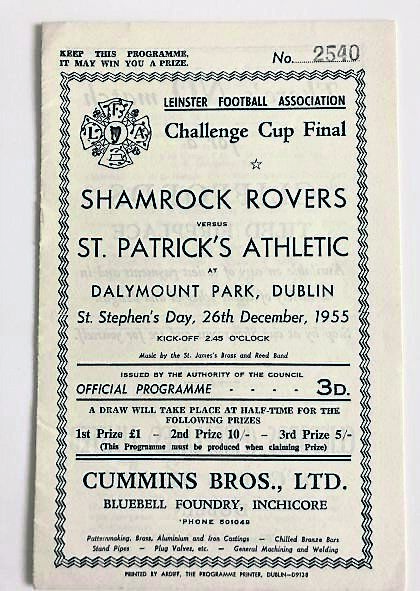
He went two goals better when the Saints followed that up with another title triumph in 1954/55 and topped the scoring charts the following season with 21 goals as St Pat’s, coached by the former Rangers player Alex Stevenson, pipped Rovers to the league title by three points on the final day.
On Saturday, 65 years on from that 55/56 season, the two sides meet at Richmond Park when they are once again first and second in the Premier Division – albeit just a quarter of the way through this term.
It is a quirk of the League of Ireland powerbases throughout the decades that the two south Dublin clubs have not finished as the top two since that campaign, when Gibbons and Tuohy set pulses racing and earned international recognition.
“In terms of achievement and what they did, St Pat’s were the team of the 1950s,” club historian Dermot Looney insists.
“It’s not always reflected when people talk about Ireland at the time, and the golden era of the League of Ireland, and how significant St Patrick’s Athletic were to that.”
Sustaining that dominance for the remainder of the decade proved a struggle, however, and while there were FAI Cup wins in 1959 and ’61, it wasn’t until 1990 that the league title resided in Inchicore again – and even then home games were played at Harold’s Cross with Richmond Park out of commission.
It was Rovers who finished the 50s stronger, reclaiming the league crown in 56/57 and then again in 58/59, where their success led to them becoming the first Irish club to feature in the European Cup with a glamour tie against Manchester United.
“There are still fans now who will reel off that whole team and say it is the greatest ever in the League,” Shamrock Rovers historian and author Robert Goggins adds.
“Of course, Paddy Coad was the outstanding individual and even though it was at the end of his career he was treated like a star at Old Trafford because of his reputation.”
The landscape today might not be the same but seeing Rovers and St Pat’s at the top is a reminder for some of a different time.
CONNECT WITH US TODAY



Be the first to know the latest news and updates