Taken far too soon, but Alan McLoughlin’s moment of magic will live forever
All eyes were on Ron Atkinson’s office door at Manchester United’s old training ground. Some entered and their worlds fell apart. Alan McLoughlin just wanted to be able to buy a second-hand car and afford the insurance.
Taken far too soon, but Alan McLoughlin’s moment of magic will live forever

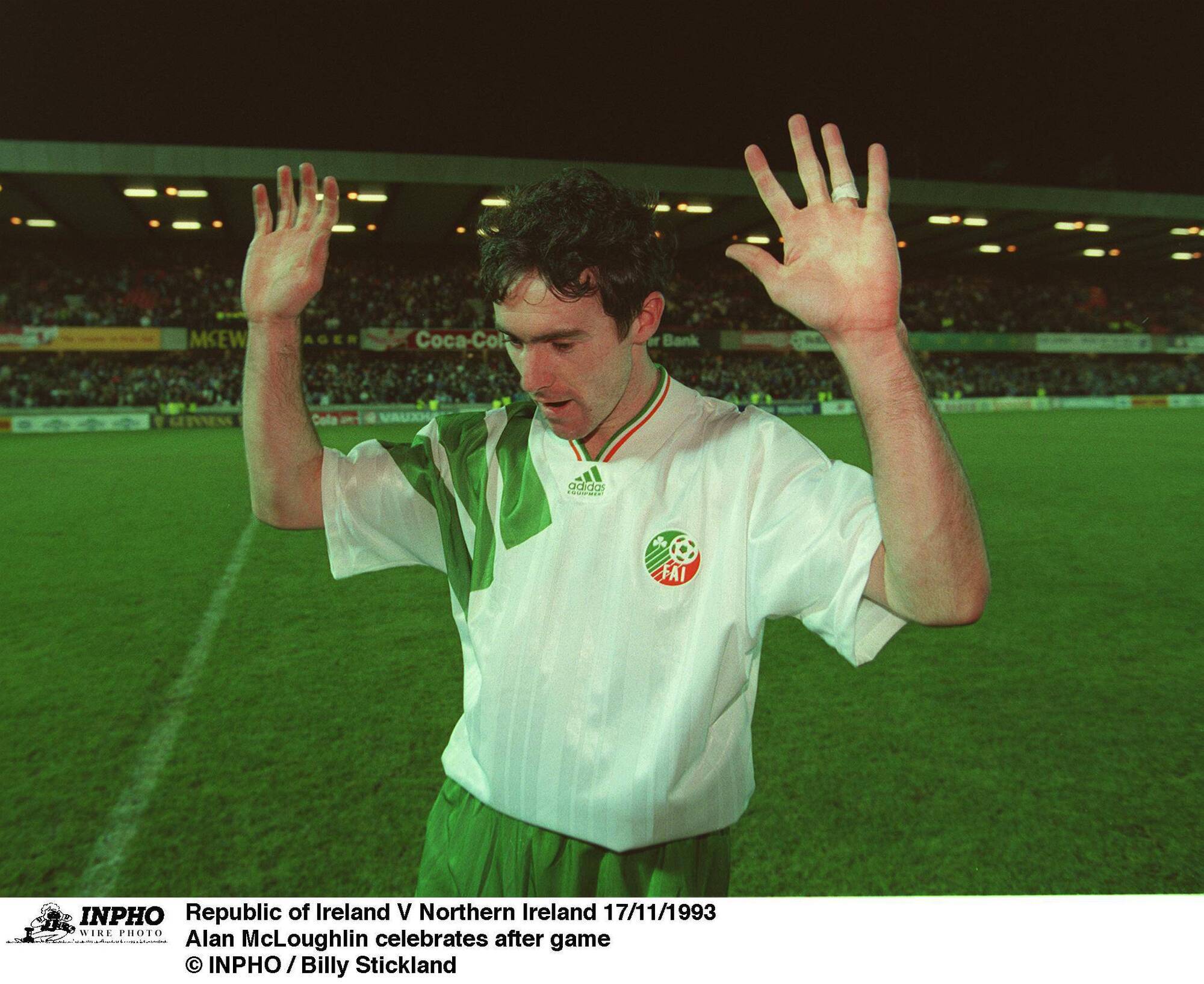
Alan McLoughlin celebrates after the 1993 win over Northern Ireland. Picture: INPHO / Billy Stickland

All eyes were on Ron Atkinson’s office door at Manchester United’s old training ground, The Cliff.

Some entered and their worlds fell apart.

Others got a new lease of life.

Alan McLoughlin just wanted to be able to buy a second-hand car and afford the insurance.

It was the summer of 1985 and some of the United apprentices were waiting to hear their fate from the first-team manager.

“I was one of the lucky ones,” Dubliner Martin Russell recalled. “Because United brought me over from Ireland I had one-year as an apprentice and was then guaranteed three years as a pro. I had that safety.

“A lot of the local lad weren’t in the same boat. They might only have one-year YTS (youth team scholar) contracts.” 

McLoughlin, the former Republic of Ireland international whose death was confirmed today at the age of just 54 following a long battle with cancer, was one of those whose future in the game hung in the balance.

United was his hometown club but, like so many others of that generation, his parents had emigrated from Ireland. Pat McLoughlin was from Largan in Galway while Nora McLoughlin moved from Knockaderry in Limerick.

As an emerging talent on YTS forms, Alan earned £40 a week with a further £35 going to Nora from the club as his designated landlady.

Atkinson ushered him into his office and smiled. “I remember him saying to us that Atkinson told him ‘good news, you’re getting a deal, 90 quid a week’. Alan was working it out in his head and realised his Mam would be losing out on her money now too because he was still living at home,” Russell added.

“He told Atkinson that he would love to be able to buy a car and pay for the insurance so he could get to training quicker and not have to worry about getting there. So Atkinson told him ‘Ok, son, 95 quid, take it or leave it’. There were no agents in those days for young players and certainly no mega money.”

That was just one chapter in a career that was defined by McLoughlin’s total commitment to his profession, flashes of brilliance with the ball at his feet, and one moment in an Ireland jersey at Windsor Park that will remain in lore, when that deadly caress of his left foot against Northern Ireland secured safe passage to the 1994 World Cup.

“I never reached the dizzy heights of being a top-class player, but for being remembered for something that special is great. It’s great for my family and my wife and kids. People still talk about it when we go to Ireland and I don't think I've bought a drink in Dublin for years,” McLoughlin told the Observer in 2002, just as he was finishing up his playing days with Forest Green Rovers at the age of 35.

He had been released by United in ’86 and began the slow rebuild of his career with Swindon Town, eventually earning a dramatic call-up to Ireland’s World Cup squad for Italia 90 when Jack Charlton chose to replace Gary Waddock at the end of the pre-tournament training camp.

A club record £1 million move to Southampton followed soon afterwards before he eventually settled at Portsmouth from 1992-99.

It was during this decade that the hard-working midfielder earned his 42 international caps, rejecting a call-up for England to represent Ireland, and receiving death threats from the neo-Nazi group Combat 18 as a result.

“I only spoke to him a few week ago,” friend and former Ireland captain Andy Townsend said. “We both knew what a challenge he was facing but typical of Al he was ready to meet it head on.

“That has always been his character, he played the game like he lived his life with a real spirit. Football wise he was unlucky because there were so many talented players at the time, if it was any other era he would have played a lot more.

“He didn’t just accept that he wasn’t going to play, he didn’t like it, but he never walked away, he never shied away from turning up for his country and was always available.

“Honestly, he was such a nice person, he was always ready to be part of the fun when it was happening but when he needed to be serious he was, and no game typified him more for Ireland than up at Windsor Park, coming on and being the guy to make the difference,” Townsend continued.

McLoughlin gets past Wales' Mark Pembridge during a friendly in Cardiff. Picture: David Jones/PA.

McLoughlin’s was a footballing life that was chiselled from the granite of rejection at Old Trafford, and because of hard work and relentless dedication, that November night in Belfast offers him a place in the heart of Irish football forever.

“When I think of Alan I think of someone who was totally committed and felt a lot of pride to play for Ireland because of the roots he had,” Ronnie Whelan remembered.

“Of course there is the goal, everyone will always remember the goal against the North. We had the song for him after it, ‘Alan, Alan, who the f*** is Alan!?’ and there was many a night out that was sung between all the lads in good fun because there was always a bit of craic.

“And the lad could play, he would give total commitment on the pitch and never let you down but he could play too. His commitment was enormous and he would always turns It’s just terrible sad to hear this news now because it feels as if that’s another part of the Jack [Charlton] era that we’ve lost. It’s a connection and a link to a great time in people’s lives that is gone.”

There will be a thousand memories and more for his family, and while there was much more to his career than that one goal, it is at least one moment the rest of us can cherish.

Gary Breen is one of them. They became Ireland teammates as the young defender emerged onto the international scene under Mick McCarthy, at a time when McLoughlin was also given a more prominent role in the starting XI for the 1998 World Cup qualifiers.

The pair share similar backgrounds with two parents and extended families all from Ireland. While McLoughlin was a Northerner raised in Manchester, Breen was reared in London, and he can still recall the feeling of lining up alongside one of his heroes.

“For me he was one of the icons of Irish football because of the goal against Northern Ireland but what I really admired him for was the way he treated people. He was from a different era to me but the respect went two ways and I always felt that.

“As a footballer he had a career to be proud of and as a person he was one of the best, a genuine hero to so many of us but he so humble.”

That is no surprise. After all, his ambition starting out was just to afford insurance for a second-hand car.

x

More in this section

Sport

Newsletter

Latest news from the world of sport, along with the best in opinion from our outstanding team of sports writers. and reporters

Cookie Policy Privacy Policy Brand Safety FAQ Help Contact Us Terms and Conditions

© Examiner Echo Group Limited