Graham Cummins: League of Ireland can't blame government for its problems
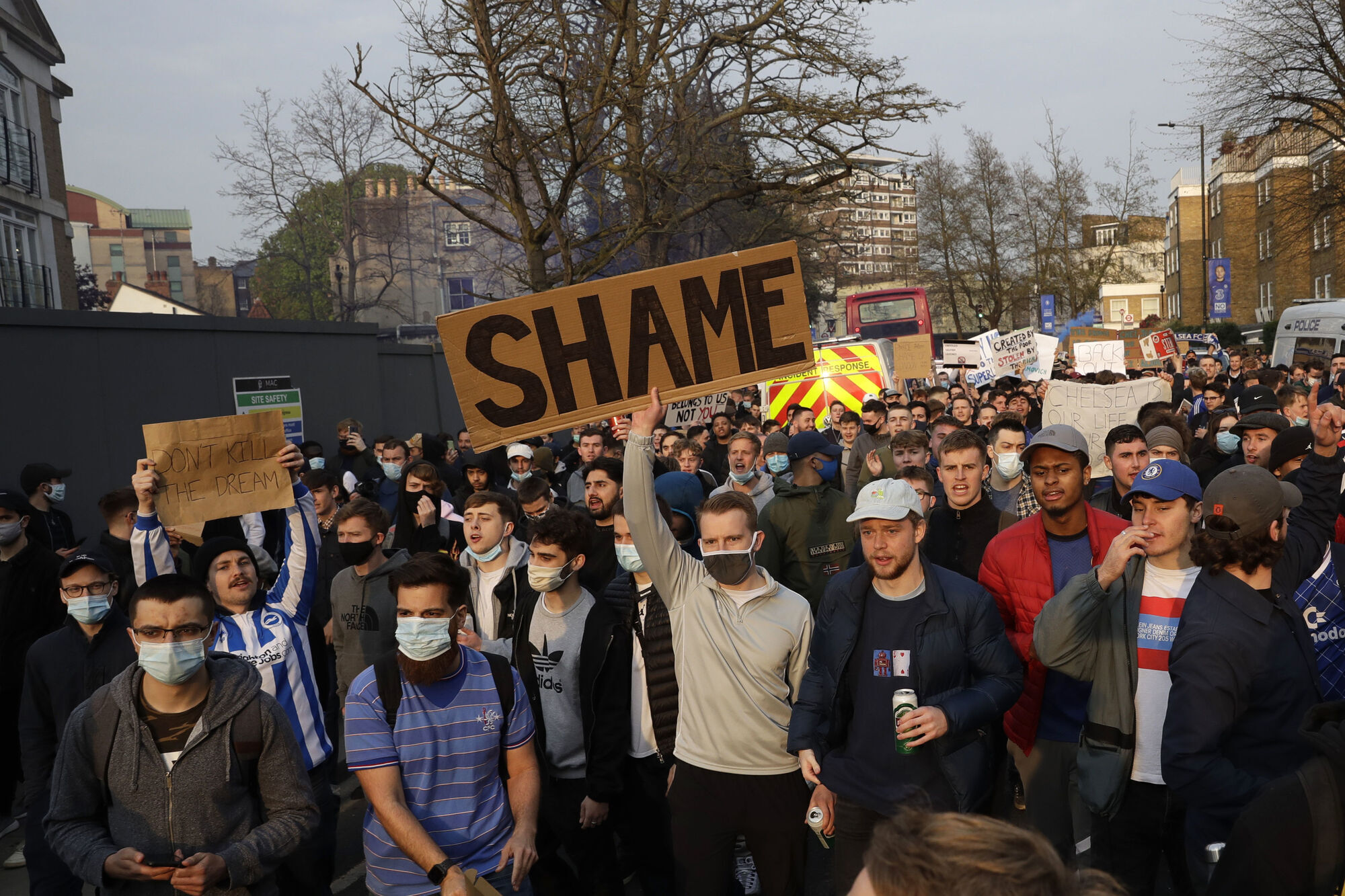
Chelsea fans protest outside Stamford Bridge stadium in London, against Chelsea's decision to be included amongst the clubs attempting to form a new European Super League. The club subsequently pulled out of the proposal. Picture: Matt Dunham
The League of Ireland doesn’t have the glamour or attraction of the English Premier League. But for supporters of the league and those involved with its clubs, Dundalk’s recent success in Europe meant a lot more than tracking Manchester City’s pursuit of the Champions League.
It’s been one of the most dramatic weeks in football history with what has happened surrounding the European Super League and it was heartening to see everyone unite to stop what would have been a travesty for football.
It wasn’t just supporters that came together to halt the Super League, but we saw governments act too. Our own Taoiseach, Micheál Martin, expressed his thoughts on Tuesday, tweeting: “I will engage with other EU governments about the possible common action against this #SuperLeague proposal. It is wrong and would divert money away from football communities, destroying core principles on which sport is based.”
The Taoiseach was merely giving — like everyone else has — his opinion, but some took exception to his comments, believing that he should be more worried about finances closer to home than concern himself with billionaire-owned superpower clubs.
Some League of Ireland fans saw the tweet as an insult, taking it as proof the Irish government is more concerned with leagues around Europe than their own. A Super League launch would have no direct effect on our game, many of them believe, but of course it would have had an impact.
Under the terms of Uefa’s HatTrick programme, national governing bodies get close to €2m per year towards costs in a list of specified areas. If the Super League had commenced, it would have impacted the money Uefa earn from having clubs like Manchester United, Liverpool, and Real Madrid in the Champions League. The revenue Uefa earns from broadcast deals would have been hit. A reduction in Uefa’s income would have had consequences on what they could pay their 55 member associations, meaning less money for the FAI and the League of Ireland.
I’m not trying to say that our league shouldn’t command more support but sometimes we need to look at the good before the bad. Without the Government’s help this and last year, there would be no League of Ireland to support. Shamrock Rovers fans would not have seen their club win a first Premier Division title in nine years.
When the pandemic hit and the league was suspended in March of last year, clubs looked for help to keep their show on the road. Many clubs availed of the Government’s income support scheme to pay their players and when the league did recommence in August, it wouldn’t have happened without the Government’s assistance.
Again this season, there has been €3.6m made available to assist clubs that cannot have supporters at games and additional funding to ensure a full league season will take place.
You can’t blame the Government for clubs going bust in Ireland — that’s down to those running the clubs. I have sympathy for the fans and staff of the clubs when I see League of Ireland teams cease to exist but none whatsoever for the people running them.
The Government cannot step in and save a club every time they get themselves into financial trouble. It’s not the Government’s fault that owners have recklessly overspent trying to achieve success. If the Government stepped in every time a club was in trouble then what’s to stop every club in the league overspending, knowing that they have the safety net of a bailout? It’s not fair on clubs that are run properly and live within their means.
Of course, more can and should be done to help the league. During the lockdown, League of Ireland has been allowed to continue because it is considered an ‘elite sport’, a status that was temporarily removed from GAA.
Yet how can a league where many clubs don’t pay their players for two months of the season be considered ‘elite’? Where contract discussions involving players invariably involve the advice to ‘sign on the dole’.
Some clubs offer players a yearly figure to play with them and it’s up to the player whether he wants his payments spread out over 12 months or get social welfare during the off-season. But players shouldn’t have to be put in that position and more help is needed.
The Government does allow professional athletes to reclaim 40% of the tax they paid for 10 years of their sporting career in Ireland when they do retire.
But that doesn’t help a player looking to secure a mortgage while still playing — it’s no wonder the best players in the league want to leave when they aren’t being paid all year round.
If the Government wants to show its concern for domestic professional football, this is an area where more help and funding is needed.
Politicians aside, the Super League controversy has taught us that wealthy owners cannot necessarily be trusted and are not always concerned about how their actions might affect supporters and players.
Unfortunately, clubs in Ireland need wealthy owners to compete, but there is the wrong way and a right way to attract investment.
Shamrock Rovers is a club that has investors but the majority of shareholding belongs to the fans, meaning that nothing, like a breakaway league, can proceed without the supporters’ permission.
It’s during weeks like this that we see the true value of this model.