Con Martin, The Ban and the birth of an Irish footballing dynasty
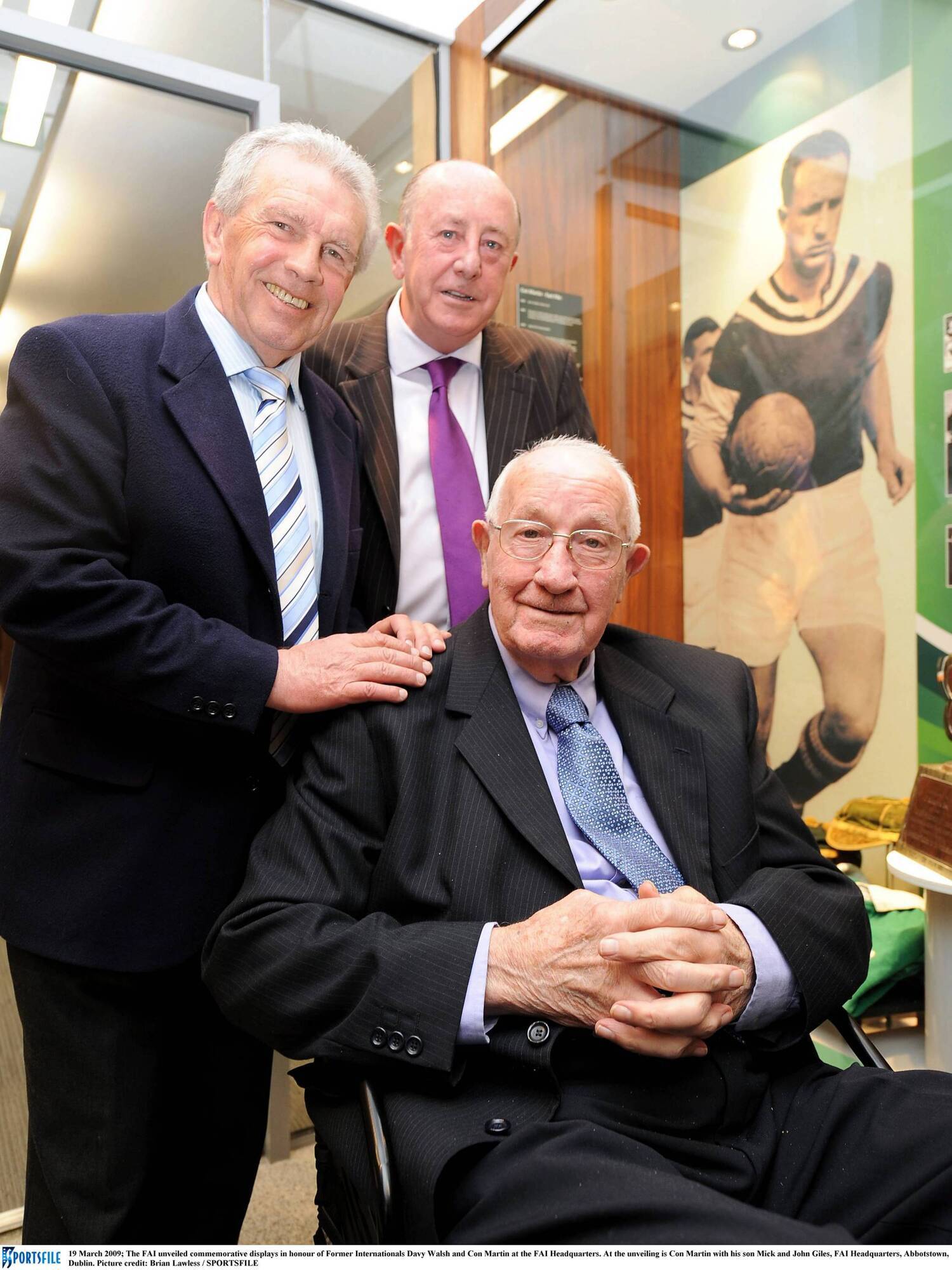
Con Martin with his son Mick and John Giles. Picutre: Brian Lawless
Seismic shifts don’t always disturb the ground beneath our feet. When the GAA repealed its infamous ban on foreign sports at its Congress in Belfast this week 50 years ago it did so with little in the way of discussion, let alone ruction. Rule 27’s presence was erased from the page in little over 60 seconds.
‘The Ban’ was described at one point as the most wicked and vile of stains upon the nation’s soul. This was long before Ireland awoke to the horrors of Mother and Baby Homes, clerical abuse and so much else, but it seems extraordinary that such an overbearing burden could have been lifted with so little by way of reaction.
Rule 27’s powers had leaked away like an old battery all through the 1960s but it had changed the course of countless lives in ways both big and small. It was a dam redirecting the natural flow of sporting passions all over the island, a bastion against the very ideal of fair play written every code’s principles. Its pernicious influence will never be fully itemised.
Some know too well the changes it fashioned.
Mick Martin was one of those who paid no heed to events in the North that day in April of 1971. A 20-year old midfielder with Bohemians at the time, his eyes were directed southwards that same month with a 1-0 win over Cork Celtic four days earlier and a cup game against Waterford in Kilcohan Park to come the following week.
“It went further than completely over my head. I was playing for Bohemians and I was getting a name for myself at the time. People were saying ‘he isn’t bad, he could be useful, like his old man’ the longer I played for Bohemians. I was focused on playing for Bohemians and enjoying every minute of it.
“My dad followed me around the place. If I was playing in the first-team and playing anywhere handy, like Athlone, or Dundalk, or Drogheda, he would be there. He wouldn’t be going to Limerick or Galway or Cork, but he enjoyed going to the games with me ma, watching me progress and eventually I came over here (to England).”
Martin’s dad was, of course, Con Martin who had the distinction of playing for, and captaining, Northern Ireland and the Republic in the course of a distinguished career that started off with Drumcondra and Glentoran, moved on to Leeds United and Aston Villa, and ended with stints back home with Dundalk and Waterford.
Con Martin wasn’t always a ‘soccer man’. An athletic, well-built all-rounder, he played basketball and tennis regularly, boasted a single-handicap in golf for most of his life and, in November of 1941, he played in midfield for Dublin when they beat Carlow in a Leinster football final that had been delayed by foot and mouth.
He was still only 18. Dublin would retain their provincial title the following year, and supplement it with a first All-Ireland since 1923, the year he was born, but his Gaelic football days were already over by then, ended by the beady eyes of a GAA ‘vigilante’ who spotted him playing the association game for Drumcondra.
Life is full of turns in the road, shaping who we are and what we do, but it is rare that one veers as sharply and with such clear consequences as this. The GAA lost a boy of promise. Soccer profited from a man who, while a centre-half by default, was so versatile that he once enjoyed a lengthy stint in goal for Aston Villa.
Con Martin played in goal for the Republic too, though not when he scored a penalty in the 2-0 win against England at Goodison Park in 1949. He passed away eight years ago at the age of 89, a giant in every sense of the Irish game who, after his playing days, still enjoyed access to the dressing-rooms at Dalyer ahead of big games.
Young Mick would invariably tag along to Phibsboro, soaking up this privileged access to the inner sanctum and noting how his dad stood out, not just because of his renown but the massive frame and the Crombie coat to boot as he chatted away to the Charlie Hurleys, Noel Cantwells and Andy McEvoys.
Little did he know that one of Irish football’s great dynasties was already in the making and that he would be central to it. Con Martin never force-fed soccer to his kids, or decree that GAA or any other sport was off the menu, but it’s not hard to see how this proximity to the game’s greats would have pointed him in a given direction.
Mick Martin would follow in his father’s footsteps by representing the Republic and fashioning a career in England with Manchester United, WBA and Newcastle United. His brother, Con Jr, played for years in the League of Ireland and Owen Garvan, a nephew, would play for Ipswich Town, Crystal Palace and St Patrick’s Athletic.
GAA, once so central to Con Martin, only rarely made an appearance after ’41. Mick played a few games with a club which he thinks was Na Fianna and represented his school. St Vincent’s CBS in Glasnevin, three or four times in Croke Park. What his dad made of life’s twists and turns was never teased out.
“He wasn’t that type of fella. He didn’t want to sit down and delve into what was, what happened, what he had done playing GAA. He had a love for GAA but it was never his duty, as far as he was concerned, to delve too deeply into it. What happens happens, you know? He wouldn’t want to complicate things. He was easy-going, he just got on with it.”
If the Martins had long moved, then Ireland was following suit.
The Ban’s hold on society was loosening all through the 1960s as the country modernised and TV made the policing of ‘foreign sports’ both ludicrous and impossible. The decade is dotted with articles in publications around the country describing it in terms such as “antiquated” and deeming the very concept to be “childishness”.
The difficulty in maintaining it as anything stronger than a paper edict was highlighted in February of 1969 when the Cavan chairman TP O’Reilly ruled that, in the absence of volunteers to serve as vigilantes, all 61 board members would now be enlisted to the lost cause, like some hapless town posse on the trail of an elusive cowboy.
Rule 27 was, by now, a doddery old dear but it still tried to bear its teeth. In August of 1970, just eight months before the stain was erased at Congress, the Martry club demanded an investigation into the Bohermeen team that had faced them in a Meath intermediate football match earlier that summer.
The objection focused on three men, all of whom were said to be well-known soccer players and one of whom had been named, according to a report in the , as a goalscorer for Parkvilla at least 14 times in that same paper. “They will be bringing on Georgie Best next and expecting our lads to play against him,” said the Martry chair.
Enforcement depended on location and the individual beliefs of administrators which meant that Waterford’s Tom Cheasty could be suspended for attending a dance organised by a soccer club while Mick Mackey’s fondness for rugby matches prompted the Limerick board to circumvent the issue by making him a member of its own vigilance committee.
Con Martin was eventually presented with his 1941 Leinster medal in the year after The Ban was lifted but it’s intriguing to wonder how his life and that of the family that followed him might have unfolded had he, as legend puts it, not been introduced to soccer while serving in the Air Corps. Or if that vigilante had woken up with a sick stomach that morning.
Mick Martin can’t answer that. Who can? All we can do now is look back at a very different time and place and scratch our heads at the concept that, for 70 years, and long after the majority of the island had gained its independence from British rule, people could decree that some games were acceptable and others were not.
“It should never have been there in the first place,” says Martin. “What’s the harm in playing soccer or Gaelic? You could play soccer on the Saturday and Gaelic on the Sunday, or vice versa, and no-one would have a problem with it.
"It was ludicrous to have something like that in place and thanks be to God that times have gone on. Unfortunately, my dad is not here but he could have coped with both very, very comfortably.”


CONNECT WITH US TODAY



Be the first to know the latest news and updates