Eamonn O’Keefe: My mad experience at Cork City... and how John Delaney saved my leg
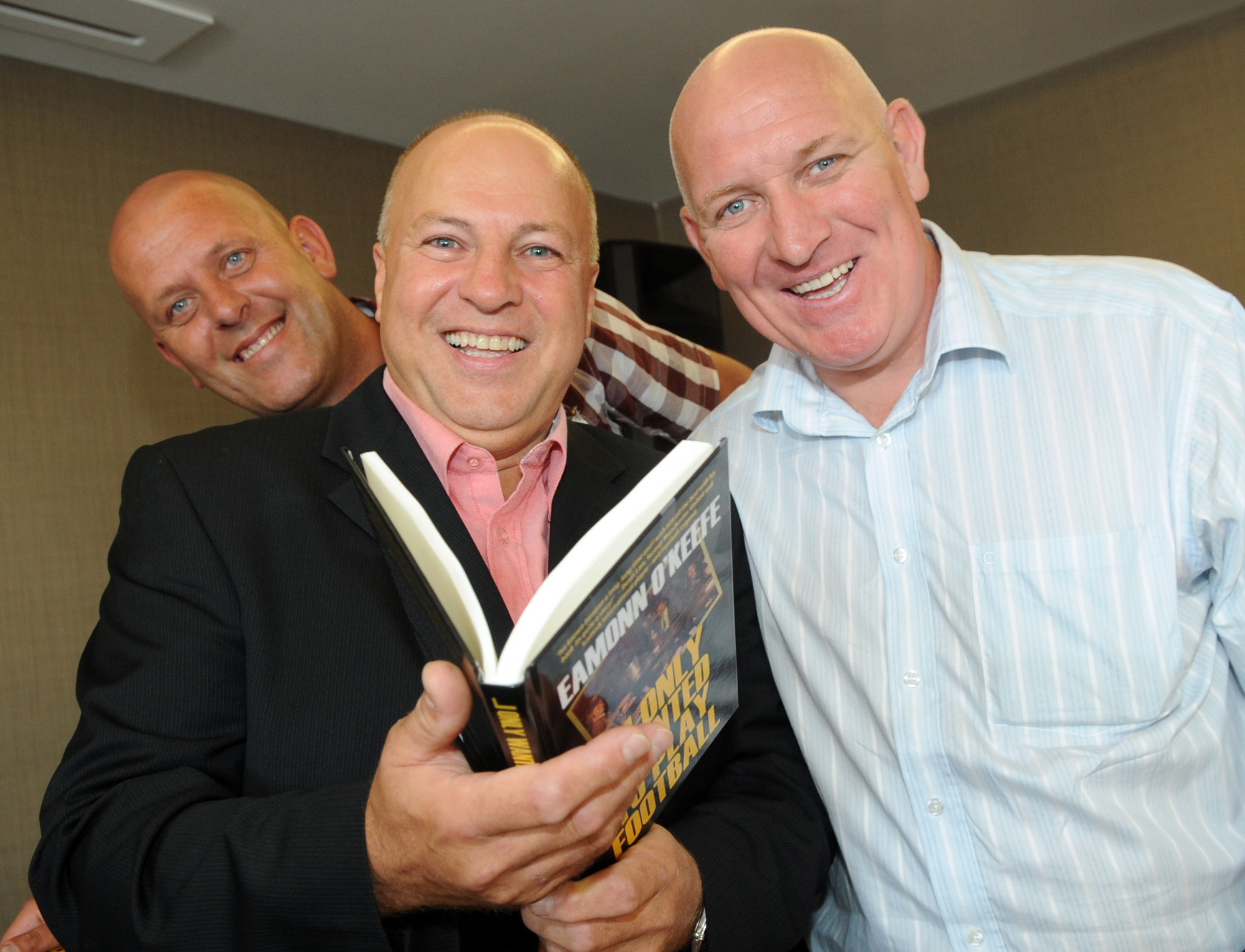
Former Cork City manager Eamonn O’Keefe at the launch of his book ‘I Only Wanted to Play Football at the River Lee hotel with former Cork City players Pat Duggan and Dave Barry in 2010. Picture: Eddie O’Hare
I RECEIVED a phone call from the Commander (Harry McNally, the manager of Chester City) asking me whether, because of my international career, I still had any contacts in Ireland as, now that Harry was manager of Chester, he was looking to organise some pre-season games.
I made a few phone calls and I managed to secure two games — one with Waterford United and another with Cork City. The Commander was delighted. God help Ireland, I thought, as I informed Harry of the details — the dates and the phone numbers of the chairmen of both the Irish teams. On his return, I asked him how he had got on.
He replied: “What a good trip!”
“Do you mean the hotel? What about the pitches? Were you treated OK?” I fired at him, with huge interest.
With his usual comical irreverence, he retorted: “Never mind all that — they supped us out of sight! I thought we were First Division but we’re non-league compared to that lot’s drinking abilities! Oh… and by the way, the chairman of Cork City wants to see you. He hasn’t got a manager at the moment and I’ve recommended you to him.”
I tried to imagine how that conversation had gone but decided not to even try… The Commander, with a few beers inside him, talking to a chairman who was able to drink him under the table? Too much!
I phoned the number that Harry had given me and I spoke to the then chairman of Cork City, Chris Herlihy, who invited me over to Cork to have a chat about managing his team.
The following day, I flew to Cork with an open mind. I was met at the airport by the chairman, Chris Herlihy and the vice-chairman, Christy Looney. (Looney? I suddenly thought to myself: Oh, no! Harry’s set me up!)
We drove to Christy’s house and they asked me if I wanted to book into a hotel or would I prefer to stay with Christy Looney? I decided that I would stay with Christy as I felt that I couldn’t pass up the chance of telling people that I had stayed with the Looneys!
We soon organised the contracts and I told them that I wanted Bill Haydock — formerly at Blackpool — to be my assistant. They were happy with this. Bill was actually in Norway, coaching, at the time but he quickly agreed to join me. Mick Conroy (aka Binzer) had now moved to Leyton Orient. We had stayed in touch and I told him that I wanted him to come to Ireland with me. Unfortunately, he was still tied in to his contract so we decided to put him on hold for the time being and see how things panned out.
The Cork goalkeeper, Paul Kelly, had recently emigrated to Australia and I thought of Phil Harrington, the Blackpool goalkeeper. I thought that it would be good for both him and me if he was to come over and join us to play in League of Ireland football and I secured his services after agreeing a small transfer fee.
We rented a beautiful bungalow in Ballinhassig, just outside Cork City — close to where the secretary, Seamus Casey, lived with his lovely family, Anne, Liam and Chris. Also, our neighbours there made us feel so welcome that it just felt perfect.
We had some early success and Bill and I started to get to know the team a lot better — but I have found that players are much the same everywhere. When I say this, I mean that, although people are of course individually different, you will always get a similar bunch of ‘types’: loud, quiet, comic, extrovert, introvert, some are quite ‘cliquey’, etc. I have to say though that, as a whole, the entire team was very supportive of Bill and myself from the minute that we arrived. And we really appreciated that.
Before the season started we won the Munster Cup, which was a tremendous boost. These lads were very good semi-pros and, if I had been asked to recommend them, I would certainly have done so. Especially Pat Freyne, Dave Barry and Philip Long — I would have recommended them to at least second division level in England. And I believe that, at 25, Philip Long was a much better left-back than half the First Division (now Premier).
There were some great moments… Playing away at Galway, in the first minute of the match, a long ball was pumped down the middle into the Galway penalty area. To everybody’s astonishment (and amusement) the centre-half — instead of heading it — caught the ball, as clean as you like!
“Feck me!!” He said to himself, in disgust, as he realised what he had done.
“He thinks he’s playing feckin’ Gaelic football!” sniggered Freyne. We were awarded a penalty and their centre-half, still furious with himself and his mistake, threw the ball away in temper. To my surprise Barry Neiland, our full-back, immediately ran after it like he was an Olympic sprinter, picked it up and then rushed back to me.
“Come on, come on!” he flapped. “Put the fecking thing in the net!”
I told Barry to calm down and that we would take our time and do it right. The players were gathering around and Barry was pushing them away and was clearly extremely agitated.
“What’s up with him?” I asked Philip Long. “He’s got the Golden Goal Ticket with one minute for the first goal and he’s annoyed that you’re taking all fecking day to take the penalty,” explained Philip, with a grin. I took the penalty and scored. It went down, officially, as two minutes into the game and Barry refused to speak to me for the rest of the day!
I had decided to sign a centre back and I discovered that Alan Dodd (the ex-Stoke City and Wolves player) was available. Ironically, Tom Docherty (manager of Wolves, at the time) had tried to set up a swap deal involving Alan and myself. It never happened, I think, because Alan didn’t want my Port Vale wages — I, however, would have been well-chuffed with his! (This was something that I discussed with Tommy Docherty when he came over to Cork for a Sportsman’s Dinner!)
I asked Alan if he would come over on a month’s ‘loan’. He agreed and so Bill Haydock, my assistant, and I met him at Cork Airport. We all shook hands and walked to the car.
“Does anybody want this Club biscuit?” Alan asked.
“Why? What’s up with it?” I asked.
“It’s got animal fat in it and I’m a strict vegan.”
“Oh! What a shame,” Bill said and then explained: “Our winger, Paul Bowdren, is a butcher and after training on Thursdays he always brings our meat order and then we all have beef stew on Friday nights.”
I could see that Alan was starting to change colour so I changed the subject. “Have you been to Ireland before?” I asked. “Yes, when I was on tour with Stoke City,” Alan answered. We chatted away until we arrived at the bungalow. Alan was impressed with the house and how a bunch of lads managed to keep it so clean and tidy.
“It’s not always like this!” Bill commented. “We always have to get on Harrington’s case — you’ll meet him soon.”
Sure enough, on Friday night, Bill cooked the usual pan of beef stew and told Alan that he had made up a small pan using just the veg — “like a soup”, for him. Alan was delighted by this and he was obviously quite touched by Bill’s considerate manner. He apologised to Bill for having to put himself out on his account. We all sat down and were enjoying the meal when, as we were finishing, Bill started chuckling to himself.
“Ha,” He said to Alan. “I sprinkled some mince into your stew Alan, and you didn’t even suss it! Veggie, my arse!” Alan immediately turned green and promptly raced to the toilet, catching his vomit in his hands as he ran. “Oh, brilliant!” I said to Bill. “The lad’s only been here five minutes and now he’s dead upset and throwing up everywhere!” “It’s all in the mind,” stated Bill, flippantly.
“What is?”
“I never put any mince in his pan, I was only messing about. He’s only been sick because he thought there was meat in it — not because there actually was meat in it. See what I mean? It’s all in the mind!”
“Thanks for that, Professor Haydock,” I said, dryly. “Now do you want to go and tell him that before he turns his stomach inside out?”
Bill scurried off in the direction of the retching noises. Alan only stayed for that first month and declined to sign up for another. I wasn’t really surprised…
We had done alright in the league and we had reached the final of the League Cup in 1987. We were down to play Shamrock Rovers in the final at Turners Cross in Cork. A great day was had by all and, much to our delight, we won 1-0. So, in our first season, we added the League Cup to our Munster Cup.
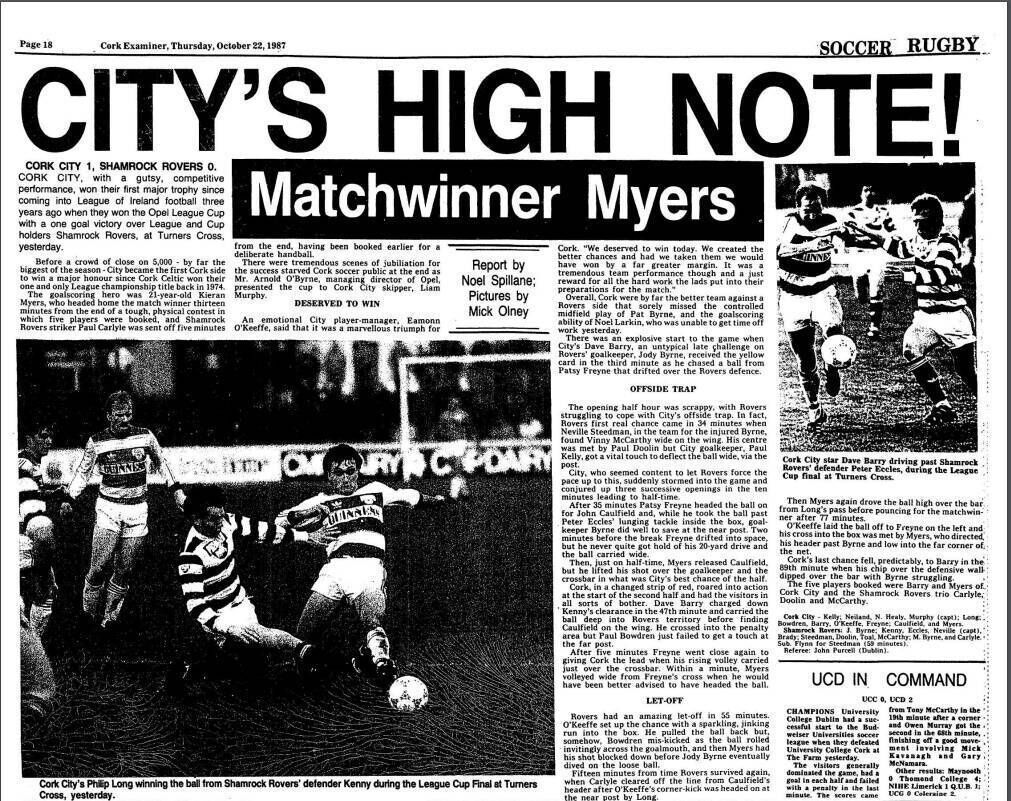
It was a fantastic start to my managerial career.
Honour
I HAD the honour of being selected to join the Opel Committee that was formed with the intention of raising the standards of the game in Ireland.
We all arranged to meet in Dublin and it was an interestingly diverse group of people that gathered, having travelled in from different parts of Ireland. The meeting was chaired by the Managing Director of Opel in Ireland, who were the sponsors.
I remember that there were some great ideas put forward and there was a mixture of both old and new concepts. I met John Givens (Don Givens’ brother) at this meeting and found him to be more in step with my way of thinking than a lot of the others — the list of suggestions and concerns that I had made, in preparation for this meeting, more or less mirrored John’s own notes.
For example, in order to increase the amount of people actually paying at the gates to see the matches as they were played, we should move the kick-off times from Sunday afternoon to Friday evening. The reasoning behind this was that Sunday was considered to be a family day. Also, they were about to start showing English Football League games on Sundays so the competition would be too strong. Saturdays were televised anyway in Ireland so Friday night appeared to be the most sensible choice. Friday evenings were then still traditionally viewed as the ‘men’s night at the local’. It was looking like floodlights might be the order of the day…
We agreed, as a committee, that these Opel meetings were only going to be worthwhile if the FAI were prepared to listen to us and, also, to make some positive moves in response to whatever we put forward. We also agreed that the chairman, as the major sponsor, needed to put this point across to them in a way that ensured that there would be no misunderstanding.
On arriving back in Cork, I spoke to Joe Delaney, who was on the board of the FAI. Joe was very approachable and, in my mind, if anything was going to be changed — and improved — with regard to football in Ireland, then Joe would be a driving force behind it — even though, I knew, he would prefer to remain as much in the background as possible.
He was, of course, very interested in the outcome of the Opel meeting and he invited me to his Limerick home for a chat. It was one of the hottest days of the year when I drove my car up onto the drive of his beautiful home, and the sun was blazing down.
I pulled into the parking area and, as I got out of the car, a big brown and white St Bernard ambled over to greet me. He was huge — probably about 12 or 13 stones, I reckoned. I locked my car door and turned around, ready now to fuss the dog. As he got within the last couple of yards of reaching me, his whole demeanour suddenly changed, shockingly and dramatically.
With a deep-throated rumble, that sounded like it came from underground, he launched himself at me in a full-on attack, instantly knocking me to the floor. Although I reacted quite quickly and scrambled to get up so that I could climb back in the car, his teeth had already fastened on my right thigh. His slavering mouth totally encased the muscle and, as he started to bite down on me, I screamed out for help.
Joe’s son, John, came flying out of the house and grabbed the dog by its neck, but he was unable to separate us.
“If I pull him, the muscle in your leg will come away with him,” he gasped, in panic. I’m sure that the attack only lasted for a few seconds but it felt like an eternity! In desperation, from my position on the floor, I managed to punch the dog, hard, on his muzzle and, fleetingly, it relaxed its grip on my leg. John responded in a flash and in that fraction of a second he managed to yank him off me (thank God John is a big lad!).
John kicked him away from me and then dragged him over to a barn-type building, where he locked him in. He then came racing back to see how I was. I was still lying flat on my back — my trousers were ripped to shreds and I was covered in blood.
“Let’s get you into the house,” he said. By now — again, probably only about two minutes had elapsed since the start of the whole terrifying incident — everybody had come running out of the house and John and Joe helped me up. Joe’s wife was crying and she kept repeating, “He’s got to go this time, Joe, no more excuses — he’s got to go!”
In the house Joe poured me a brandy, as I was shaking like a leaf, and then he phoned the local doctor. He was instructed to drive me round there straightaway and, once there, the doctor cleaned me up and stitched my leg on both sides where the dog’s teeth had punctured the skin.
Throughout the whole time that the dog had hold of me, John himself had been gripping on tightly to the fat on the dog’s neck and, by continuously pulling him upwards in that way, he had managed to prevent the dog from putting its front feet on the floor. I have no doubt whatsoever that, if the dog had been able to put its feet down, it would have been able to lever its weight much more effectively — and the outcome would have been a damn sight more serious than it actually was.
Joe reckoned that the dog was getting old and, after sitting out in the scorching hot sun all morning, it had just snapped. He said that he wasn’t prepared to take any chances with it though and, if I had been a child, my leg would have been snapped in two. Joe decided, there and then, that it would be put to sleep immediately. I like dogs as well as anybody else and it’s always going to be a tough decision if you decide to have your pet put down — but, credit to Joe, I genuinely feel that he had no other choice. The dog was a loose cannon.
Now, complete with my bandaged leg, we returned to Joe’s and we sat for half an hour talking. The now rather awkward atmosphere was eased greatly when Joe informed that I mustn’t worry — he intended to get the dog sorted out with a tetanus jab in the morning!
As for John Delaney, I don’t think I am exaggerating, or over-dramatising, when I say that he saved my leg.”
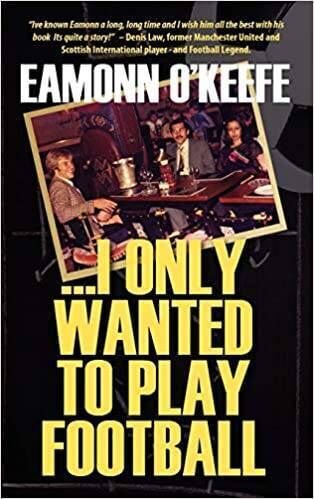
- This is an extract from Eamonn O’Keefe’s autobiography, I Only Wanted to Play Football, published in 2010.
ON MONDAY
- Read Part 2 of the Cork City chapter in Monday’s Irish Examiner, covering Jack Charlton’s trip to Cork, the missed signing of Roy Keane, and an unfortunate end to the City experience.


Cancel anytime
CONNECT WITH US TODAY



Be the first to know the latest news and updates