Ireland's shape-shifting
Twelve months ago, following a 4-1 drubbing by Wales in Cardiff, Martin O’Neill used a back three for his last five matches in charge (four draws, one defeat).
A 3-5-2 in Poland (1-1) was followed by a 3-5-1-1 against Denmark twice (both 0-0), Wales (0-1), and Northern Ireland (0-0).
Mick McCarthy ditched 3-5-2 after the opening 15 matches of his first spell in charge.
Shortly after Haris Seferovic’s goal in the 16th minute, Ireland reverted to 4-1-4-1.
John Egan, who started to the right of Shane Duffy in a back three, moved to the Derry man’s left in a conventional back four.
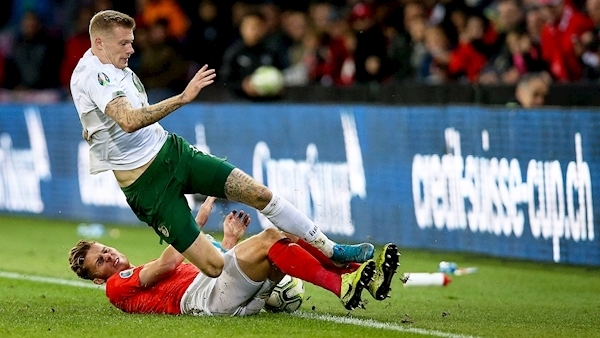
James McClean switched from left wing-back to the right side of midfield, with Aaron Connolly and James Collins taking turns to alternate between the left flank and the lone striker’s role.
After Callum O’Dowda replaced Collins for the second half, Ireland adopted a 4-3-3, with Alan Browne and Jeff Hendrick on either side of Glenn Whelan in midfield, and O’Dowda and McClean flanking Connolly up front.
Following Séamus Coleman’s red card, Browne filled in at right-back.
The young striker who offered hope in the dying days of O’Neill’s reign has stalled under McCarthy, despite a transfer to the English Premier League.
Dropped in Geneva after three starts as a wide attacker in Group D, he lacks the defensive instincts of a Jon Walters.
Happier in a central role, he could be an impact sub against Denmark.
Unbeaten in 23 competitive matches over three years, the Danes lost two World Cup qualifiers inside three days in October 2016, the same month in which James McCarthy last played for Ireland.
Both Poland, who defeated Denmark 3-2 in Warsaw, and Montenegro, who won 1-0 in Copenhagen, deployed two holding players in a midfield four.
The Poles used 4-4-2. Montenegro adopted 4-4-1-1.
CONNECT WITH US TODAY



Be the first to know the latest news and updates