Carlos Alberto obituary: ‘He treated the ball like a person he loved and would hold in his arms’
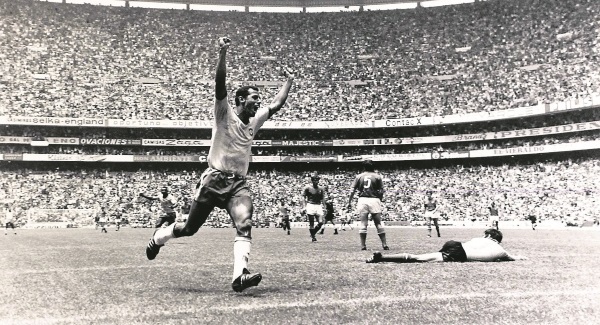
His body is upright, arms whirling, both legs extended: the left behind him, the right scything through the air.
The picture could be of some master of the martial arts. But this lethal athlete is in the act of scoring a goal.
An iconic goal, the goal of all goals. For this is Carlos Alberto, the captain of Brazil and that extraordinary leap and strike has just crowned the finest move in the finest World Cup match of all-time.
“He never mistreated the ball. He was tender, he treated the ball like a person he loved and would hold in his arms,” said his team-mate Hercules Brito, in his tribute that followed Carlos Alberto’s death last week.
It seems an unlikely thing to say of a player who could strike a ball with such blinding power, but the Brazil of 1970, Brito included, combined grace with menace like no other team before or since.
Some of them are legends.
Pele, Rivelino, Jairzinho, Tostao, and Gerson formed probably the most lethal attack in history. Gerson and Pele both scored stunning goals in that 1970 final against Italy.
But those goals are barely remembered because of the sheer grandeur of the final move, involving nine different players, beginning with one of the lesser lights, Clodoaldo — supposedly a defensive midfielder — who almost casually dribbled round four Italians while still in his own half. It was a game and a goal that inspired a generation, both fans and players, among them the 15-year-old Alan Hansen.
“It was at that moment I knew I wanted to be there myself, playing in games like that,” he says. “I will never forget watching that game.”
Carlos Alberto would never forget it either. He should have played in the 1966 World Cup, when he was already Brazil’s best defender, but didn’t even make the squad.
“I thought my place was guaranteed,” he said. “When I was told my name had not been announced, I even thought someone was playing a joke.”
Brazil’s failure in England, when Pele was almost literally kicked out of the tournament, toughened them up for the tournament in Mexico, above all the captain. They were like a team possessed, but they were also very well prepared. The spontaneous brilliance of that crowning goal was based on some good homework, as Carlos explained to the BBC in 2006.
“We knew before the game it could happen,” he said, “because we knew how the Italian team played. They played man-to-man on the central line. They followed our forwards.
“And our coach, Mario Zagallo, said to Jairzinho: ‘Always, if it’s possible, make a movement to the left side to bring Facchetti (the Italian left back) with you to make space for Carlos Alberto to go forward.’
“I tried a few times to go there but football is interesting because we know how the opponent will play but we cannot count how many goals we will score.
“But towards the end of the game, Jairzinho was on the left side with Facchetti, who left his position to follow him. There was space for me on the right side.
“When Jairzinho received the ball from Rivelino and gave the ball to Pele my stride was totally open, and Pele waited a few seconds for me to be there and then gave a beautiful pass for me to score.
“Pele knew I was coming, because we had spoken about that kind of chance before the game, if Jairzinho made the movement to the left side.
“We only realised how beautiful the goal was after the game.”
Carlos Alberto was no longer just captain, he was known as Capita — The Captain — but sadly that was his only World Cup. He was injured in 1974 and by 1978 he was with Pele and Franz Beckenbauer at New York Cosmos, and retired from international football. Apart from his time in the USA his club football was played mostly at Santos, also with Pele. But he was and remained committed to Fluminense, and Rio de Janeiro was always his home, even during the two years when he managed Corinthians, the top Sao Paulo club, which was a bit like a Liverpool man going to Old Trafford.
Carlos Alberto was not a great success as a manager, despite his qualities as a leader, although he was briefly in charge at clubs from Miami to Monterrey, as well as in Rio. His career in the dugout ended somewhat ignominiously in physical confrontations with a couple of match officials.
Off the pitch, however, he was the nicest of men and made a second career as a football pundit. His last appearance on TV was just two days before his death from a heart attack, aged 72.
He also had a third career, with a surprising foray into Rio de Janeiro politics, as a councillor for the left-wing Democratic Workers’ Party, the PDT.
It seemed an odd move for some journalists, because in 1970 he had been the darling of the military dictatorship and its most feared leader General Emilio Medici.
It was during one of the country’s darkest periods, when thousands of opposition activists, including the PDT leader Leonel Brizola, were forced into exile, and others were jailed and tortured, or simply disappeared.
Quizzed on his affiliations in 1988, he seemed uncomfortable about the reminder: “I was very young at the time,” he said, “and I only wanted to know about football.”
It was the huge gulf between rich and poor which had persuaded him to become involved in politics he said, telling how two desperate young men had held him up at gunpoint in his home, and how he wanted to do more for the people of Rio. The right back who ended up on the left. It might almost be a metaphor for that 1970 team.
CONNECT WITH US TODAY



Be the first to know the latest news and updates