The English view: Change in approach and attitude pays dividends
“Do I look like an England fan?” the man in the fancy-dress outfit asked police in a thick Irish accent as they questioned him at Stansted Airport early on Saturday morning.
“No,” came the response, “but we aren’t taking any chances.” The level of concern at this potentially volatile fixture was obvious to those of us who crossed the Irish Sea over the weekend.

It began at the airport as anyone who looked like they might be a football fan had their passport details taken by armed police.
These were then radioed back to base for cross-checking against a list of 1,875 known football hooligans.
If there were a match, police informed the queue at Gate 40, then they would be unable to board the flight.
There were no matches, and the leprechaun claimed his window seat without issue.
.@England fan Dane Cloak exchanges pennants with @FAIreland supporter Declan Finnegan. pic.twitter.com/0eicHwHfdt
— England (@England) June 7, 2015
Yet theses measures give a glimpse into the reasons why following England abroad is no longer the dangerous pastime it used to be.
The nadir came in the 1980s and 1990s. The scenes in Dublin in 1995 and Marseilles three years later are still vivid even now.
White shirts; tattoos; racist chanting; the indiscriminate throwing of seats and bottles — the reputation of the English hooligan was well earned.
Some 17 years on and the authorities are confident they are winning the battle against the hooligan fringe, and particularly against the right-wing element that used to be a constant presence within England’s support.
The police and courts issue regular banning orders, and each of those 1,875 fans had to ‘sign on’ at a police station between 10am and 1pm yesterday, to ensure they were not in Dublin.
PHOTO: England fans in good voice inside the Aviva. Still 0-0. #IreEng pic.twitter.com/H0VnTUgUsi
— England (@England) June 7, 2015
Supporters who did travel were obliged to collect their tickets in person, providing photo ID to ensure they were not passed onto others.
The police also had ‘spotters’ in the crowd at the Aviva, on the lookout for known troublemakers as they worked alongside gardaí.
In the end, the game passed off without incident, both on and off the pitch.
The pleas issued by both Roy Hodgson and Wayne Rooney pre-match had obviously been heeded by the 3,000 England fans who were in the stadium, and the estimated 2,000 who had also travelled without tickets.
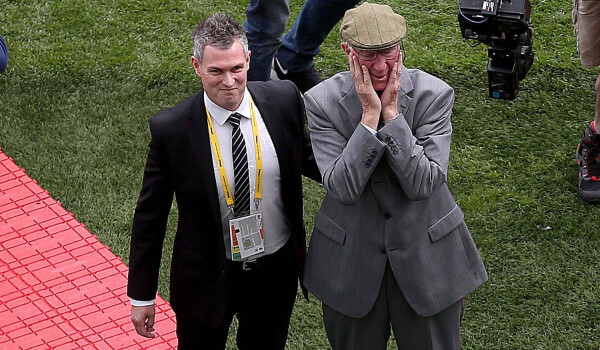
Both England and Ireland supporters rise as one as Jack Charlton is presented to the fans on the Aviva Stadium pitch. pic.twitter.com/QlFCfgxaHt
— breakingnews.ie (@breakingnewsie) June 7, 2015
It helped that neither team inflamed the situation by launching an attack of note, while the decision to salute Jack Charlton before the match was inspired as it took any remaining tension out of the occasion.
Instead, the England fans amused themselves by signing about the FIA. ‘Sepp Blatter, he paid for your ground,’ was one chant, while Thierry Henry was also lauded as they made the most of the revelations last week of a €5m payment from FIFA back in 2009.
It was good natured, and taken as such by the home fans.
Yet it also — pleasingly — went against the grain in terms of recent England away games.
A letter from the FA to supporters ahead of this fixture noted ‘a distinct deterioration’ in behaviour over the last year, with 18 fans banned and 46 others warned about their behaviour since September.
Most worryingly, supporters were heard to chant ‘No surrender’ and ‘Fuck the IRA’ during the victory over Scotland in Glasgow last November, while there were reports of a tram being bounced off its tracks in Switzerland.
But the supporters I encountered both in and on the way to Dublin were a mile removed from the archetypal hooligan.
Preoccupied with finding a decent pub to watch the Champions League final, barely any of them were old enough to have been in Lansdowne Road, or at least playing an active part in the troubles, in 1995.
They seemed to understand the importance of this fixture after events of 20 years ago. But mostly they wanted to have a few beers and watch the football, not settle decades-old scores.
It’s just a shame that the football wasn’t worth watching.
The man in the leprechaun outfit might wish he hadn’t bothered.


CONNECT WITH US TODAY



Be the first to know the latest news and updates