A final date with destiny
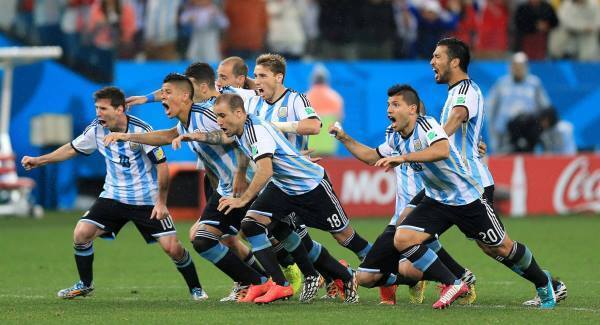
Almost there now and, as the world awaits the 2014 final of the Copa Do Mundo, we can but hope that Germany and Argentina will sanctify the holy ground of the Maracana with a game for the ages.
Not that we’ll be holding our breath. At this dizzying altitude, at the very summit of world football, fear of failure can all too easily eclipse will to win and, lurking like a dark shadow in the corner of the mind, is the memory of how these two nations pretty much stank the place out when they last contested the final, in Rome, in 1990.
Yet, there are reasons to feel optimistic too, not least in the fact that what is nominally, the greatest game in the world, will play host to the man who is, unequivocally, the greatest player in the world.
More on Lionel Messi later but, for now, there is just enough time to pause and reflect on the roller-coaster ride which has brought us to this point of definition after one month that seems to have passed like a day while encompassing the events of a year, here in Brazil.
My own view is that this has not been a great World Cup – but a sensational one.
The distinction has to do with how we define greatness in football, and one requirement for an immortal Mundial must surely be that it is touched by the presence of at least one truly outstanding team, a side which not only emerges as fully deserving winners but, in doing so, elevates the entire sport to another level – like Brazil in 1970 or Spain in 2010.
A great World Cup also demands great games between the great powers. Again, think of the bounty of riches that was 1970 in Mexico, and simply swoon at the luminous memory of England 0 Brazil 1, Italy 4 West Germany 3 and, the pièce de résistance, the Brazilians’ 4-1 victory over the Italians in that celebrated final in the Azteca Stadium. And, of course, 1970 also had Pele, the greatest there has ever been, and at the very peak of his powers, just as 1986 was lit up by Maradona, 1998 by Zidane and 2002 by Ronaldo. Just occasionally, one man can make all the difference.
The 1974 final was another to enter the pantheon, as the formidable West German team of Muller, Beckenbauer, Overath et al. edged out Johann Cruyff’s dreamy Dutch side. And who will ever forget 1982 in Spain, when Brazil’s beautiful losers were knocked out in a thrilling contest by eventual winners Italy, and there was also that raging, tumultuous 3-3 semi-final in Seville which ended with West Germany edging out a justifiably aggrieved France on penalties?
World Cup 2014 might not have produced a classic superpower head to head to rival any of those – again, we look more in hope than expectation for a final shot of redemption tomorrow – and yet it has been a tournament of epic entertainment value, which those of us fortunate to have been here in magical Brazil and all those watching from afar, are bound to remember with fondness and gratitude – not to mention a generous helping of sheer disbelief.
Which is where the sensational dimension comes in, most strikingly in the way that the month-long action was virtually book-ended by two earth-shaking results – Holland’s 5-1 demolition of Spain and, of course, Germany’s frankly preposterous 7-1 humiliation of the host nation.
The first I watched in a café-bar in Manaus, a spot in the heart of the mighty Amazonian rain forest which somehow seemed an appropriately bizarre vantage point from which to discover, with no little shock, that the reigning world and European champions were now all at sea.
The second I witnessed in the flesh, and neither ‘shock’ nor ‘awe’ comes even remotely close to conveying the sensation of utterly jaw-dropping disbelief which took hold of every single one of us in that crowd of just over 64,000 in the Estadio Mineiro in Belo Horizonte.
Yes, agreed, this was indeed a game for the ages — but only to the extent that its relationship to the classic encounters mentioned above is comparable to the relationship between night and day. Brazil’s disintegration was something entirely off the scale in the whole history of the game at this level, seeming to belong more to the realms of lurid horror fiction than the presumed reality of a World Cup semi-final which, after all, is supposed to be a contest between two of the four best football teams on the planet – and not, as appeared to be the case last Tuesday, an absurdly one-sided, minor cup fiasco in which hapless non-league amateurs are put to the sword by ruthless pros from 10 divisions above.
Yet it happened, it really did, and I was there to see it. And I might as well warn friends and colleagues now that, when I get home, I am going to be boring them about ‘Maracanazo – The Sequel’ for rather longer than those six minutes it took Germany to put four past the nation which, lest we forget – and irrespective of what happens tomorrow – will emerge from this tournament still holding the all-time record for the highest number of World Cup triumphs.
And there was so much else that was memorable, for good and ill, about World Cup 2014: James Rodriguez’ spectacular ‘golazo’ for Colombia against Uruguay at the Maracana (and, yes, annoyingly for friends and colleagues, I was there at my ‘local ground’ in Rio to see that too); the epic spirit displayed by the US and Costa Rican teams; the heart-stopping drama of Brazil’s penalty shoot-out win over Chile; David Luiz’s physics-defying free-kick against Colombia (now destined never to get another mention in his native land); Luis Suarez yet again giving all us amateur psychologists plenty to chew on; the liberal refereeing which, though Neymar might not approve, helped keep the action moving, for the most part, at a cracking, attacking pace; and, rivalling Portugal’s Ronaldo in the under-achievement stakes, England, poor old England, going entirely to World Cup form by extending their record of routine under-achievement to 48 years of hurt.
And then there’s Lionel Messi – did I mention I was in the Maracana to see his brilliant goal against Bosnia? In an otherwise unremarkable side, Messi has repeatedly supplied the critical, game-changing intervention, making a mockery of the — to me – rather baffling contention that he hasn’t quite “done it” at this tournament. Admittedly, he hasn’t spent his whole time slaloming past innumerable opponents on the way to racking up serial hat-tricks but then every opposition team here has set out to suffocate him with double and triple marking and – a crucial point — it’s not as if in the blue and white shirts around him he can locate the incomparable support skills of Xavi and Iniesta in their prime.
Yet, he has still managed to score four goals, provide the sublime assist for Angel Di Maria’s winner against Switzerland, orchestrate the move which led to Gonzalo Higuain’s decider against Belgium and then make light of taking his side’s first penalty in the semi-final shoot-out against the Netherlands which sent them on their way to the final. A lot done, you might say, more to do. Much more, in fact.
As the demonstrably superior collective, Germany will deservedly go into tomorrow’s final as favourites. They have belatedly developed an ominously settled, coherent and confident look about them since calmly popping the French bubble in the quarter-finals yet, for all that there was shimmering brilliance in the way they ripped Brazil apart in Belo Horizonte, the merit of that stunning achievement simply cannot be separated from the ignominy of the host’s farcical self-destruction.
Trapped in the role of the nearly men of international football for the past 12 years, few would begrudge Germany their first world title since 1990 – and especially not if they can secure it in a manner which serves to wash away the lingering sour taste of what was, for neutrals at any rate, a depressingly damp squib affair in the Stadio Olimpico. Far, far better instead, if – whoever emerges victorious tomorrow — the final that comes to mind at the close of play is the 1986 meeting of these two nations when, having been inspired throughout the tournament by the greatest solo show on earth, Maradona’s Argentina beat West Germany 3-2.
Which comparison, naturally and inevitably, brings us back to the man of the hour – with all due respect to the likes of Muller, Mascherano, Lahm, Di Maria and all the rest. For neutrals whose allegiance can always be won over by football’s capacity to enchant and entertain, the dream must be that the world is treated to some more Messi magic in the Maracana.
It’s almost a trite observation to make at this point but so inescapably true that you simply can’t write it up any other way: if Lionel Messi can emulate Diego Maradona here in Rio tomorrow, then a sensational World Cup will finally enter the realms of greatness.
CONNECT WITH US TODAY



Be the first to know the latest news and updates