La Roja must turn to next generation
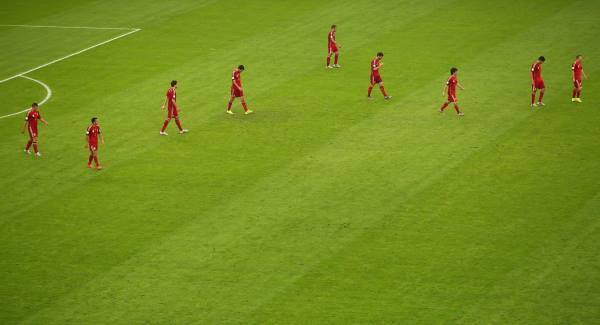
Keeping faith with past-their-time players such as Iker Casillas and Xavi Hernandez was the ultimate reason for Spain’s shocking first-round World Cup exit. But the tiki-taka philosophy which brought La Roja such success through recent tournaments does not now necessarily need to be turfed out.
Successive defeats to Holland (5-1) and Chile (2-0) meant Vicente Del Bosque’s side became the first team to be eliminated from this year’s competition, on Wednesday night, while also being the first World Cup holders to be eliminated just two games into the next tournament.
While Del Bosque and other senior players including Casillas, Andres Iniesta and Sergio Ramos claimed after Wednesday’s game to be surprised their run of success had ended so abruptly, another veteran, Xabi Alonso was more forthright.
“We were not in the right mental or physical shape,” Alonso said. “We were not up to it, and we deserve to be out. Cycles end with a defeat, and this has been a very painful defeat. For sure, things are going to change.”
Spain’s lack of preparedness was most evident in an inability to respond to any setback on the pitch — with individual mistakes draining confidence and energy from the entire team. The coherency which saw opponents dominated completely while winning Euro 2008, the 2010 World Cup and Euro 2012 had vanished. During those three tournaments, Spain conceded a total of six goals in 19 games. They let in seven in just two outings in Brazil.
Spain’s previous ability to control games from start to finish using their famous Barcelona-influenced style was gone. Holland and Chile both played well, but neither are world beaters, and have both struggled to beat Australia in their other group games. They were however intelligently able to take advantage of Spain’s weaknesses — ripping the ball from tired midfielders, running straight at overexposed defenders, and accepting gifts from woefully out-of-form goalkeeper Iker Casillas.
Something very similar had happened in last summer’s 3-0 defeat to Brazil in the Confederations Cup final. It was also reminiscent of Barcelona’s limp failures against Bayern Munich and Atletico Madrid in the last two Champions League seasons.
Del Bosque had tried (belatedly) to introduce some of Atletico’s vigour and freshness to the national side. But Diego Costa was not tactically or physically ready, while midfielder Koke was only introduced at half-time against Chile with the damage already done. Other young or emerging options were either injured or not thought yet be ready to step up.
While Del Bosque deserves to be criticised for complacency — the Spanish FA are also to blame.
The World Cup winners have, for commercial and diplomatic reasons, visited all of Qatar, Equatorial Guinea, Venezuela, Panama, Puerto Rico and the US in recent years. Such fixtures were lucrative for the association (and the players) but not useful for testing new faces needed to revitalise the team. Casillas and Xavi were also required to be present as ‘ambassadors’ of Spain’s brand.
Last summer’s Confederations Cup was another missed opportunity. While Casillas was floundering in Brazil, potential successor David De Gea was captaining the U21s to a second consecutive European championship victory. Koke, Thiago Alcantara, Isco, Alberto Moreno and Jese Rodriguez also starred in that competition.
Other national teams have fast-tracked starlets into the senior team (Germany’s Mario Gotze, Italy’s Mario Balotelli or England’s Raheem Sterling) rather than make them serve time in the youth ranks.
Instead, Del Bosque stuck loyally to Casillas (156 caps), Xavi (134), Alonso (113), Fernando Torres (110) and David Villa (95), saying again between the Holland and Chile games that he still thought these were the best players available. But the news that Villa and Xavi are set for semi-retirement in the US and Qatar football respectively next autumn was a harbinger. Anyone already accepting they can no longer cut-it at top club level should not be going to a World Cup.
Del Bosque himself suggested on Wednesday night that he would not stand in the way if the federation decided to replace him as coach. However none of possible successors Pep Guardiola, Rafa Benitez, Athletic Bilbao’s Ernesto Valverde and Olympiakos’ Michel look the right fit. Julen Lopetegui, who coached the U21s to last summer’s success, would be a candidate if he had not just taken over at Porto.
Whether or not Del Bosque stays, a new generation of players should get precedence now. Koke, Thiago and Isco have shown at underage and club level they have the technical ability to play tiki-taka. They now need senior international exposure to emerge as new leaders.
While retirements are expected, many established players will also stick around. Andres Iniesta is about the only one to emerge from this tournament with his reputation intact, and he has just turned 30. Sergio Busquets, Sergio Ramos, Gerard Pique, Cesc Fabregas, Jordi Alba, Pedro Rodriguez and David Silva are all still younger and hugely experienced and talented. For various reasons none have performed well in Brazil, but they all still have plenty to give.
A new Spain must emerge, different from that lead by Casillas and Xavi, but perhaps just as good. A Euro 2016 qualifying group alongside Ukraine, Slovakia, Belarus, Macedonia and Luxembourg, with two teams going through automatically, offers plenty of opportunity for younger players to gain experience. Get the blend right and Spain will again be among the favourites in France in two years’ time.
Yesterday’s Spanish sports pages were a mix of pain and sadness — along with calls for fans not to forget all the great moments that Iker Casillas, Xavi Hernandez and company had given them through recent years.
The morning after Wednesday’s 2-0 defeat to Chile had seen Vicente Del Bosque’s previously all- conquering side eliminated from the World Cup after just two games, fans woke up to a stark Marca cover which confirmed it had not all been a nightmare.
#LaPortada 'The End' pic.twitter.com/2g2KTIWRox
— MARCA (@marca) June 18, 2014
‘The End’ it said in English, over a photo of a lonesome Andres Iniesta walking into the distance — while adding ‘A lamentable end for La Roja’s most glorious era’.
“It was nice while it lasted,” said the AS front page — with Iniesta again pictured along with downcast captain Iker Casillas. Inside the paper Juanma Trueba’s match report began: “The end was horrible. It had to come some day, that was accepted, but we never imagined such a painful goodbye, so unrecognisable and so vulgar. Goodbye, World Cup.”
Orfeo Suarez of El Mundo was harsher in his criticism of a team which had been unable to fight back when facing adversity — first when collapsing and conceding four second-half goals to be hammered 5-1 by the Netherlands, then while limply surrendering to a first defeat to former colonial subjects Chile.
“For such a capitulation there is only one explanation,” Suarez argued. “The style and the strength was gone. The players were gone, and the coach gone. The head was gone, and the heart. Spain’s footballing empire found its Trafalgar in the bay of Rio de Janeiro.”
In El Pais Ramon Besa wrote that it was somehow fitting that the side which had played such perfect tiki taka football when winning Euro 2008, World Cup 2010 and Euro 2012 had collapsed so completely this year.
“The problems all surfaced at once, and there was no way to rescue even one virtue, or even to negotiate a dignified scoreline,” Besa said. “Maybe because Spain was not a conventional team, one of those who sometimes win and sometimes lose, but one with an admirable uniqueness, impossible to copy or clone. Nobody played with the football like La Roja. But over time the ball was inflated so far that it burst — and the national team was left naked at the World Cup.”
There was also a melancholy feeling over the passing of a unique generation of players, but also a conviction that a new equally successful team could now emerge.
Carlos Martinez of Cadena Ser radio said: “Sadness for them, above all — they have given us such joyous moments over time. So you feel bad having to talk about their fall. It is a cycle which is over. But when the hangover passes we will realise that the national team must be renewed, and will be renewed.”
CONNECT WITH US TODAY



Be the first to know the latest news and updates