Barca are not the formidable force of old
As ever, Mourinho laced his view with several large helpings of hyperbole; this is not the worst Barcelona team for “many, many years”. But when measured against the sides that virtually reinvented the game under Pep Guardiola, they are no longer the possession-hungry, pint-sized juggernaut that humiliated the great and the good of European football.
The counter-argument, of course, is that they didn’t have to be.

Dani Alves’s goal in the final minute of added time provided an eloquent response to any criticism and, having established a two-goal advantage at the home of a side regarded as by many as this season’s most likely breakthrough act, it would take an extraordinary turnaround if Barca were to be denied a place in the last eight.
It did not feel, however, as though the Etihad Stadium was bearing witness to the likely winners of this season’s Champions League, let alone the dawn of new a era of Catalonian supremacy.
Undoubtedly, they remain a formidable side, packed with extravagant talent and enviable experience. They have been criticised during a recent slip in form for lacking options, but there side remains packed with match-winners, capable of changing a game. Alves’s contribution in sealing the win provoked the usual reality check that he is, nominally at least, a right-back.
Yet for City, the overriding feeling was one of frustration and not, as so many other teams have experienced at the hands of Barca before, demoralisation and humiliation.
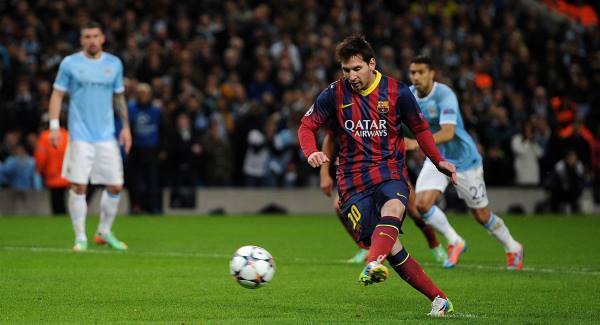
This match had been presented as any number of things. It was an arm wrestle between the financial muscle of Abu Dhabi and Qatar, a showdown between the Premier League and La Liga, a confrontation of arrivistes and footballing aristocracy. Crucially, it could also be seen as a contest between Martin Demichelis and Lionel Messi. And no matter how competently City’s ageing centre-back performed for 53 minutes, there was only ever going to be one winner.
The outcome of this first leg hinged on the one time Messi found himself isolated against his countryman. A penalty and a red card swung the tie emphatically in Barcelona’s favour. But there had been little to suggest the Catalans were a team to be feared before then and while the one man advantage played into their hands, there was an underlying feeling that had City showed more composure and belief, they might still have found a way back into the game before Alves wrapped things up.
Martino’s Barcelona lack the terrier instinct of Guardiola’s and are happier to relinquish possession in the opposition half rather than pressurise shell-shocked opponents in regions of the pitch previously regarded as safe territory. That meant that when City did manage to wrest possession – and after they had rid themselves of the nerves that paralysed them in the opening 15 minutes – Manuel Pellegrini’s side were able to find respite.
That they failed to build on that and develop sustained attacking momentum speaks volumes of the continuing fear at being confronted by Messi, Xavi and Andres Iniesta and what they can do to a team that has ruled its home patch on all but two other occasions this season.
Twice Manchester United had been left bewildered by Barca’s wizardry in the final of this competition, most memorably at Wembley three years ago when Guardiola’s team hit new heights. If they still have that in them, they disguised it well.
They may still be finding their feet after the upheaval by the break from the Guardiola years that continued briefly under Tito Villanueva, and Martino’s model may only now be starting to function. Cesc Fabregas said this performance would mean critics would “have to shut up”.
That’s unlikely to silence Mourinho should their paths cross any time soon.