A marriage that endured much more angst than joy
A miracle would still have been required if Ireland managed the unthinkable and got a win last night because the realisation that dreams of the Copacabana were dead had already set in.
Fittingly, to maintain the funereal theme, Ireland wore their black strip in the country where FAI officials first met with Giovanni Trapattoni back in 2008 to offer him the job when he was still manager of Red Bull Salzburg.
This was, even if Trapattoni manages to cling on until next month’s dead in the water double-header, a farewell to a marriage which has latterly endured much more pain than joy. Amongst the many damning facts peddled against Trapattoni the past few days, the most telling of all is that this is Ireland’s earliest elimination from a qualification group since 1985.
Even during previous failed campaigns hope lingered on until the final block of games. Now the players will travel to Koln and then host Kazakhstan next month with nothing but pride to restore. They will, in typical football-speak, say that reacquiring that pride is very important to them but this is not the position any self-respecting professional footballer wants to find themselves in.
Indeed that trip to Germany, even though they could perhaps begin to ease up with top place secured, is a fearsome prospect — especially with John O’Shea and Richard Dunne suspended.
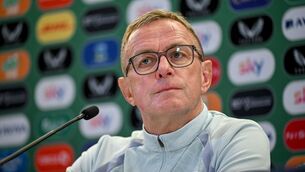
Whether there will be a new manager or Trapattoni is allowed to finish the campaign remains to be seen.
Yet on the grander scheme of things it seems legitimate to ask if this — falling short of the line — is our true level?
Looking in from the outside, a belief still exists that Ireland are regular over-achievers. A national side from such a small country with an at times shambolic domestic league should not be qualifying for tournaments.
Trapattoni’s remark on Monday that the main difference between Ireland and their rivals for second-place, Sweden and Austria, was that they “both have leagues, Ireland has no league” may have caused offence to those who invest time and money in the Airtricity League but you could, with the removal of tinted spectacles, see what direction he was coming from.
There are valid counter-arguments to be made — Irish clubs have enjoyed some success against Swedish sides down the years, for instance — but the Allsvenskan operates at a different level to the Airtricity League, while Austria Wien are currently in a position an Irish club has never found itself in with the possession of a spot in the Champions League group stages.
Trapattoni is still viewed as one of the greats across the continent and for all of his poor decisions as Ireland boss, there are genuine claims that the players at his disposal are limited.
Robbie Keane’s admittance this week that there has never been such a thing as Plan B with Ireland since he made his debut in 1998 was additional proof that even without Trapattoni such limitations have existed to the extent where simple and direct has always been viewed as the most effective gameplan.
If the new manager comes in with a determination to play eye-pleasing football with a squad that contains so many average players, it could have — a la Roberto Martinez at Wigan — a negative impact defensively. As Trapattoni himself has often said, “football is prose, not poetry”, and there is a reason Ireland have never played the beautiful game beautifully.
Change is, of course, required and Trap’s management of the team has long reached a state beyond repair. However, we should not lose sight of the fact that Ireland have enjoyed so many good times since the Charlton years that the disappointment felt this week is reflective of how, for a small country, we have often been spoiled in the last 25 years.


CONNECT WITH US TODAY



Be the first to know the latest news and updates