Football’s salt and pepper man still curries favour
As the new Stamford Bridge boss takes his seat in the dug-out for his first match back against Hull City tomorrow, the home crowd is likely to be raucously emotional at the return of their Special One. The man himself insists he cannot afford to be.
That is not to say Mourinho will not feel anything. Quite the opposite. He just plans to let those shivers run down his spine this afternoon, by visiting an empty Stamford Bridge and getting reacquainted with the surroundings.
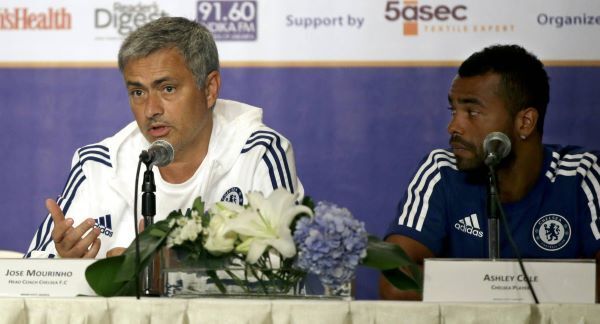
“I go [today], so I try to feel something [today] and something on Sunday,” Mourinho smiled in his season-opening press conference yesterday.
“To be back there will be a different feeling. I had it when I came back here with Inter [in the 2009-10 Champions League], but now I go to my dug-out, my stadium, my people. I have to control it a bit but, a couple of minutes and, after that, I have to be focused on the game. The fans probably before the match will focus on me and Roman [Abramovich]: me because I’m back, and Roman because he celebrates 10 years at a club that owes him so much.
“But we have to focus on this game, this competition and try and make Stamford Bridge a tough place for everyone to play, and make my people feel we are really at home.”
It was a theme that Mourinho was happy to warm to. On the eve of a new Premier League season in which its top clubs have fallen behind the likes of Bayern Munich and so many elite players went elsewhere, Richard Scudamore could not have wished for a better promotion. Mourinho even jokingly agreed with the chief executive’s view that the Portuguese brings “stardust” to the competition he feels is his own.
“If he’s the boss and says that, maybe he’s right... or I have to say he’s right! I see myself as somebody who should be in this competition because it’s my favourite one. When I have this passion for this football country, I’m in my natural habitat and I want to be seen as someone who is not British but is connected with this football country.”
Mourinho then offered one of his typical soundbites, in what was a notably relaxed press conference.
“I look forward to the salt and pepper of football... the unpredictability of every game, the result, of who is going to win, who is going to qualify for the top four, who is going to be relegated.”
It remains to be seen if Mourinho will be as good-humoured when that leads to a first Chelsea reversal. Either way, the unpredictability has only been amplified by the absence of the man that Mourinho himself has referred to as “the boss”. For the first two decades of that Premier League, there was really only one sure thing: Alex Ferguson’s sheer force of personality would ensure Manchester United competed for the title. In retirement, he leaves behind a temporarily more open division. It is here where Mourinho may step in.
The Chelsea boss has this summer already talked about potentially becoming the Premier League’s new “Godfather”, yet what was most notable about his first spell in the division was the manner in which he ruled over everyone.
If Ferguson had set the bar, Mourinho raised it. Chelsea’s points-per-game ratios in both 2004-05 and 2005-06 remain the finest records in the entire history of the English game. For that spell, there was one other sure thing to the Premier League: to finish ahead of Chelsea, you had to perform to an extreme level. Ferguson managed to do so in the 2006-07 season but it was a perceived drop in standards since then that Mourinho criticised yesterday. He does not see the top end of the competition as quite so strong as the 2004-08 period.
“You think Manchester United won the Premier League last year because they were an unbelievable team? I don’t think so. The other contenders didn’t have a very good season. The same the year before when City won. Were they an extraordinary team? I don’t think so. Others made so many mistakes that City eventually won.
“I know it’s difficult to win points in the Premier League but I felt that, for example, last year in the first period of the competition United won matches and the other teams were losing incredible points. I think sometimes you win because you are tremendous. Other times you win because you are the best. But you can be the best without being tremendous.”
Which leads to the obvious question: can Mourinho make this Chelsea as tremendous as that record-breaking team of 2004-06? He is certainly aiming to be the best and win the title — as well as the Champions League.
“We have a good squad — some with talents who aren’t end products, some kids who haven’t played a Premier League match because they are young... but I want to think, ‘yes’, that this team, step by step, will be better, make fewer mistakes, and will be more solid.
“My squad [in 2004] was a squad of end products at that time. We were the kind of team I felt immediately that, with tactical work and some group work — and especially mentality for a team that didn’t have a winning culture — the team was in conditions to win it immediately. We can this season. Of course we can. But it’s a different process.”
It may also require one more different player. In response to a question about the very public pursuit of Wayne Rooney or one other focal-point forward beyond Romelu Lukaku, Mourinho offered another quip.
“Even if we [managers] say we’re very happy with our squad, we lie, because we always want to make it better.”
Mourinho says he will wait “to the last day” as regards another signing, but insisted David Luiz is not for sale, regardless of whatever Barcelona offer.
Transfers were of course one of the factors which saw Mourinho and Abramovich fall out in the first place in 2007, as well as the style of football and what the Chelsea owner felt was an unnecessary detachment from first-team affairs. It is the one big question surrounding his return, whether it can really be as harmonious as all are portraying. The current squad may be perfectly suited to the kind of counter-attacking style Mourinho played at Real Madrid in 2011-12, but that still does not mean he and Abramovich will fit so easily together in the long-term.
The Portuguese claims the way in which he now thinks primarily of team “stability” indicates he is a changed man, but does not agree his football needs to change.
“The story is always the same. Record number of points in the Premier League: Chelsea. Record points in La Liga: my Real Madrid. Record for goals: my Real Madrid.
“My teams are offensive teams. Sometimes they gamble more times than anyone else. Sometimes, when we’re not winning in the last 20 minutes, we give it a go. We are never a defensive team.
“You see the profile of player we have: Oscar, [Eden] Hazard, [Juan] Mata, [Kevin] De Bruyne, [Andre] Schurrle... we can’t play physical football with these people. My players are technical players, they want the ball, need the ball, and I want to attack and try and be dominant. That’s what we will try to do.”
Just as in his returning June press conference, he also reiterated his desire to build for the long term.
“I look to improve my players and, obviously, give a contribution to my club to be better and better. Not thinking in just a selfish way, because I never do that, but to think long-term. To leave good conditions not just for tomorrow but for the long term. We are a very young squad with young players.
“Of course I’m more mature. I don’t have a different personality, but I prioritise different things in life and football. I feel very confident, very stable with great maturity. But DNA is the same and my nature doesn’t change.”
Tomorrow, Mourinho returns to a stadium in which he has never lost a league game. It was undeniably part of his last Chelsea team’s DNA and is an even more daunting fact for Hull City. That is just one of the reasons they revere him so much, that is how he brings the stadium together after the ructions of the last few years.
The single uncertainty is how long it can all last.
CONNECT WITH US TODAY



Be the first to know the latest news and updates