Opportunism Keane’s hallmark
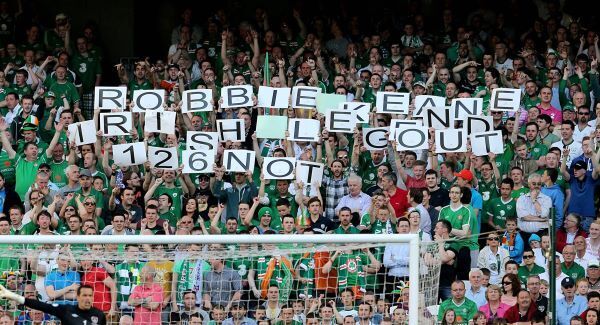
The Irish captain marked his record 126th cap with his 57th, 58th and 59th international goals. For all the ease of the opposition at Lansdowne Road last night, that is an impressively difficult feat.
Ireland may have had more talented players up top in the past, such as Frank Stapleton, but the numbers and nature of those figures surely mean Keane has marked himself out as the country’s finest ever forward.
For all the easy criticism about only scoring against sides such as the Faroes, too, the real point is that these strikes continue to round off a career in which he’s scored against pretty much everyone. Look at the record: a series of genuine match-winners in qualifiers, four in play-offs, three in a World Cup and one of them — against Germany — probably the most important strike an Irish player will ever hit, given the stage and the stakes.
If Keane should no longer really start matches of that profile, this latest hat-trick again illustrated why he is worth keeping in the squad. Ultimately, few Irish players are capable of such inherent opportunism. All three of his goals here were of a similar ilk, deceptively precise strikes from close quarters that were always just out of the keeper Gunnar Nielsen’s reach. In that sense, they weren’t quite tap-ins.
They also provided the one inarguable element of this match: the final score.
Other than that, it was a game that was difficult to read too much into. Ireland have always had a curious record against such minnows. Of Europe’s small six — Andorra, Liechtenstein, Malta, Luxembourg, San Marino and then the Faroes — last night’s opposition were the only side Ireland have not suffered a close call or outright bad result against.
We don’t need to be reminded of draws with mountain-tops or last-minute winners against ski resorts. Yet, as close as this was for so long at Lansdowne Road, there was never that same fear of embarrassment due to how early the opening goal arrived.
From there, the one big element of debate arises. Should Ireland have attempted to express themselves with a bit of an exhibition, or was the sense of job done against such deep opposition always going to lead to a feeling of dullness and complacency?
Again, it’s tough to say. Like so often with Giovanni Trapattoni, there was an element of both. For stretches of the game, especially in the first and last quarter, the side produced genuinely exciting football. There were a handful of exquisite one-twos and exchanges in front of the Faroes box, not least one from a set-piece in the 26th minute. The goals were all also superbly worked.
In between, though, it all got a bit dull as Ireland seemed to betray a common quirk of the Trapattoni regime: falling off after an early first goal. This time, though, it may not have been a consequence of the system or the approach. It might have just been the conditioning of such poor opposition.
A few players, at the least, regularly tried to thrill to varying degrees of success. Aiden McGeady was often electric on the ball but awfully flat when releasing it, other than that first cross for Keane. Wes Hoolahan, by contrast, frequently showed him how it was done, while also showing Trapattoni how he should have made his first competitive start long before this. Seamus Coleman offered the cross for the second.
Finishing it all off was Keane. The captain ensured that, if it wasn’t always easy watching, it was another easy win. No, Ireland didn’t rack up the kind of rout that we so often see other continental teams do against such sides. Keane, however, continues to add to a record that many other nations would envy.
The count hasn’t stopped yet, either.