Fans show true colours as the focus on football
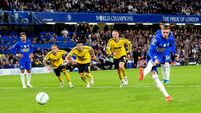
Immersed in a green smoky haze and a deafening noise, the celebrations after Shane Long’s goal were, without venturing on the hyperbolic, special.
It threatened to become one of those ‘I was there moments’ until Frank Lampard drew level, but for 10 short minutes, Irish fans could party like it was Stuttgart again.
A cordon of orange bibs and half a dozen rows of black sheeting separated the official away end from the home fans, but it was impossible to miss the green shirts that rose in unison around the entire stadium.
There was, quite clearly, no need to conceal your allegiance, as men, women and children bedecked in green sat freely amongst their white-shirted neighbours.
How both sets reacted to the opening goal was always going to be an acid test. After all, David Kelly’s opener had been the fuse which lit the riot in 1995. But when Long’s magnificent header looped over Joe Hart’s reach, Irish fans in the home seats were far from reluctant in their celebrations. There were, from this vantage point at least, no adverse reactions from English supporters.
The game has been sanitised in the 18 years since that unfortunate night at Lansdowne Road. En route to one of football’s truly iconic theatres, there was a certain sense that, similar to how Anglo-Irish relations have improved, this rivalry has become a tad more cordial as time has progressed.
The police presence, in comparison to say a major Premier League game, was low-key and relaxed. Outside the ground, fans mixed freely and there was no edginess when walking along Wembley Way.
Two hours before kick-off, a group of worse for wear Irish fans stood next to a police van, singing ‘Olé, Olé, Olé’ but instead of goading and provoking, seven passing English supporters joined in with a song of their own. No political undertones, just two sets of fans supporting their teams.
Later, as kick-off approached, there were a few reports of sporadic chants of ‘No surrender’ on a train heading towards north-west London, but to suggest it was anything more than a tiny minority airing such nonsense would do a disservice to the thousands who behaved admirably.
A cynic may even suggest that the ‘friendly rivalry’ went too far, with hundreds donning half-and-half scarves. The swag sellers outside the ground were shifting more of them than any other, even if some of the old-fashioned amongst us were left questioning their true purpose.
The ground took its time to fill up, but when it did and the players made their way out of the tunnel, it was near impossible to think straight such was the ear-splitting level of noise.
And then came what many termed the defining moment away from the pitch: the anthems. Amhrán na bhFiann was belted out by the visitors with the usual gusto, and the English support respected it impeccably. In turn, God save the Queen passed off without incident and a collective sigh of relief was breathed. Now, we could focus on the football.
It was a slight pity that, prior to then, the atmosphere was diluted by Wembley’s annoyingly loud PA system. With the inoffensive talking head, Olly Murs circling the pitch’s perimeter, urging fans to ‘do the robot’, one was left longing for a time when the most audible thing in the minutes leading up to the game was the fans.
Then again, football has changed, and if the so-called pre-match entertainment was the biggest crib on a night which had the potential to turn political and, eventually ugly, then we’ll take Wembley ’13 over Lansdowne ’95 every day of the week.

CONNECT WITH US TODAY



Be the first to know the latest news and updates