After a series of controversies, have Chelsea become toxic?
Straight up, I admit it — I grew up supporting Chelsea. My father followed them and had a tape of the 1971 Cup Winners’ Cup final, so it was natural to walk the same road. By 1994 I got so upset after my team were dismantled 4-0 by the evil empire of Manchester United that I threw a spectacular tantrum (I was nine, it was acceptable). Around the same time I had a poster of Gavin Peacock on my wall (I was nine, it wasn’t acceptable).
Four years later I finally made it to Stamford Bridge. After the game, myself and my father hung around the dressing rooms for an hour in the rain until Dennis Wise came out, apologised for the delay, took a football inside to be signed by the team and sent out Roberto Di Matteo, Gianfranco Zola and Gustavo Poyet for photographs. If a club is about those that support it, then Chelsea ranked pretty highly and I felt as proud as I did excited.
When you support a team, there’s a certain tolerance, to the extent I even ignored and excused the daily jibes in school that I was “following a bunch of English wankers”. But Roman Abramovich and the amoral culture he has brought, imposed and tolerated cannot be ignored or excused and it’s turned me off a team that could once dictate my mood. Wednesday was just the latest show by a pathetic circus that’s impossible to support.
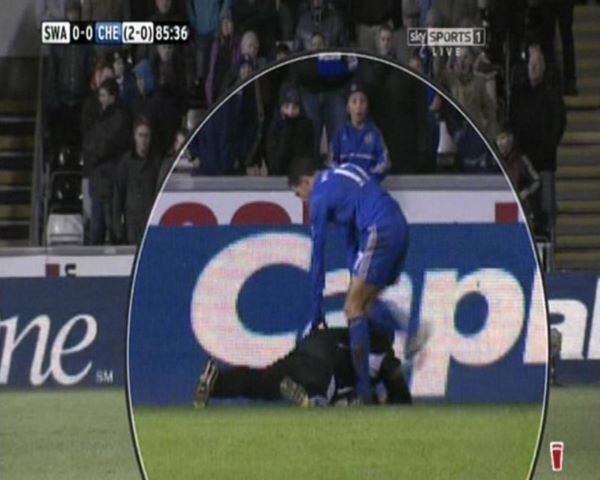
So what if a Swansea ball boy was time-wasting – as if this doesn’t happen at the Bridge – and so what if his Twitter picture shows him drinking cider. In what other job could an adult swing a boot in the direction of a minor and then be backed by his employers? Chelsea even had the nerve to look for pity but then again this is a club that believe they are always in the right and believe it’s okay to do anything to get over the line.
Of course, Chelsea aren’t alone in their self-righteous, contradictory and dismissive attitude. But growing up, I always dreamed of Chelsea being successful and now that they are, I cannot help ask at what cost. Just look at their treatment of Frank Lampard, their repeated lenience towards John Terry, the air rifle incident, the cheating, the managers that have been chewed up and spat out, the appointment of Rafa Benitez, the allegations of racism against a referee...
The club stands for little anymore and is insular to the extent that in trying to be the best, they’ve lost sight of what the best is about. Not that it’s surprising. When you turn a club into the play-thing of a man who has been surrounded by endless and serious allegations of corruption, then what do you expect?
As a journalist you try to stop following teams to avoid bias. Chelsea have certainly helped us to grow apart, although even if we hadn’t, it’d be pretty difficult not to see the saddening reality.
A round the time of one of Chelsea’s lowest moments this season, when Ashley Cole decided to describe the FA as a “bunch of twats”, an employee at the club’s Cobham training ground puffed out his cheeks and sighed. “There’s always something at this club lately.”
When you start to list those somethings, you don’t get the cleanest of images: affairs, allegations of racial abuse, air rifles being shot at youth players, unbridled player power for a group of outrageously pampered and pompous stars and, now, a senior professional seemingly kicking a ball boy in the ribs.
On top of that, then, is an impatient oligarch whose wealth has itself invited many uncomfortable questions.
Below all that, though, the very discomfort expressed by that employee illustrates this isn’t necessarily a culture that runs right through Stamford Bridge.
Because, really, the question of whether Chelsea are a “toxic” club cuts to the heart of what a club actually is. When you watch from a distance, it’s difficult to look beyond selected TV images like an impassive Roman Abramovich or imposing John Terry.
But, when you walk down the Fulham Road or around the club’s training base, a different feeling rises.
As a consequence of the bombastic promotion of the Premier League, it’s easy to forget that even the most elite clubs are still social institutions that are important symbols, and formers, of local identity. They are the true English equivalent of parish and county teams in GAA. Ultimately, the clubs would not exist without the community they grew up in.
That is undoubtedly the case at Chelsea too. And, for all the impressions of extreme right-wing support or plastic city traders in the crowd, a visit to Stamford Bridge remains a pleasant and largely welcoming experience. Rafa Benitez may privately disagree but even the furore over fan reaction to his appointment has been somewhat misunderstood. By dismissively bringing up flags while at Liverpool, the Spaniard questioned the integrity of the club’s support.
That authenticity, clearly, is important. And it is also very evident within the club itself.
Around football circles, Chelsea are liked for the warmth and friendliness of their everyday staff — many of whom are ‘proper Chels’ locals who have been working there since the days George Best said they were the only other club he’d play for. You only had to look at their emotional reactions in Munich in May to realise that victory went a lot deeper than an oligarch’s whims.
Because of the playing staff or manager at a particular time, external perceptions dictate the club as a whole must share their characteristics. The internal reality is often different and that’s the case at Chelsea.
Outside, you imagine brash, ultra-capitalist arrogance. Inside, you get homely warmth. Undeniably, the team has issues but they still haven’t been toxic enough to corrode the club’s core.