No carnival on the night, only deliverance
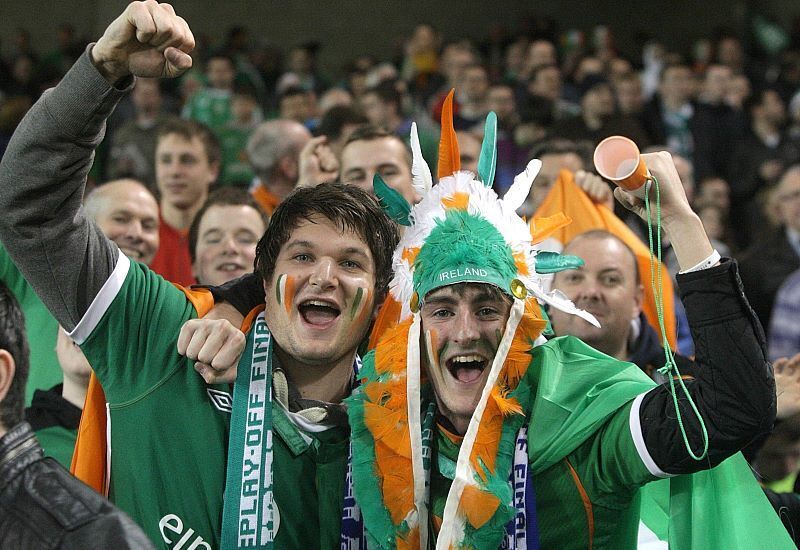
Although the celebrations continued long into the night as Ireland rightfully enjoyed one of the team’s finest ever achievements at a raucous Lansdowne Road, the more muted affairs on the pitch were somewhat in-keeping with the Euro 2012 campaign. And, indeed, the entire Giovanni Trapattoni tenure.
Because, as persuasive as the end results have now been, the minimalist nature of Trapattoni’s formation means that the performances on the pitch haven’t always been as convincing. And while qualification should perhaps have ended all the arguments about the manager’s style, it would be wrong to not acknowledge the fact there are a significant proportion of the football public who are still not entirely enamoured with the manager’s approach, despite the undeniable success he has now delivered.

Much like the team’s continuous push and pull between admirable defence and the necessity to get forward, the debate about Trapattoni’s ultimately successful campaign is caught between two schools of thought.
Looking back at the campaign as a whole, from one angle his achievements are mightily impressive. Essentially, Trapattoni took a team who hadn’t qualified for anything in a decade to only the fifth tournament in their history. And he did so by coming through a group featuring a Euro 2008 semi-finalist and a team who got to the last 16 of the last World Cup. All of that was done with an exceptional defensive record that is all too rare in international football.
From another perspective though, qualification does not look as impressive as has been made out. Trapattoni is only following the examples of sides as under-whelming as Latvia 2004, Switzerland 2006, Poland 2008 and Slovenia 2010.
Yet, despite such luck in his favour in this series, Trapattoni often left the team a hostage to fortune in other ways. By playing so conservatively, Ireland often ceded command of games to a worrying degree — most notably against Armenia and Macedonia.
But that was also why the key, emphatic first leg against Estonia was so promising. Trapattoni has always maintained that the side would start evolving once they had the confidence and assurance gleaned from a qualification.
And there were clear signs of that on Friday. In a win that probably would have felt much more epic had the results been reversed and it came last night rather than four days earlier, Ireland admirably went for the jugular. It has since emerged that, at 2-0, the push to kill the game off was more player-led than manager-led. That, after all, was the most interesting long-term theme to be drawn from last night’s match: would we start to see an evolution that would bring the team on for Euro 2012 itself?
Although it would have been crowd-pleasing to finish the qualifiers with a flourish, there were still signs of encouragement.
From the start, Stephen Ward began to overlap Damien Duff. That is as rare as a Trapattoni team conceding a goal and it created the extra angles for some pleasing passing movements.
The team did return to type in the second half though, as — once more — they withdrew and surrendered control of midfield around the hour mark.
It’s something Trapattoni is going to have to look into in the six months between now and the championship. Likewise Shay Given’s grip. This was the second home game in a row in which he struggled with a relatively soft long shot.
In saying that, you would be inclined to give both the team and the keeper the benefit of the doubt given that the match’s general lack of intensity didn’t focus minds. In that, it wasn’t exactly a fair reflection of either the team’s qualities or any potential evolution.
Because ultimately, although the carnival never came, deliverance did. Ireland have qualified. That may not be a unique achievement. And may require a fair bit of qualification. But then that is the key word: ‘qualification’.
At the end of it all, Trapattoni has returned Ireland to the biggest stage. And that is to be celebrated.