The slam is grand, but the World Cup is great
“Folly dat,” has been the order the week as a nation looks to Giovanni Trapattoni’s boys to give us another Saturday of sporting joy after last week’s sensational double-helping of success.
Sport — or ‘the toy department’ to give it the title by which it’s not so respectfully known among some newspaper folk — has migrated from back page to front and, at a time of national crisis, finds itself in the unaccustomed position of being held up as an example of all that is great and good and honest and admirable in Irish life.
And it’s not just ‘Declan Kidney for Taoiseach’. More than a few people who should no better have talked up the notion of sport as the inspiration for a great national renewal.
This recalls the theory that, somehow, Irish football’s unprecedented success in the Jack Charlton era was midwife to the birth of the Celtic Tiger. I never quite worked out the connection myself.
Indeed, if memory serves, the first man to float the notion was none other than legendary physio Mick Byrne and the bould Mick was such a Jack loyalist that he would have been equally happy to credit the big Geordie with peace in the north, the discovery of penicillin and the repeal of the corn laws. Furthermore, I’m pretty sure that the only figures Mick ever massaged were the muscular ones belonging to warrior heroes like Moran, McCarthy and McGrath. (Speaking of whom, can I entice you inside these brackets for a moment to remind you of the Charlton-managed team which played in Ireland’s last competitive meeting with Bulgaria? That was the 2-0 win at Lansdowne in 1987 and the Irish line-up that day was: Bonner, McGrath, Moran, McCarthy, Whelan, Houghton, Lawrenson, Brady, Galvin, Stapleton and Aldridge. Ah, dear. Men in green, I think, is the appropriate phrase). Back in the present, plenty of people are still basking in the warm glow of that stirring Grand Slam success and rightly so. Such was the full-blooded drama of the game in Cardiff last week that it even sucked in those of us who haven’t paid a huge amount of attention to the oval ball game since slippery eels like Mike Gibson and Barry John were doing passable imitations of George Best for their nations.
Truth to tell, I’ve always been, shall we say, fairly relaxed about the fortunes of our guys in green. A good friend and fellow round ball devotee put it best a few years ago when he remarked: “Do you know what it is? If the Irish rugby team win a match, I think ‘grand’. And if they lose a match, I think ‘grand’.”
I can’t say I’m entirely free of such ambivalence, myself. Dare I confess that there was even a part of me — the bad, juvenile part, of course — which, as Stephen Jones lined up that final kick in Cardiff, couldn’t help thinking: “Jaysus, if he gets this I can’t wait to see the puss on McGurk.” A sinful, unworthy thought, of course and, on balance, even I’m happy to admit that, in the end, there was infinitely more pleasure to be derived from watching Paul O’Connell’s victory dance as Ireland celebrated a truly memorable achievement.
But, deserved and heroic and long-awaited as it was, it’s hardly a belittling of the Six Nations triumph to point out that World Cup success for Ireland in football — meaning, with all due respect to Keano, mere qualification for the finals, at least for starters — would put the Grand Slam in the shade. Indeed, even World Cup success in rugby — as in going and winning the damn thing — would scarcely come close. Somehow, “Dublin 4 holds its breath” or even “Munster holds its breath” can’t make a claim on immortality quite like George Hamilton’s famous utterance as Dave O’Leary shaped up to take that penalty back in 1990 and, to paraphrase another great commentator, Philip Greene, the silence in Ireland could be heard in Genoa.
And that’s not just a parochial observation. For example, how often these days do you hear folk across the water waxing nostalgic about England winning the rugby World Cup in 2003? Yet, Blighty is still banging on about 1966.
And while Nelson Mandela’s seal of approval added symbolic significance to the Springboks’ triumph on home soil 10 years earlier, that famous watershed moment could hardly obscure the simple fact that, in terms of sheer popularity and crowd-pulling appeal, the people’s game, indeed the national game, in South Africa — right through the dark years of apartheid and up to the present day — has always been football.
By the way, lest anyone think that your correspondent reserves esteem for football and his scepticism — read, general ignorance — for rugby, it might be worth noting that when the Sports Desk of this fine organ informed me the other night that Cork had a new manager, my immediate reaction was, “Jeez, Paul Doolin didn’t last long.”
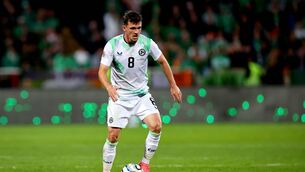
All of which is a roundabout way of saying that, when Trapattoni’s team take the pitch tonight, they will be another step closer to a goal which, if achieved, would engage the emotions of the whole country like nothing else in sport quite can.
And the same applies almost everywhere else — when it comes to sport, the round ball is the one that makes the world go round.
So, yes, after Drico and Dunne, the boys in green might have a hard act to follow. But following them, we can only hope, will remain the hardest act of all.

CONNECT WITH US TODAY



Be the first to know the latest news and updates