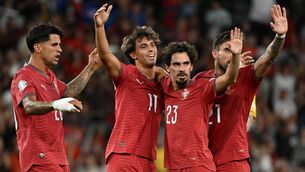
Young Swiss side beginning to mature
SWITZERLAND’S national football team has been talking a lot about cheese recently - not in an effort to confirm national stereotypes, but rather to challenge them.
The cheese in question has been the ‘petit Suisse’ - a sweet, creamy concoction that actually originates from the French region of Normandy but which has come to serve as a taunt for the ‘little Swiss footballers’ so often overshadowed by their more illustrious European neighbours.
During the build-up to Saturday’s impressive 1-1 draw at home to France, Switzerland’s French-based players Alex Frei and Daniel Gygax spoke at length about their frustration with the nickname.
By the time the final whistle went on a match that the Swiss should arguably have won, the phrase was being bandied about with a good deal more levity.
“We proved again tonight that we are a strong side,” Saturday’s goal-scorer Ludovic Magnin told reporters. “The ‘petits Suisses’ are going to be very hard to swallow on Wednesday against Ireland.”
Needing a win to keep their own qualifying hopes alive, Ireland should provide a strong test of Switzerland’s newly-found confidence against the sport’s bigger nations - though Kuhn believes the player’s performances to date have already gone a long way towards altering the ‘small Swiss’ image.
“We have definitely shown on the pitch that we are ready to perform when we are really challenged and to play without a complex when we come up against great teams like France,” Kuhn said.
Finding the precise reasons for the turn-around in Switzerland’s footballing fortunes is perhaps like asking any two Swiss to agree on the exact ingredients needed for the perfect fondue - but youth development and the active courting of players with joint nationalities have certainly played a major role.
The Swiss FA is now 10 years into a youth development programme that accounts for up to one-third of the association’s 15-20 million Swiss franc annual budget. The programme, which has seen the creation of four national training academies and the awarding of bonus payments to clubs that introduced youth development schemes, has brought fast results.
In 2002 the Swiss won the European U-17 Championship with a side that included current senior team members Philippe Senderos and Tranquillo Barnetta to earn Switzerland their first ever title at any level of international football.
In the same year a team including Alex Frei, Ricardo Cabanas, Daniel Gygax and Stephane Grichting reached the semi-finals in the European U-21 category.
Were it not for the association’s own efforts off the pitch, Barnetta, Senderos, Cabanas, Colombian-born striker Johan Vonlanthen and newly-capped Swiss-Albanian defender Valon Behrami could all subsequently have been poached by other national teams.
Next year the Swiss are planning an even more pro-active approach - sending a mailshot out to 628,000 Swiss nationals living abroad in an effort to find potential new players.
“The second-generation Swiss players have brought a great strength to the side and introduced a multicultural aspect that is also an important part of modern Switzerland,” Kuhn continued.
“The fact that our young players have also experienced success at U-17 or U-21 level against all the big teams is one of the reasons that the old Swiss complex has disappeared.”
Another factor, according to Kuhn, is the large number of Swiss players now plying their trade in Europe’s biggest football leagues.
Only three of Saturday’s starting 11 are based in Switzerland, with the other eight playing at top division sides in Italy, England, Germany, France and Holland - suggesting that the country’s players are already enjoying a stronger footballing reputation than the nation as a whole.
Having guaranteed themselves a place at the 2008 European Championships as the tournament’s co-hosts, Kuhn’s young team have already made sure of at least one shot at the big time and just at the point that they reach full maturity.
If they can secure a World Cup berth, though, the Swiss will of course relish the chance of ripening a little earlier - as well as avoiding the ‘hard cheese’ jokes that would no doubt greet a Dublin defeat.