Anything seems possible for Ireland now after stunning Scots display
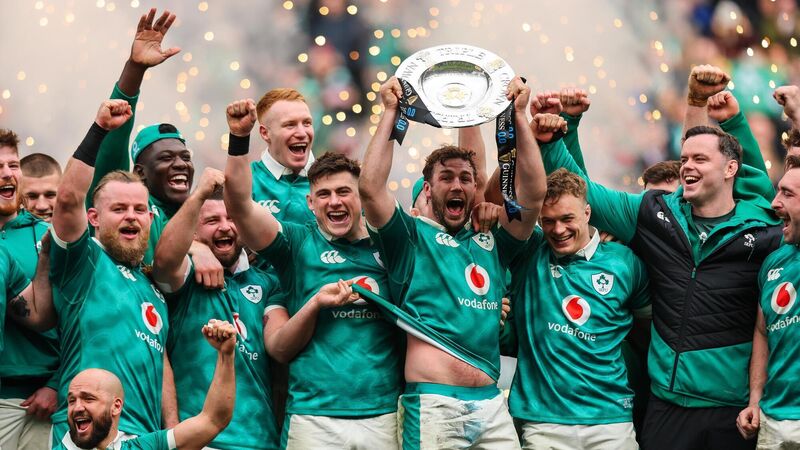
LOOKING FORWARD: Ireland’s Caelan Doris lifts the Triple Crown Trophy. Pic: ©INPHO/Ryan Byrne.
IRELAND 43 SCOTLAND 21
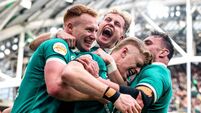
Always looking forward, Ireland’s journey towards the 2027 World Cup has taken another giant step forward with the Guinness Six Nations Triple Crown this emphatic victory delivered.
The title may have been denied by the unerring boot of Thomas Ramos at the very end of an epic Super Saturday’s final-round action as France rescued their championship defence in stunning fashion with a 48-46 win over England but Andy Farrell can take immense encouragement from the way his team responded to it's nightmarish start to their 2026 campaign, also in Paris, with four consecutive wins, a second Triple Crown in as many seasons and the best performance of the lot when it mattered most.
Given the horror show at Stade de France on February 5, a 36-14 defeat that saw Les Bleus rack up 29 unanswered points before Ireland could lay on glove on their hosts, a runner-up finish five weeks later represents a fine effort.
To have done it without the likes of injured absentees Ryan Baird, Mack Hansen, Robbie Henshaw, Hugo Keenan, and the top three loosehead props in the country; to have negotiated the first three rounds without the suspended Bundee Aki and then losing James Lowe and a fourth loosehead to injury midway through highlights the achievement.
Farrell has used a personal record 35 players across five matches, handed Test debuts to Nathan Doak and Edwin Edogbo and nine further Six Nations debuts to reward provincial form in greater depth than any of his previous six campaigns as head coach.
All that and Ireland still managed to register a record 42-21 away victory in England while saving the very best until last, this powerhouse performance to reduce an in-form Scottish team to rubble.
Gregor Townsend’s team had arrived in Dublin confident they could finally land a trophy in the Six Nations era and end a 27-year drought dating back to the 1999 Five Nations title their head coach had helped win with a try in all four games.
Instead, Townsend was forced to swallow a 12th consecutive defeat to Ireland. His side had not played badly, and they kept pace with the Irish for much of this contest. They were not, however, allowed to reach the heights they had scaled seven days earlier when France’s Grand Slam hopes were ended in a virtuoso attacking display that reaped seven tries and a 50-40 victory at Murrayfield.
Each of Scotland’s three tries at the Aviva on Saturday was met with a devastating counterpunch from Ireland before two late tries from wing Tommy O’Brien, both converted by Jack Crowley, finally took the game away from the visitors.
Jamie Osborne, Dan Sheehan, Rob Baloucoune and debutant Darragh Murray had preceded O’Brien’s double with Scotland having scored through Darcy Graham, Finn Russell and Rory Darge in a pulsating encounter.
And while Russell kicked all three of his conversions for the visitors, Crowley kicked five conversions and a 72nd minute penalty that left the men in blue needing a miracle to bridge a three-score deficit at 36-21.
When the immaculate Tadhg Beirne clamped onto the ball as Scotland gamely pushed for some sort of a reply, the roar that greeted the Ireland turnover on the their goal-line was the match of any of the six tries scored.
It must have felt like a punch in the guts for the visitors, their misery completed when a pass was fired into their captain Sione Tuipulotu’s head, the ball collected by Stuart McCloskey, whose basketball-style, one-handed pass from over his head put O’Brien through for his second in the 80th minute.
The emergence of McCloskey as Ireland’s first-choice inside centre after five seriously good performances in this championship, of Baloucoune and O’Brien as wings with genuine pace and rugby smarts, and of Tom O’Toole, whose conversion from tighthead prop to loosehead to cover the losses of Andrew Porter, Paddy McCarthy, Jack Boyle and then Jeremy Loughman all bodes very well for Ireland’s future.
Indeed, even before the team strode out onto the Aviva Stadium pitch for their final game of the competition, Farrell was steeling his players for what comes next and the way ahead.
It may sound counter-intuitive to risk clouding his players' minds with the bigger picture in the week of a pivotal trophy decider yet for the head coach, plotting the way ahead through to October 2027 and the start of the next World Cup brought added clarity to the task right in front of them, if their performances against Scotland are any guide.
“I suppose the story is that you've got to try and understand what it is that we're trying to get to and what it is that we're trying to achieve," Farrell explained as he implored his squad to gather even more momentum with their provinces ahead of this summer’s opening three Nations Championship matches Down Under.
Such was the accurate ferocity they inflicted on the Scots on Saturday, with and without the ball, one imagines all four provincial head coaches benefitting from this Six Nations campaign and the buoyancy it has brought to their international players. The knock-on effects on their squads could be awesome.
“Well, we'll see what the momentum is with the lads going back to their provinces now,” Farrell said.
“We've talked about it in the changing rooms. People have had to grow for this competition. The lads who've had a sniff of it, who've not necessarily played today, it's up to them to keep on competing as well, to show us that they've learned some lessons and everyone is fighting for a seat on the plane.”
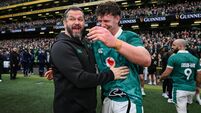
If Ireland can continue on this trajectory through to the World Cup, anything seems possible because the performance produced on Saturday was very near a complete one and it even elicited a comparison by Farrell of his current squad to the great Wales teams of the 1970s.
“It is, because we put the pressure on ourselves,” he said. “That's something internally that we were chasing down as well. That's five trophies in five years. I think it's the great side of the 70s from the Welsh point of view, who's done that last and what a special side that was.
“It's something that we're trying to make sure that we're continuing to do, put pressure on ourselves and deliver when it matters to us. That was why we were able to put that type of performance in.
“Remember, we've been to these days before, the last day, and not really performed at our best, even if we had won. So that's a step in the right direction.”
J Osborne; R Baloucoune (C Frawley, 65), G Ringrose (B Aki, 65), S McCloskey, T O’Brien; J Crowley, J Gibson-Park (C Casey, 77); T O’Toole (M Milne, 65), D Sheehan (R Kelleher, 65), T Furlong (F Bealham, 65); J McCarthy (D Murray, 65), T Beirne (D Murray, 50-60 - blood); J Conan, J van der Flier (N Timoney, 52), C Doris - captain.
B Kinghorn; D Graham (K Rowe, 65, T Jordan, 68), H Jones, S Tuipulotu – captain, K Steyn; F Russell, B White (G Horne, 61); P Schoeman (R Sutherland, 68), G Turner (E Ashman, 17 - HIA), Z Fagerson (D Rae, 68), M Williamson (A Craig, 61), G Gilchrist; M Fagerson, R Darge, J Dempsey (M Bradbury, 61).
Luke Pearce (England).


CONNECT WITH US TODAY



Be the first to know the latest news and updates