James Ryan holds his hand up over costly Springbok red card
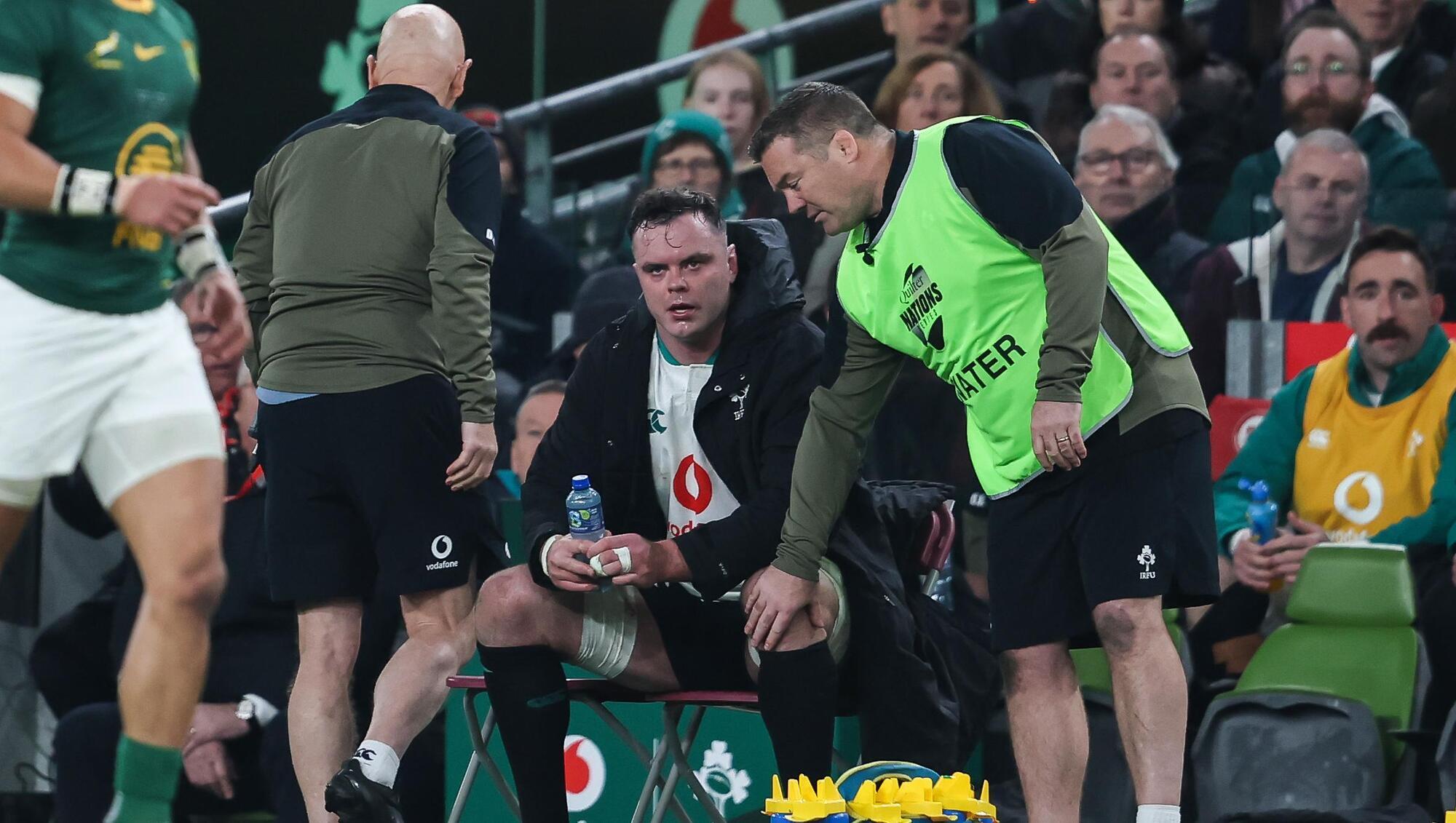
NO EXCUSES: James Ryan says there are no excuses for his red card against South Africa. Pic: ©INPHO/Gary Carr.
A contrite James Ryan has accepted that there are no excuses for the red card he earned against South Africa last month.
The Leinster and Ireland second row caught Malcolm Marx flush in the face with his left arm when attempting to clear out a ruck in the Springbok 22. The immediate result was the cancellation of Tadhg Beirne’s try and a yellow card.
The resultant bunker review upgraded that card to a 20-minute red and Ryan was subsequently landed with a six-game suspension eventually reduced to two in light of his good disciplinary record and a class of ‘tackle school’.
“I was devastated, to be honest, because it was at such an important point in the game. We'd just scored, the try got reversed, they got a penalty and I was sent off. So a big moment in the game and I felt like I let the lads down a little bit there really.
“So, yeah, I mean, the big thing now for me is just making sure I learn from it and it doesn't happen again because, at that level, it's such fine margins and it probably costs us a little bit in the end.”
Inherent to the lessons learned was that experience in tackle school, officially known as World Rugby's Coaching Intervention Programme, which amounted to some staged scenarios and the player mimicking the ruck in question.
“We'd put a couple of tackle pads into the back of the ruck to sort of lengthen it a little bit. Then I'd talk through what I should have done differently and what I would do next time. We'd record that and then send it on to them.”
Not exactly complicated, then.
Tackle school has been derided by some and it’s easy to understand the scepticism. Everyone could see what Ryan, a 29-year old with almost 200 games of elite senior rugby behind him, did wrong. No simulated retread out on the UCD pitch was needed.
As for the criticisms of tackle school? Above his pay grade, Ryan said.
Rugby is a high-octane, high-impact sport. It requires razor-sharp execution and Ryan, to be fair to him, didn’t accept the get-out clause when it was put to him that the law of averages all but make it inevitable that the odd ruck entry or tackle will be timed poorly.
“Yeah, I understand what you mean. To be honest, no, I'm not going to make any excuses for it because you can't obviously tuck your shoulder or go off feet like that. So, to be honest, it was just a poor moment for me more than anything.
“It would be easy to say, ‘yeah, look, we play on the edge and these things happen’ but hitting rucks for a second row forward is one of your primary roles. I just need to do better there really. So hopefully it doesn't happen again.”
Hitting rucks isn’t what it used to be.
Rugby’s landscape is always shifting with the introduction of new laws. Those related to the banning of escort runners and a shift in interpretations of the breakdown have had enormous consequences as to how it is played.
The new breakdown rules, to put it simply, now favour defenders in that referees are more likely to reward a prospective poacher all but immediately when in the past they needed to be latched on for a few seconds.
“So, in terms of the attack and breakdown, your anticipation and your urgency to get into the contest and get rid of the threat is huge now. You've got to see it quicker, you've got to act quicker than you did before. So that's certainly changed a bit.”
None of this is good for a Leinster or an Ireland team that made such play in modern times of their ability to play with ball in hand, through intricate phases and across a multiplicity of breakdowns. The margin for error has all but evaporated.
Leinster attack coach Tyler Bleyendaal has spoken of the need to adapt their game to the new realities while maintaining the approach and the DNA that suits the approach and the skills of the club. Ryan doesn’t see it as just a Leinster or an Ireland issue.
“It doesn't suit any attacking team when you don't get it right. When teams play against us and Leinster, they probably view the pace that we want to play at as sort of a threat. So the blueprint for a lot of teams is going to be slow us down around the ruck.
“We often call it the heartbeat of our game. So, for us, it's just making sure we get it right because it's very hard to put teams under pressure and play on the front foot when you don't get it right. So it’s huge for us.”
CONNECT WITH US TODAY



Be the first to know the latest news and updates