Ireland need World Cup quarter-final win to save stuttering season
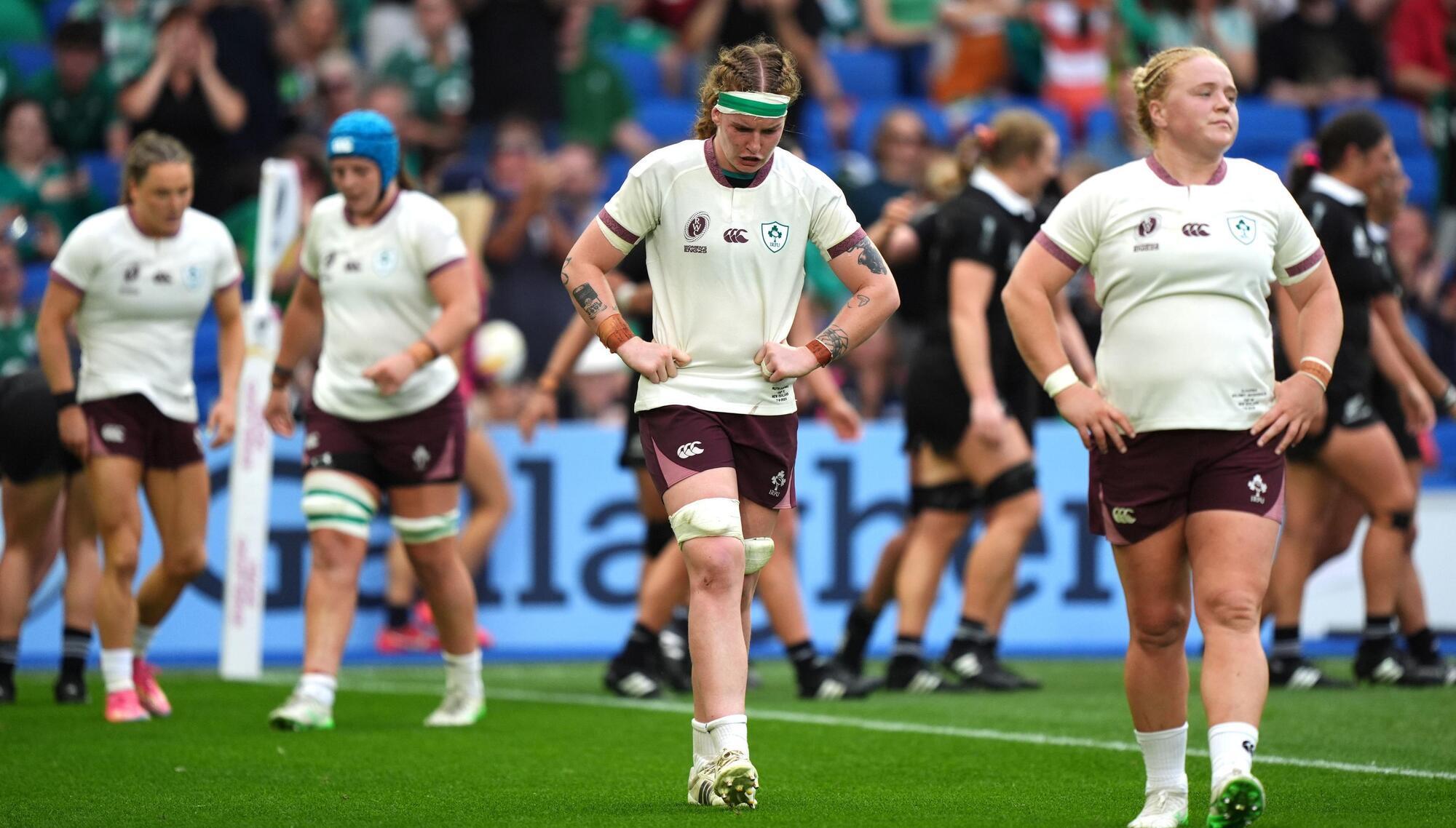
Ireland's Ruth Campbell reacts after conceding a try during the Pool D match against New Zealand. Pic: Ben Whitley/PA
Ireland’s season started just shy of six months ago against France. The hope as they meet their continental cousins again this weekend, this time in a World Cup quarter-final in Exeter, is that their season doesn’t end against the same opposition.
Avoiding such symmetry will be a tall order against a side they haven’t beaten since 2017, but the winning or losing of this game will determine whether the entire calendar year is seen as a success or a failure for a side that still has a long road to go under Scott Bemand.
That may sound obvious. The World Cup is the be all and end all in any given year, but such is the stuttering nature of the team’s fortunes that they won’t be able to lean on much in terms of consolation from earlier efforts if they depart the tournament at this stage.
Ireland began the year on the back of a quite frankly astonishing defeat of New Zealand in the WXV1 tournament in Vancouver 12 months ago and it’s worth remembering now that there were genuine fears they would be routed in such elite company at the time.
Go back a year earlier and they were competing in the third tier of the WXVs under new management having lost all five of their Six Nations games so what transpired in British Columbia was little short of miraculous.
And probably set unreasonable expectations in the short-term.
Beating the Black Ferns wasn’t so much a turning point as a jackknife in form. It was followed by an effort against the Canadian hosts that, while ending in defeat, seemed to suggest that the team was bounding into World Cup year with serious momentum.
Ireland felt aggrieved at some referring decisions in that Canada defeat, and conceded three tries when down players in the sinbin, but there were regrets of their own making in a failure to convert pressure into points early on.
We’ve heard a lot more regrets since.

When France left Belfast with an opening Six Nations win it was 31 handling errors and 20 turnovers that got away. England’s 45-point win in Cork was built first and foremost on a dominant scrum, and then there was the closing loss to the Scots.
Injuries didn’t help in Edinburgh that day but the 26-19 reversal still came as a shock given the trajectory Ireland appeared to be on. Events in Brighton last Sunday — against an exceptional and motivated opponent — are now feeding into the doubts.
Ireland huffed and puffed on the New Zealand line on numerous occasions but never managed to score in a Pool C game they lost by 40 points. It now feels like this is a team struggling to fit together enough pieces of the jigsaw to complete the bigger picture.
“Coming into the quarter-final we just have to take as many positives as possible as quick as we can,” said centre Aoife Dalton after the Black Ferns shutout. “We had a lot of positive moments out there, it is just about capitalizing on that.
“I don’t know how many entries we had into their 22 and we just couldn’t get points on the board so we will take loads of learnings from that game. We probably needed that coming to this week and we’ll look forward to a quarter-final.
“That’s what we came here for. Step one was qualifying for the quarters.”
Boil it all down and the question has to be asked whether this year has been one of progress or stasis for Bemand’s project given they have been well beaten now by all of the game’s Big Four in France, England, Canada and New Zealand.
Their wins have come against Italy, Wales, Scotland in a World Cup warm-up, Japan and Spain. The win in Italy was their most impressive but Wales are poor and seven tries were conceded in the pool games against the Japanese and Spanish.
It’s worth reiterating that Bemand himself spoke about how the next World Cup, in Australia in 2027, was his main goal when he took over the role of head coach from Greg McWilliams: the point being that this one is really a preparatory chapter in a longer story.
That was reflected at the back end of the Six Nations and in the first of the warm-up matches against Scotland when players like Aoife Corey, Jane Clohessy and Ivana Kiripati were given opportunities in the green jersey.
Injuries to others dictated those hands to a significant degree but Kiripati is one of four players in the squad of 32 yet to play at this tournament and the type of player who will be so much further down the line in four years’ time.
The French seem to have more momentum and belief than they carried into the spring while Ireland are down key players from that meeting in Erin King and Dorothy Wall while we wait for updates on Aoife Wafer, Stacey Flood and Edel McMahon.
Make a World Cup semi-final and the reward is the exciting if frankly frightening prospect of a meeting with England. Otherwise, Ireland will be turning into 2026 with a lot of soul-searching to do and with the glow of that win in Vancouver an increasingly feint ember.