Munster lineout is misfiring and opposition know it
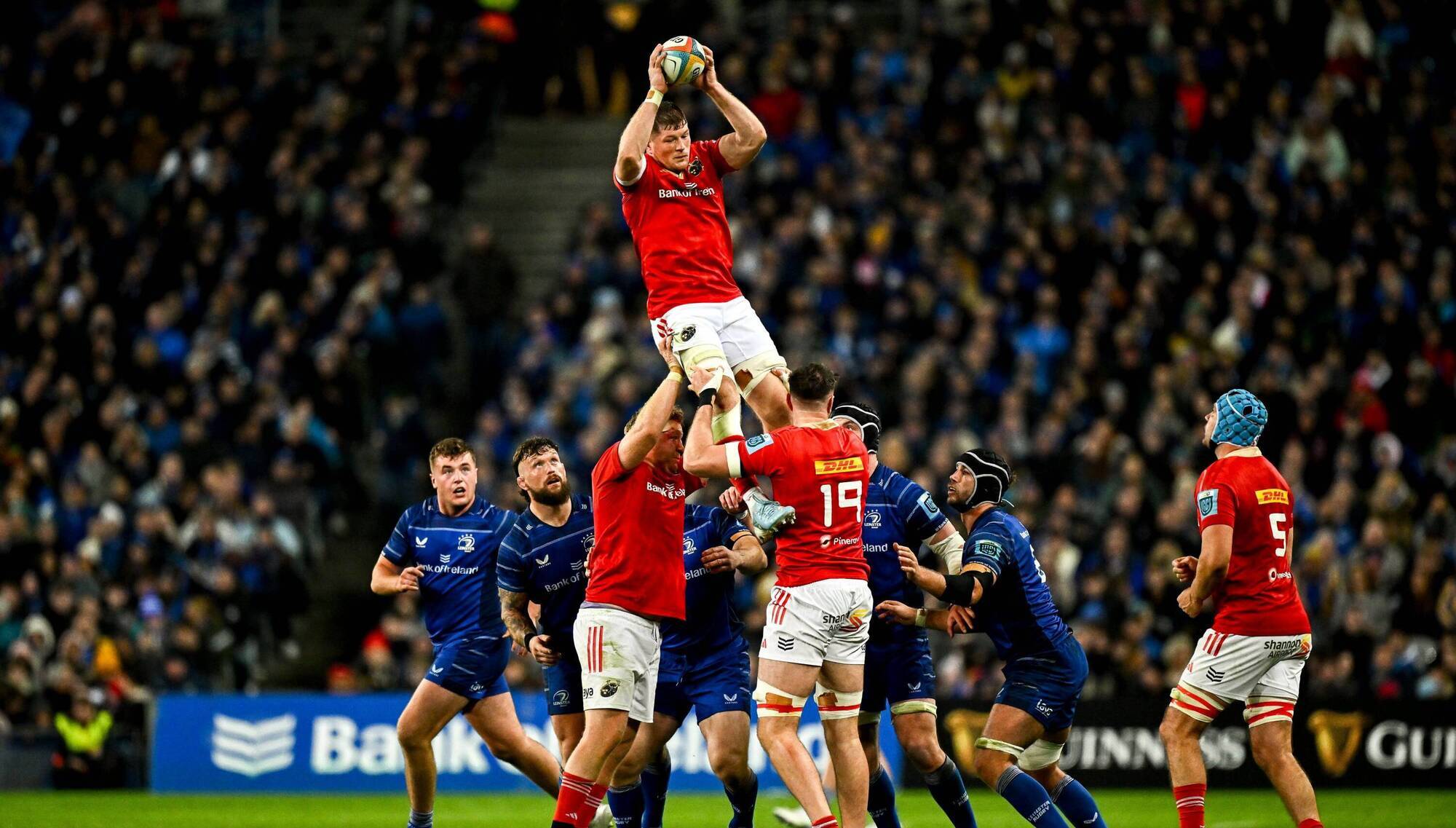
Jack O'Donoghue of Munster takes possession in a lineout against Leinster at Croke Park. Pic: Seb Daly/Sportsfile

“No scrum no win, how fitting!” exclaimed massage therapist Paul McMahon as he opened the door to his practice and saw my hoodie. 'No Scrum No Win' is a rugby-themed clothing brand from France and that hoodie was one of approximately three pieces of free clobber I got during my playing career. In hindsight, it probably wasn’t the best thing to be wearing around Limerick that day.
It was Monday, January 19th, 2015. We were still licking our wounds after being hammered by Saracens two days earlier at Allianz Park, sending us out of the European Cup at the pool stages for only the second time since 1998. While virtually everything went wrong for us that day, our obliteration at scrum time was particularly rough.
A poor choice of studs for the artificial surface didn’t help but regardless of that, we were completely overpowered by a superior Saracens pack and found ourselves going in reverse for much of the afternoon. It’s hard to articulate how humbling it is to get demolished in a scrum and that was probably the worst scrummaging experience I had in my life. No scrum no win indeed.
It’s been a case of no lineout, no win for Munster in recent weeks. After losing five out of 16 the previous weekend against Leinster, the set piece misfired again in Cape Town on Saturday in the defeat to the Stormers and they secured just eight out of 14, or 57% of their own ball. That puts their lineout retention at 63% for the last two weeks. Obviously, this is far below the acceptable level for any side with aspirations of winning silverware.
The gold standard for a lineout is 90% and any set piece-oriented side will aim there. That level of consistency is not easy to maintain over a long, arduous club campaign and above 85% would still be considered a strong performance. If you look at the top performers in the URC, Top 14 and Premiership last season, for example, you can see how difficult that gold standard is to reach.
No URC team reached 90% but Sharks, Bulls and Edinburgh all came close at over 89%. A total of 10 teams finished the season with a success rate of 85% or more, while Munster finished 13th out of 16 at 83.6%. The standard in Top 14 was lowest, with Pau having the strongest lineout at 87.1% and just three sides securing 85% of their own ball.
Packs were most reliable in England, where nine of the 10 sides left standing at the end of the year were above 85% and three were above 90% - Bristol being top of that pile with an incredible return of 93.9%. These figures tell us that 90% is hard but 85% is very doable. After five rounds of the current URC season, Munster have the weakest lineout in the competition at 79%.
Granted, a few front line players are unavailable currently but with Tom Ahern at blindside on Saturday, Munster had three targets between 6’6 and 6’9, something most lineout coaches can only dream of. The problem of late is the lost balls aren’t coming from one specific place. It would be a much easier problem to fix if you could point the finger at a hooker throwing badly or a caller making poor decisions but in fact, it’s been a mix of everything.
We have seen bad throws, bad calls, poor execution, bad luck and without doubt, some solid defending. A top side can probably get away with one of these issues on a given day. When it progresses to three or four, as it has for Munster in the last two weeks, you end up with a figure like 63%. In a competitive league like the URC, you will struggle to beat an average team if you’re only winning 63% of your own ball, let alone a quality side.
As a lineout unit, there appears to be a lack of clarity and cohesion. Like anything in rugby, the clearer and more aligned you are with the system and people within it, the more confident everyone is. When uncertainty creeps in, people get tetchy and second guess themselves and those around them. The margins in a lineout are so fine that the tiniest deviation from the prescribed way of doing things is disastrous.
Think about it: at every lineout you have a jumper, two lifters, a caller and a hooker involved. You will often have someone selling a dummy as well. To execute, you have the call, the movement on the ground, the jump and the lift, as well as the timing, speed and accuracy of the throw. That’s a hell of a lot of things to get right and a hell of a lot of things that can go wrong. You must have a well-oiled machine to get this right consistently enough to achieve a figure approaching 90%.
A well-oiled machine runs smoothly and needs a small bit of TLC here and there to rectify some minor issues. One that isn’t is going to cause you significant problems that are going to be a pain in the ass to fix. Evidently, Munster’s lineout has been closer to the latter of late and now a side that has traditionally taken pride in its set piece finds itself under pressure to fix it, and fast.
When doubt starts to creep in, it can fester. It becomes a thing. These players will go into their lineout session Tuesday knowing the spotlight is on them this week. Opponents seize on this and try to capitalise. If you’re analysing a side with a dominant lineout, the focus is on trying to identify ways to disrupt that dominance. If you’re prepping for Munster after the last two weeks, you’re smelling blood and targeting the lineout as a way of exerting your dominance on them.
Anyone can have a bad day at the lineout, I know as well as anyone. In the aforementioned game against Saracens, I threw the ball at Paul O’Connell’s arse in a calamitous moment of miscommunication, something that actually summed up our performance on the day. I made it into a rugby bloopers reel with that one, as was pointed out to me by a chuckling Georgian prop in Grenoble one morning.
While every individual is entitled to an off day, the collective unit cannot fail to click week after week. Like any front row who progresses to head coach, Graham Rowntree’s bread and butter is his set piece. He’s old school. Get the basics right first. Accordingly, he will be particularly frustrated with the last couple of weeks. If his no-nonsense, platitude free post-match interview was anything to go by, his forwards will have no doubt about the significance of a strong set piece outing in Durban next Saturday.
When in doubt, shorten it up and keep it simple. That mantra has been around for as long as lifting in lineouts. Expect to see more five man options this weekend, more balls to the front, and a higher tempo as Munster try to limit Sharks’ opportunities to get in the air.
CONNECT WITH US TODAY



Be the first to know the latest news and updates