French rugby’s healthy second tier reveals failings across the Channel

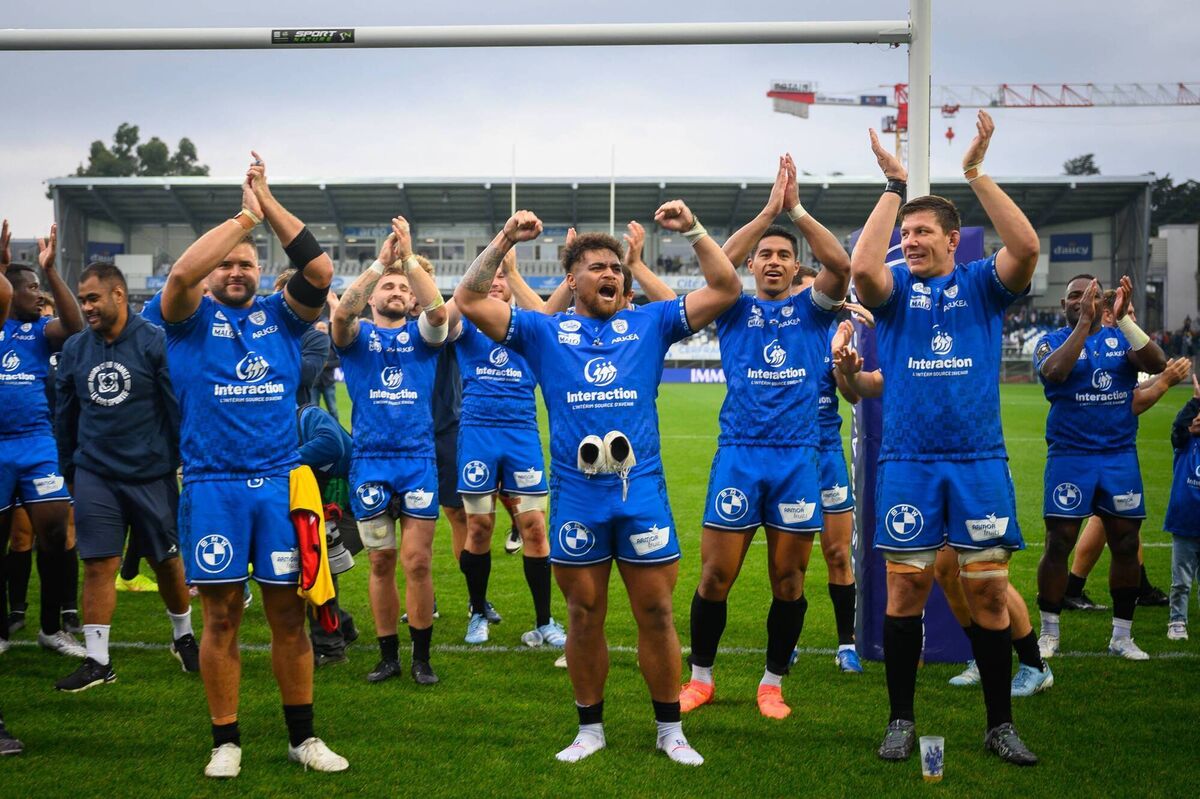
Vannes' New Zealand wing Salesi Rayasi celebrates scoring a try as tiny Vannes made history with their maiden Top 14 win last Saturday against Lyon at Stade de la Rabine. Pic: Loic Venance, Getty.
There were tears at the final whistle at Stade de la Rabine last Saturday. And with good reason. RC Vannes had never played in the French Top 14 before this season, which made their 30-20 inaugural win against Lyon a genuinely historic moment. Rugby has not traditionally been a big deal in Brittany but, all of a sudden, the Breton public have become oval‑ball connoisseurs.
There were 11,792 crammed into the stadium and the hometown heroes in blue – even Mako Vunipola is a Vannes man these days – looked anything but a side happy to make up the top‑flight numbers for a season. No surprise there. The second‑tier league of French rugby, the Pro D2, is rising in quality and competitiveness each year, assisted by the latest huge broadcasting deal struck between Canal+ and the Ligue Nationale de Rugby.
From the 2027 season, the Pro D2 clubs will receive €10.7m every season in broadcast revenue for the next five years, roughly a tenth of the sum received by the Top 14 sides but more than enough to encourage a healthy, vibrant league whose leading teams can aspire to join the elite. All will be looking currently at Vannes and thinking: “That could be us.”
Just across the Channel in England, the vibe is very different. Newcastle, who have finished bottom of the Premiership for the previous two seasons, attracted just 5,116 supporters to their first game of the new campaign at home against Bristol Bears. They lost 24-3, a result that sadly did little to signal a radical change in luck this season. Crowd‑wise, Manchester City v Arsenal at the Etihad Stadium attracted more paying fans – 52,846 – than all five Premiership rugby games combined. Even Notts County v Gillingham in League Two attracted more than the rerun of last season’s Premiership final between Bath and Northampton.
Hopefully the Falcons and the crowds will both perk up soon. And, sooner rather than later, those at the sharp end in England also want to know whether a promotion playoff is a realistic possibility this season. As things stand, clubs in the second-tier English Championship are still awaiting clarity around the all-important finer details, not least more equitable future funding, that were meant to be settled before the season kicked off at the weekend.
In theory the goalposts shifted slightly this summer, with a capacity of 5,000 now acceptable providing a wannabe promoted side has proper plans in place to increase that to 7,500 by year two and to 10,001 by year four. Eligible sides also have to pass a facilities audit that will not be completed until January. Even if they clear that hurdle, the funding gap between the leagues effectively makes “doing a Vannes” from a standing start all but impossible.
It is a situation the Championship clubs want properly resolved, one way or another, for everybody’s sake. On the one hand, there is a wealth of evidence in American and Australian sport to suggest promotion and relegation is not compulsory for a healthy league assuming other key prerequisites – a salary cap linked to club revenue, a collective bargaining agreement, a player draft, etc – are in place.
On the other, there is British team sport’s rich tradition of promotion and relegation, neatly summed up by none other than Newcastle’s director of rugby, Steve Diamond. “I’ve always coached and played with relegation and think it’s a magnificent thing,” he told the Times last week. “I know it’s not like this in the States and other places, but the jeopardy is all about promotion and relegation. It’s difficult to motivate my lot here in dead-rubber games.”
That uneasy situation is further magnified now the Premiership consists of just 10 teams. If eight are going to qualify for Europe – and no one is realistically going down because a sly sub-clause can always be found to slam the trapdoor shut – where is the feelgood oxygen every good league needs? The RFU is still talking to people behind the scenes about the possibility of resurrecting Worcester and Wasps, but the ongoing logistical hurdles, particularly in the latter case, remain enormous.
Either way, the need for a “whole‑game solution” is as vital as ever. The RFU surely cannot simply turn its back – or be seen to be doing so – on sides such as Coventry, Ealing Trailfinders and Doncaster Knights who would be competitive, at the very least, if a promotion-relegation playoff did happen. And how will it look if the RFU, having trumpeted the reintroduction of a playoff, ends up not permitting it amid a blizzard of red tape and financial chicanery? “I don’t think the game will accept that,” says Simon Halliday, the former England centre who acts as Ealing’s public representative. “A playoff has to happen or it’s a joke.” The Championship clubs have also voted in favour, going forward, of second-tier teams being allowed to field a maximum of just six Premiership loanees. This is significant because where else, aside from a few Premiership Cup games, are up‑and‑coming Premiership squad members going to enjoy game time if they do not instantly make the first team at elite level?
Hefty parachute payments to sides coming down (effectively guaranteeing they bounce straight back up) are also apparently on borrowed time. But there is a far bigger picture here and it needs resolving urgently: how does English rugby ideally see itself in 10 or 20 years’ time? Meanwhile mighty Vannes are off to Toulon this Saturday, flying a Breton flag for rugby dreamers everywhere.
The other big result of the weekend came in Santiago del Estero in northern Argentina where the Pumas kept alive their hopes of winning the Rugby Championship with a historic single-point victory over South Africa. It completed a notable hat-trick: never before has Argentina defeated the Springboks, the All Blacks and the Wallabies in the same calendar year.
Even if another win over a fired-up South Africa in Nelspruit this weekend proves a step too far and the Boks secure this season’s title, it will go down as a notable few weeks for Argentina’s new head coach, Felipe Contepomi, in his first year in charge of the national side. And throws into even sharper relief their deeply disappointing performance against a 14-man England in the pool stages of last year’s World Cup in Marseille when just about everything they touched went wrong. It just goes to show what a change of head coach, fresh energy in a couple of key positions and a positive outlook can achieve in a short space of time. One or two other nations – not least Australia who now occupy a joint all-time low ranking position of 10th – would love to take a leaf out of the Pumas’ playbook.
CONNECT WITH US TODAY



Be the first to know the latest news and updates