Humphreys: 'Our mindset is absolutely that we're here to win'
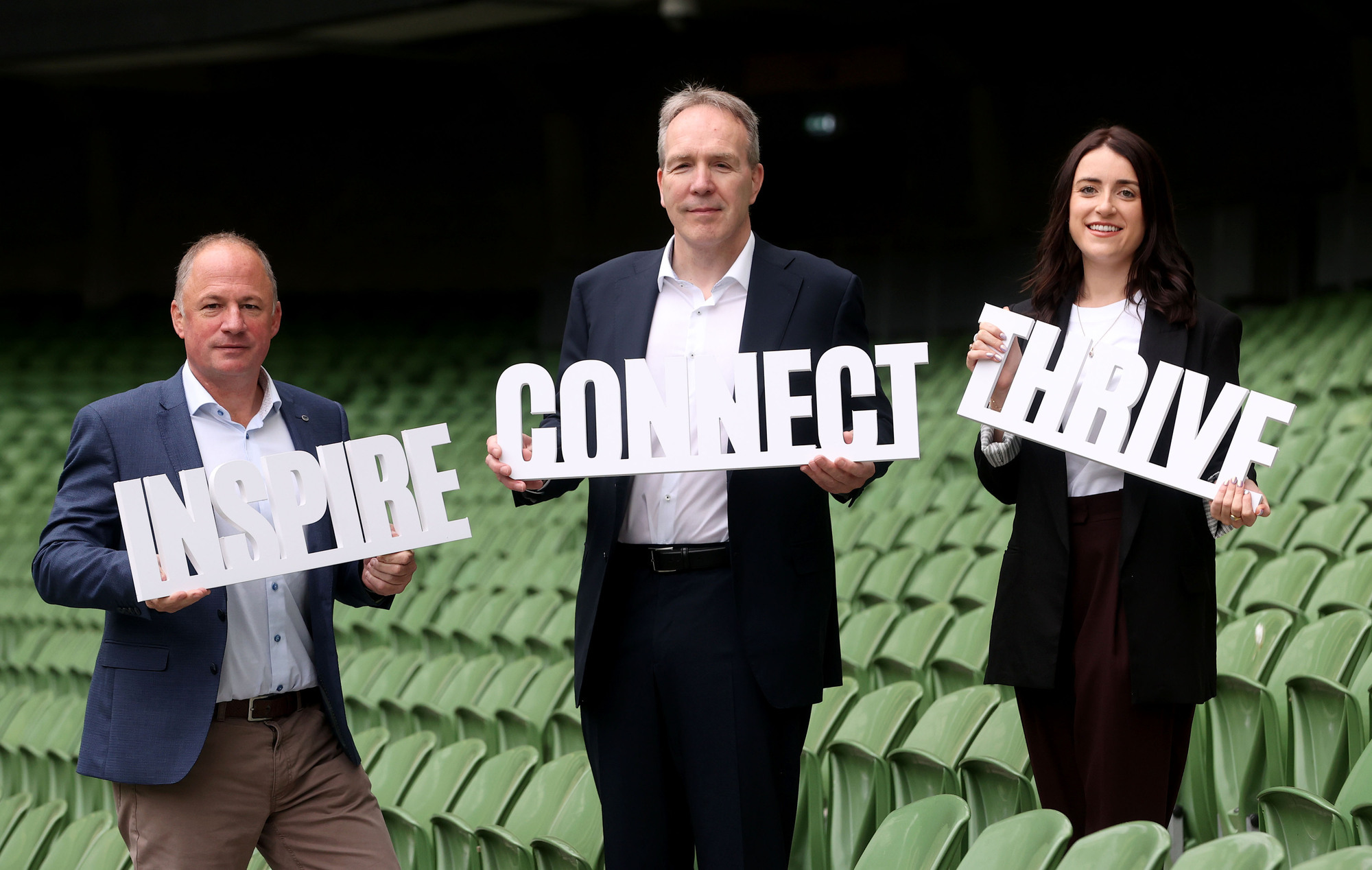
IRFU performance director David Humphreys, IRFU chief executive officer Kevin Potts and IRFU strategy and projects manager Kate Binchy. Pic: Dan Sheridan, Inpho
David Humphreys declared “we’re here to win” as he prepared to replace David Nucifora as IRFU Performance Director.
The former Ulster and Ireland fly-half, who joined the IRFU three months ago at the start of a transition period working in tandem with Nucifora, who will depart following the Paris Olympics in August after 10 years in the role, was speaking at Aviva Stadium on Thursday as the governing body released its Strategic Plan for 2024-28.
Unlike the previous plan covering 2019-23, which failed to deliver on clearly defined targets for the Ireland Men’s XV team to reach at least the World Cup semi-final in both 2019 and 2023 or for the Women’s XV to win a Six Nations and achieve consistent top three finishes in the championship, the new document, published under the title “Rugby in Ireland 2024 - 2028: Inspire, Connect, Thrive” steers clear of setting tangible key performance indicators (KPIs).
Humphreys, who was previously director of performance operations at the England And Wales Cricket Board, having served as director of rugby at both Ulster and Gloucester amongst other roles, said: "Coming in from the outside… I was very strong in terms of not having really specific KPIs.
“Why I say that is one of the things you'll hear, and it's a bit of a cliché in sport, you talk about a player leaving the jersey in a better place or someone who's in a role moving onto a different organisation and leaving it in a better place.
“If you look at the 2018 to 2023 strategic plan and what was set out there, I don't think any of us would sit here and say that Irish rugby isn't in a better place today than it was at the beginning of 2018 regardless of what we have and haven't won, so that's a very important part of it.
"But I also have a really strong view that high performance can't stand alone. The success of this strategic plan won't be on what we achieve on high performance but it's about making sure that the game in Ireland benefits from what we're going to do right across the strategic plan.”
Humphreys added he was not about to try and fix what wasn’t broken.
"My view is that having come in and seen all the good stuff and having a much greater awareness of what has been done very well, but also a much great understanding of where some areas perhaps that we can do things, not necessarily better, but very differently and hopefully the outcome will be that we know from a high-performance point of view that we're winning games.
"That's the big difference in the strategic plan when we talk about winning teams. 20 years ago, it was about what game we could win to avoid the wooden spoon. The big difference now is we're coming into every season with the expectation that our Irish men's team is going to win, our provincial teams are going to be winning the URC, our provincial teams are going to be winning in Europe, so our mindset is absolutely that we're here to win. We're here to continue that.
"We know that so many of those teams within the system are at very, very different stages of their evolution and what that means is we will be working as quickly as we possibly can with them to address some of the areas.
"If you look at the women's 15s going into a World Cup year, that's a huge priority for us. Kevin (Potts, IRFU CEO) has been very vocal in terms of where that sits in our strategy going forward. It's about giving them support at a coaching level, playing level, preparation level that will ensure that by the time we get into the World Cup, they're in a good position to compete."
Potts backed Humphreys’ take on the absence of KPIs.
"Well, there are expectations on the high-performance side of winning. We don't need to tell everybody that we want to win and our teams are going out to win. I think in our last plan, we got hung up on lots of numbers and this time it's about setting out the hows and the whats and the outcomes if everything is being done well.
"Behind the plans, there are annual KPIs that will be set and we will be publishing on an annual basis so people can see the direction of travel but our expectation on the high-performance side is that we win. We don't need to say that, do we?”
The IRFU, as part of its broader remit to grow the game, has placed the acceleration of women’s rugby at the heart of its strategy during a period which will see both the men’s and the women’s Sevens sides vie for medals at this summer’s Paris Olympics, and the 15-a-side Ireland team compete in the top tier of World Rugby’s WXV competition and return to the Rugby World Cup in 2025 having finished third in the 2024 Six Nations.
It is a vision formulated over the past 15 months, a period which began as the Ireland team finished bottom of the 2023 Women’s Six Nations without a victory and in search of a new head coach and with the IRFU accused in some quarters of institutional neglect of the female game.
The plan’s composition involved what the IRFU called an unprecedented level of collaboration between it and the four Provinces and also a consultation process with more than 5,000 rugby stakeholders. Its priorities are “delivering great rugby experiences, driving our high performance ambition, accelerating the Women’s game, and inspiring our fans”.
“Notable is a step change in Women’s Rugby with a clear commitment to accelerating its development."
The IRFU will appoint a new Women’s Strategy Implementation Lead to coordinate the delivery of these commitments both on and off the pitch. This new senior role will report directly to IRFU Chief Executive, Kevin Potts while the governing body has also committed to delivering a “thriving Provincial game with a move towards four contracted Provincial teams”, which will be competing in cross-border, season-long tournaments.
CONNECT WITH US TODAY



Be the first to know the latest news and updates