Sportsblog: Detecting a vibrant rugby heartbeat in northern France
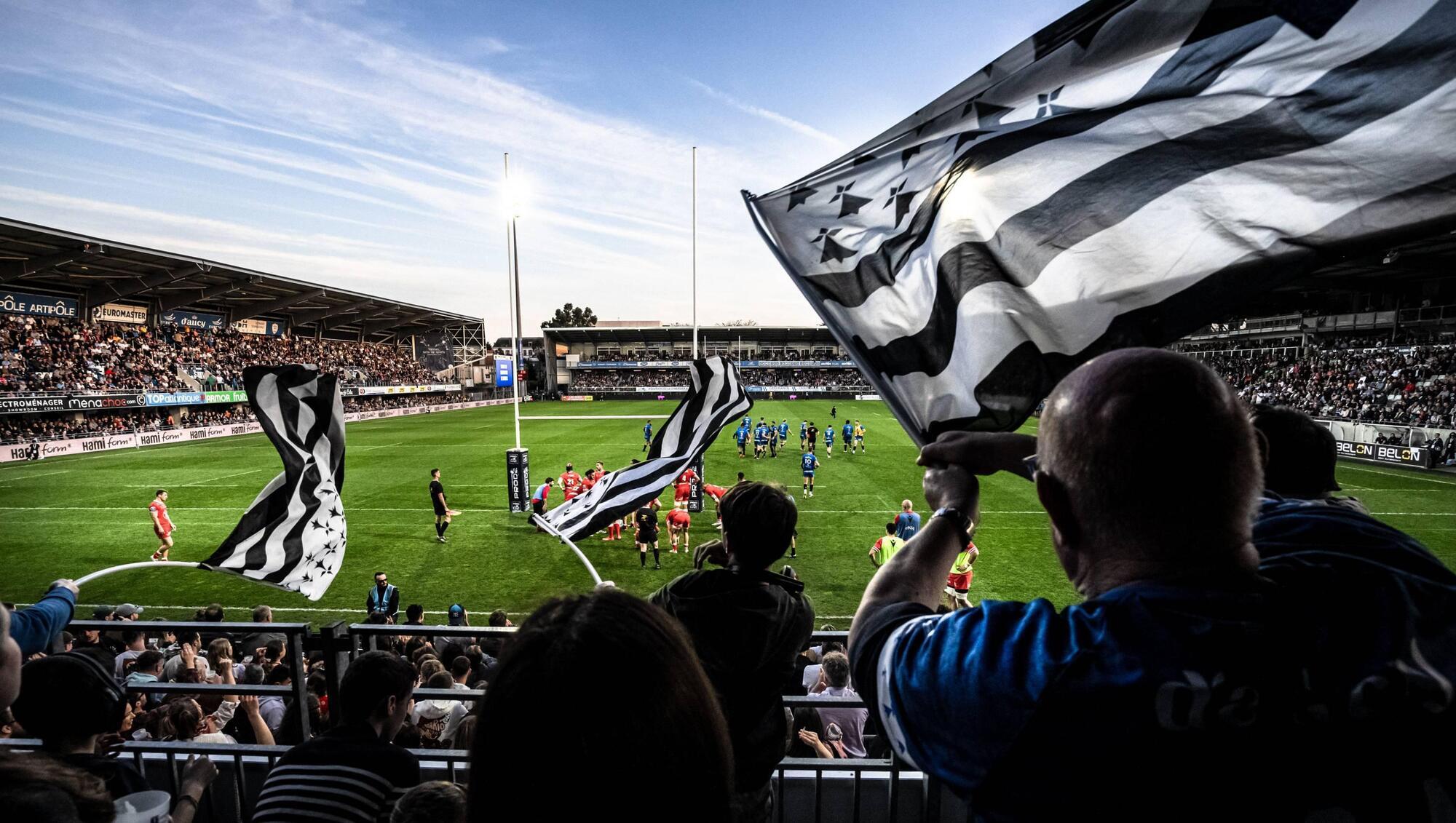
NORTHERN LIGHTS: The Vannes rugby faithful celebrate. Pic: Vannes Rugby
Think French rugby, and the mind’s eye focuses on the south of the country. You imagine current and former powerhouses Toulouse and Toulon; Perpignan and Narbonne; Bordeaux and Beziers, or Ronan O’Gara’s upstart high-achieving newcomers at La Rochelle.
It’s no secret that rugby’s French heart beats strongest in the south. Of the 30 clubs in the Top 14 and ProD2 in the 2023/24 season, just five – Racing 92, Stade Francais, Nevers, Rouen and Vannes – are north of a line between La Rochelle on the Atlantic coast and Oyonnax, near the Swiss border.

The game’s under-represented northern contingent will drop to four next season, after Rouen Normandie were relegated to the third-tier Nationale 1 last month at the end of a dramatic final night of the ProD2 season, with Nice later promoted to replace them.
But, it’s not all bad news for the game in the north of the country.
A genuine northern powerhouse is rapidly emerging, trailblazers of a concerted push by rugby authorities in France to increase the footprint of the game beyond its traditional territories.
The irony is that rugby in France was born far from its modern southern heartlands in the very north-west in which it is now threatening to re-emerge, with Vannes and, yes, Rouen at the vanguard of its return.
In 1872, the year that William Webb Ellis died in Menton, near Nice, English settlers in Normandy formed Le Havre Athletique, where they played a hybrid form of rugby and soccer, called ‘combination’.

Five years later, British businessmen in Paris formed English Taylors RFC, then Paris Football Club a year later. The more recognisably named Racing Club de France – which today goes by the name of Racing 92 – was founded in 1882, followed by Parisian rivals Stade Francais in 1883.
The former beat the latter in the first-ever French championship decider in 1892, in a match refereed by Pierre de Coubertain, the founder of the modern Olympic Games.
Racing Club de France is the first name on the Bouclier de Brennus – which was based on an original design by de Coubertain.
Back to modern times, and what could perhaps be termed as a return to the earliest traces of the game in France.
The emergence of Vannes – a club founded less than a lifetime ago, in 1950 – as a rising rugby force has been so rapid that a new high historical water mark could be made early on Saturday evening in this year’s ProD2 final, just eight years after the club last made a permanent impression on the French rugby firmament, and under the watchful eye of a single head coach.

Later Saturday, all seven final weekend Top 14 matches will kick off at the same time. There are some crucial encounters in the French top flight this weekend – Stade Francais v Toulon, with a semi-final pass at stake; play-off futures are on the line as La Rochelle host Racing 92; while Perpignan and Castres head to Pau and Bayonne respectively, hoping to steal a top-six finish at the last.
But, important though those matches are for the season-long hopes and ambitions of several French top flight clubs, none of them carry the potential weight of history of this year’s second-tier decider.
If the Breton side beat opponents Grenoble to lift the ProD2 championship bouclier at Toulouse’s Stade Ernest Wallon, they will become the first side from north-west France to gain promotion to the top tier of the domestic game. If it happens, rugby fans from Toulouse to Castres, Stade Francais to Toulon, will pass through a remarkable 18th-century facade not far from the port to enter Vannes’ cauldron, Stade de La Rabine, next season.
Having finished second in the table behind Provence and earned a bye to the semi-finals, Vannes – with ex-Munster second row Darren O’Shea, who’s set to leave for ProD2 rivals Valence Romans at the end of the season, in the engine room – beat ‘traditional French rugby heartland’ outfit Beziers 27-21 in a hard-fought encounter.
The excitement, the relief in Vannes after the final whistle last Friday was palpable. Eight years ago, in June 2016, they had become the first Breton side – the first north-western France side – to reach the second tier of the men’s domestic game in the professional era.
Three seasons later, Vannes reached the ProD2 semi-finals for the first time, where they lost to Brive. Defeats in the last four against Biarritz at the end of the 2020/21 season, and Oyonnax last season followed. Emotions, then, would have tended towards doom-laden excitement in the lead-up to last Friday’s semi-final, despite the public confidence of homegrown player-turned-coach Jean-Noel Spitzer and his squad.
Spitzer, 50, has coached Vannes since retiring as a club player in 2005, when they were in the amateur Federale 2 league. They were promoted to Federale 1 at the end of his first season in charge. Eleven seasons later, they won promotion to the ProD2.

This week they stand on the brink of more history.
And, even if they miss on the title and promotion in Toulouse, Vannes would still have a second bite of the promotion cherry back at Stade de la Rabine eight days later, against 2022 Top 14 champions Montpellier in a promotion-relegation play-off.
Two chances at history, then. Two chances to expand rugby in France beyond its current heartlands, and bring the game back to the north-west of the country, much closer to where it all began 152 years ago.