The Scotland view: A spectacular flash in the pan please
Scotland have a bad habit of going missing in games, and it costs them. They don't seem prepared to recognise it as a problem, so it is little wonder it keeps happening
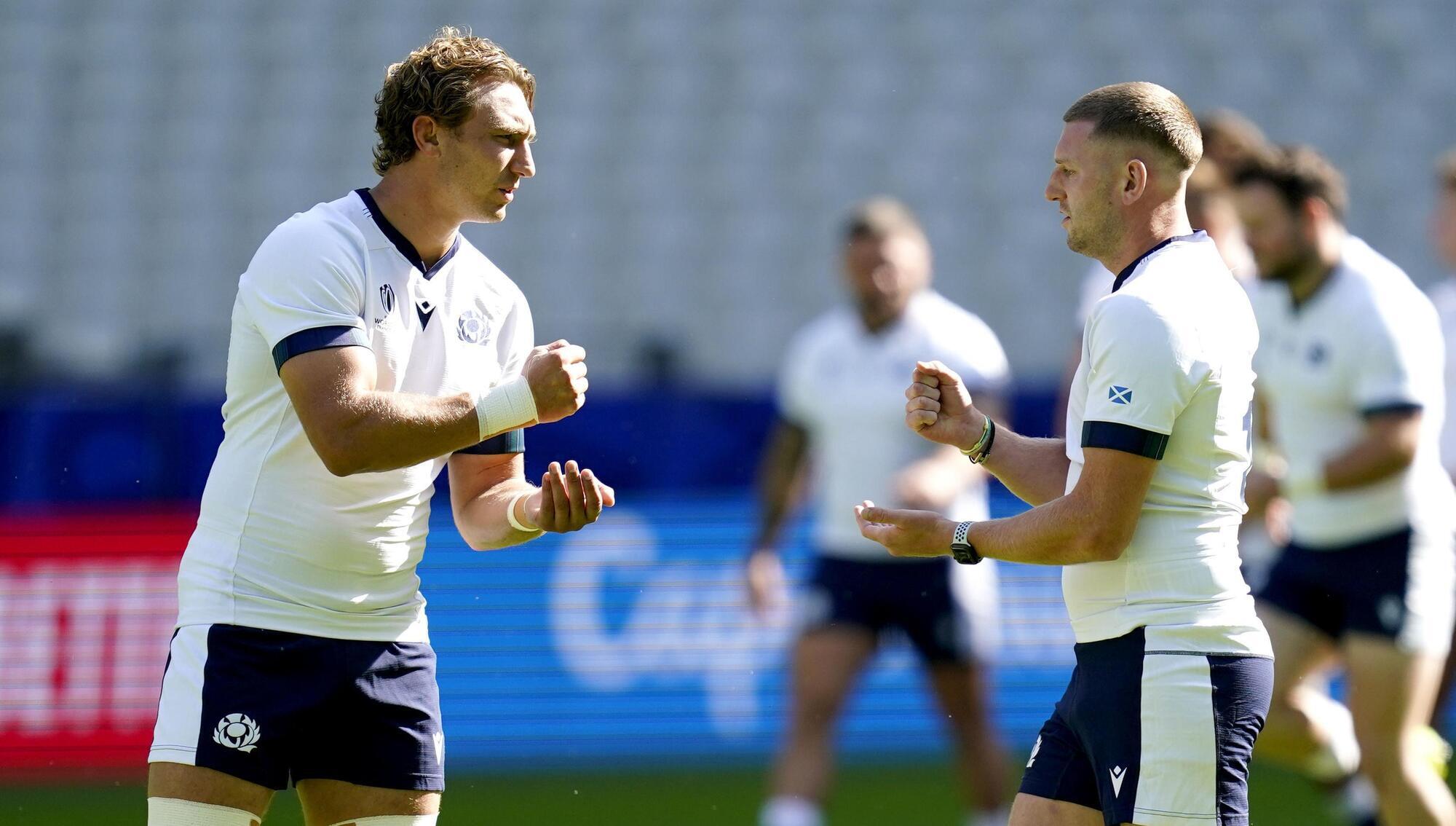
TAKE YOUR CHANCE: Scotland's Jamie Ritchie (left) and Finn Russell play rock paper scissors during the team run at the Stade de France in Saint-Denis. Pic: Andrew Matthews/PA Wire

TAKE YOUR CHANCE: Scotland's Jamie Ritchie (left) and Finn Russell play rock paper scissors during the team run at the Stade de France in Saint-Denis. Pic: Andrew Matthews/PA Wire

Donal Lenihan shared a video on social media in the aftermath of Ireland’s seismic victory over South Africa a fortnight ago which showed what seemed like a still-packed Stade de France (although some Springbok fans must surely have already disappeared into the Parisian night) reverberating as one to the tune and lyrics of ‘Zombie’.

The Cranberries’ classic has become the unofficial anthem for Andy Farrell’s side at this World Cup, and scrolling past that clip as a Scotsman, it was almost impossible not to pause and think: ‘How did that happen? They used to be just like us!’.


There was a shared sense of destiny there that Scotland can only marvel at. Ireland have earned the right to be genuine World Cup contenders through years of painstaking progress, adapting and learning from setbacks along the way, and consistently providing supporters with something they can really buy into. According to James Lowe, the Ireland squad are expecting their supporters to outnumber Scots by three to one in the stadium Saturday night.

Scotland firmly believe they can cause a major upset – which would be among the biggest in the tournament's history given Ireland’s current form, world ranking, and results against Scotland over the last six years – but if they do it will be a one-off.

It won’t be the product of a strategy for sustained growth and development, rather a spectacular flash in the pan achieved by a talented group of players who have been shrewdly assembled – some plucked from real obscurity – by Gregor Townsend in the hope that they can all click at the same time at this World Cup.

Ireland’s identity is based around a very clear, process-driven game-plan executed with unrelenting precision and discipline by excellent players. The loss of a leading light through injury, suspension or a drop in form may cause a brief splutter but the engine will keep rumbling on. Scotland's successes tend to be more brittle.

Furthermore, Ireland come into their own when their backs are to the wall (or at least that’s how it seems from the outside looking in). In contrast, Scotland have an adversity problem.

There was a relatively innocuous moment during that South Africa match when the ball squirted out the side of a ruck in the middle of the park to potentially provide the Springboks with dangerous turnover possession, but Jamison Gibson-Park was on it in a flash, managed to get back to his feet and stay strong long enough to be enveloped by his forwards, and the threat was averted.

These sorts of lapses regularly cost Scotland seven points, while the number of times one setback is compounded by another to make it 14 points is frightening.

The two tries conceded in three minutes early in the second half of the Springboks defeat had a familiar ring to it. A very similar thing happened during Scotland’s only defeat in their warm-up schedule, when Damian Penaud and Charles Ollivon scored in the 42nd and 44th minutes of a 30-27 victory for France in Saint-Etienne.

Townsend’s team also conceded quick-fire tries in the fourth and seventh minutes of their loss in France during the last Six Nations, and in the 56th and 61st minutes of their defeat at home to Ireland in the final game of that championship a fortnight later.

Scotland have a bad habit of going missing in games, and it costs them. They've been asked about it and don't seem prepared to recognise it as a problem, so it is little wonder it keeps happening.

And if Scotland do somehow manage to get everything right Saturday night while catching Ireland on a very rare off-day, all recent evidence points to them falling at the next hurdle (most likely France in the quarter-finals) because they have so far failed to develop the resilience needed to perform at the required level game on game.

We saw that at the start of the 2021 Six Nations when they beat England at Twickenham in the opening round only to blow up the following week against Wales, then also lose their next game at home against Ireland. That autumn, they beat Australia but were thumped by South Africa seven days later.

The 2022 Six Nations was a similar story, with Scotland beating England again, this time at home, only to fail to fire a shot against Wales away, before losing their two remaining ‘big’ matches against France at home and Ireland away by 19 and 21 points respectively.

That summer they blew hot and cold when losing their Test series in Argentina by two games to one, and in the last Six Nations they secured a third consecutive win over England, followed that up with a record win over a hopeless Wales, but then lost to France and blew their best chance of beating Ireland since 2017 (when the visitors to Murrayfield lost three key forwards inside the first 20 minutes and their replacement hooker early in the second half, leaving Cian Healy in the middle of the front-row at scrum time and Josh van der Flier throwing in at the line-outs).

Several factors contribute to this frustrating hot-and-cold routine, and principle among them is an over-reliance on the talismanic Finn Russell.

Against South Africa four weeks ago, Russell had a strangely one-dimensional day, seemingly determined to get the ball outside the opposition’s ferocious blitz defence with long flat passes no matter how slowly possession was coming to him. There were very few, if any, of those cheeky grubber or chip kicks that feature so prominently in the Scotsman’s highlights reels and may just have caused the on-rushing Damian de Allende and Jesse Kriel some pause for thought.

Without Russell at his imperious best, Scotland were bereft of attacking ideas. There was no plan B. You rather suspect that the logic behind restoring his old pal and former flatmate Ali Price at scrum-half this week is at least partly trying to take some of the weight for managing the shape and tempo of the game off the stand-off’s shoulders.

The good news for Scotland is that when Russell spoke earlier this week, he made a point of asserting that he is determined to play what he sees in front of him on Saturday. Could it be that the great rebel of Scottish rugby stuck too rigidly to a game-plan that wasn’t working against the Springboks, and that he is now ready to unleash his best - instinctive - rugby on Ireland?

There has certainly been a sense of liberation emanating from the Scotland team during their press activity this week. "We're not going to die wondering," promised captain Jamie Ritchie. Throwing caution to the wind is high risk – but the only chance they've got.

If they do pull it off, the designated 'anthems' for after the game are 'Loch Lomond' by Runrig and '500 miles' by The Proclaimers. Will the stadium rock with the same passion as it did two weeks ago? Song sheets may have to be distributed.

x

More in this section

Sport

Newsletter

Sign up to our daily sports bulletin, delivered straight to your inbox at 5pm. Subscribers also receive an exclusive email from our sports desk editors every Friday evening looking forward to the weekend's sporting action.

Cookie Policy Privacy Policy Brand Safety FAQ Help Contact Us Terms and Conditions

© Examiner Echo Group Limited