'They just like food and lots of it' - Irish rugby's recipe for World Cup success
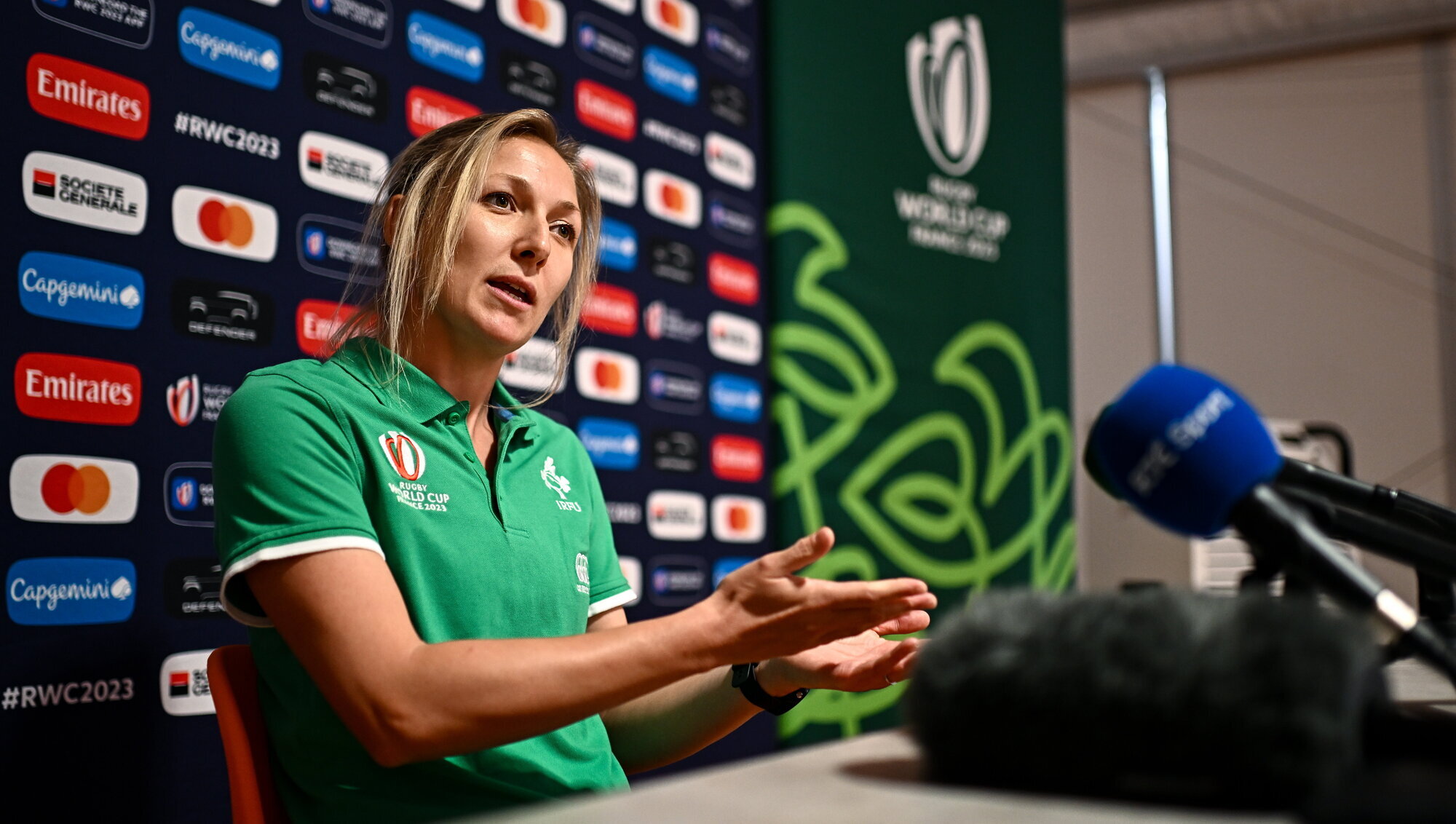
OFF MENU: IRFU head of nutrition Emma Gardner during a media conference at Complexe de la Chambrerie in Tours. Picture: Harry Murphy/Sportsfile
If food is mood, as the IRFU’s head nutritionist Emma Gardner insists, the Ireland’s World Cup squad must be eating very heartily indeed.
Gardner knows what she is talking about. Having been involved with Great Britain’s Olympic gold medal-winning women’s hockey team at Rio 2016 and also England’s 2019 Cricket World Cup triumph she knows the recipe for providing teams with a successful nutritional programme on which a successful campaign can be based.

And if the singing emanating from a first floor dining room booked for the Ireland party in one of Place Plumereau’s finer restaurants in central Tours on Saturday night is any guide, then Andy Farrell’s men are in great shape for the challenges that lie ahead, starting with this Saturday’s must-win final Pool B showdown with Scotland at Stade de France.
Hockey and cricket are clearly very different sports to rugby, with a myriad of different nutritional requirements for each position in a team, yet the Lancastrian, just a year unto the her role as Ireland’s performance nutritionist, is bringing a wealth of invaluable experience to Ireland’s bid for the Webb Ellis Cup in France.
Gardner, whose CV begins with a spell at Northampton Saints a decade ago, said: “Every World Cup or Olympics, they’re all very similar. I took a lot of learnings from both those environments, the Olympic Games with hockey and the Cricket World Cup, more so in the nature of getting back to baseline, getting players ready to play again.
“With hockey they had to win seven matches in 13 days to win a gold medal. In cricket, very similar to rugby, you’ve got to be able to back up games potentially twice a week.
“I think it’s been good experience for me because I’m used to the nature of the tournament and how it falls. Used to getting players ready for a match but then having to get them ready again is probably the main learnings.
“But just experiencing a World Cup, it’s a long tournament, as well as it being back-to-back. There’s a long time to concentrate and keep players focused. I think a big learning for me is ‘food is mood’, particularly in these campaigns.
“So there comes a point where, you know, our guys here are brilliant, we’ll have conversations, what type of food do they want. We obviously try to keep the quality good and of high quality all the time but they’ll be times where we go ‘let’s just calm it a bit’ and just give them what they want and relax because that’s also important when you’re here for such a long time.
“We’ve been in pre-season since the middle of June, that’s a lot of meals to prepare for. It’s also hard to keep people occupied with food. It’s often the one thing – internet, food and sleep seem are the three things that tend to keep people happy.
“So my learnings from all the campaigns I’ve worked in around these tournaments is make sure the food is really good. We’re so fortunate to have our two chefs with us who do an amazing job but also communicate with what people want and need and try and keep everybody in camp happy and in that space. I think we do that well here.”
Garnder described the Ireland players as “very straightforward” and said buy-in from them to her objectives for the squad was never an issue.
“They love their food, which is good for me, it makes it easy, they're not fussy, my life is very simple in a way. They just like food and lots of it. That's basically the simple message that you'll hear from our camp.
“Working with these guys at international level, we all see week-in and week-out the physicality in how the game has developed and the type of game we play.
“Every collision creates a further energy demand. The time the ball is in play will influence the fueling strategies we do, so I think there's a natural player buy-in because they feel it and experience it. They know what they need to do to fuel for 80 minutes.
“I say to them all time, 'How are we looking in the last 10 to 15 minutes of a game?', because for me that's where my area kicks in with them, and we never want to have an excuse where we aren't winning a game because we're under-fuelled.
“There's a natural buy-in, but one of the biggest things we've seen the difference in (over 10 years in performance nutrition) is our recovery, how much better they feel in a shorter space of time.
“We've got better in our recovery especially. If they start with a full fuel tank and only slightly deplete it, it's easier to get them back to a baseline.
“That's just not for performance, it's also minimising injury risk, minimising illness. Some people just see nutrition as food, hopefully my role spans way beyond that, and hopefully we see that in our results as well.” end