The key focus areas for World Cup officials
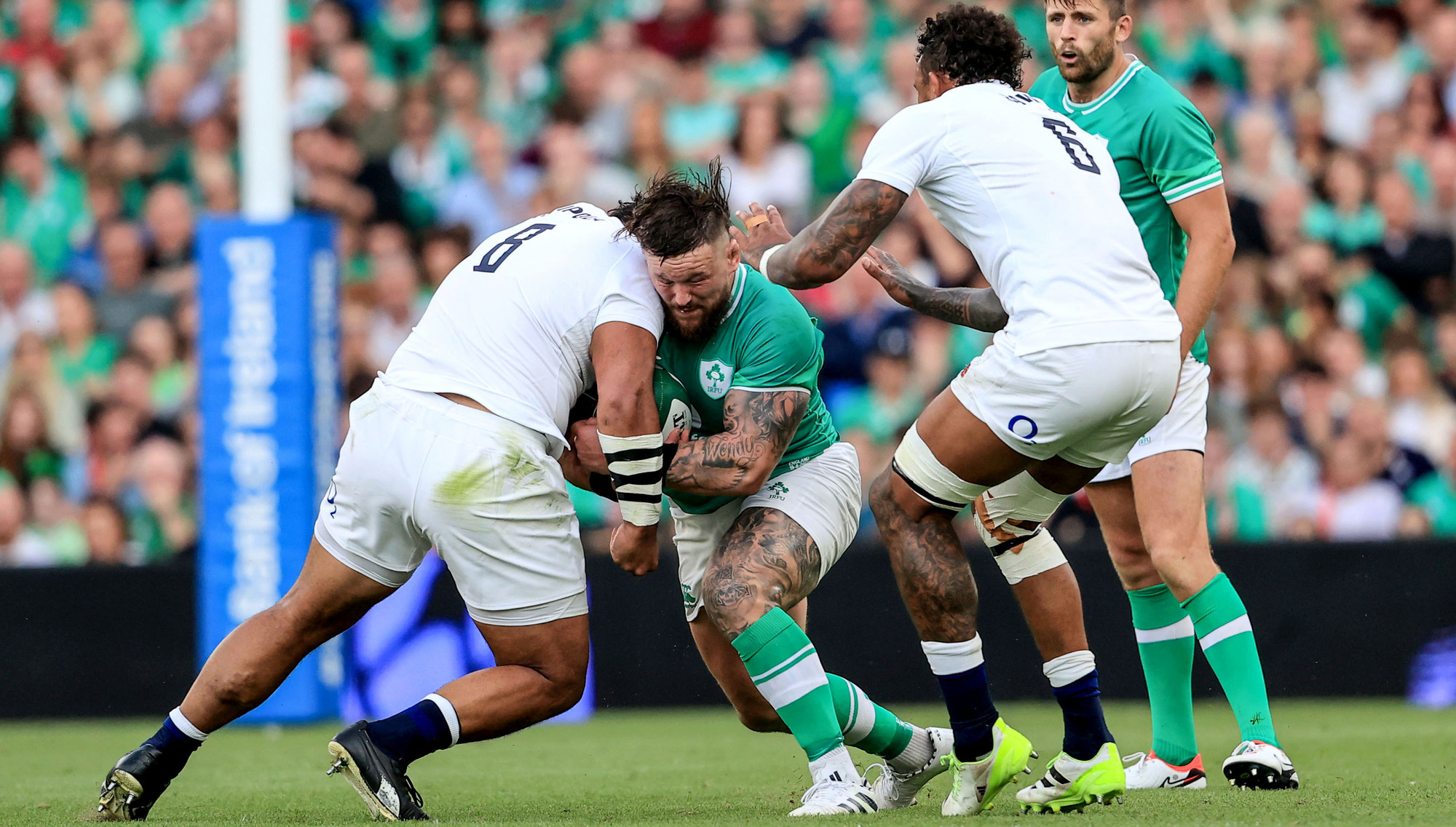
PAYING THE PRICE: England’s Billy Vunipola was sent off after this high hit on Ireland’s Andrew Porter in their clash at the Aviva Stadium last month. Picture: Dan Sheridan/Inpho
The three “S’s” - Safety, Speed, and Space are what the match officials will be looking at as the three main focus areas during the World Cup.
At all times players must conform to Law 9.11 which states 'Players must not do anything that is reckless or dangerous to others including leading with the elbow or forearm, or jumping into, or over, a tackle.'
For very obvious reasons player welfare is a key concern, so in terms of safety, there are a number of situations that are high risk.
The first of these is the tackle. When players are making a tackle they must do, and not do, certain things.
1. They must not be upright.
2. They must be attempting to wrap, and very importantly it’s not enough to have wrapped with the left hand if the other side is where the foul play contact is being made.
3. They must not lead with the head.
When any of the above happens, and there is head contact, the outcome is reviewed using the Head Contact Process (HPC), asking the following four questions:
1. Was there Head Contact?; 2. Do we have Foul Play?; 3. What is the Degree of Danger?; 4. Is there any mitigation?
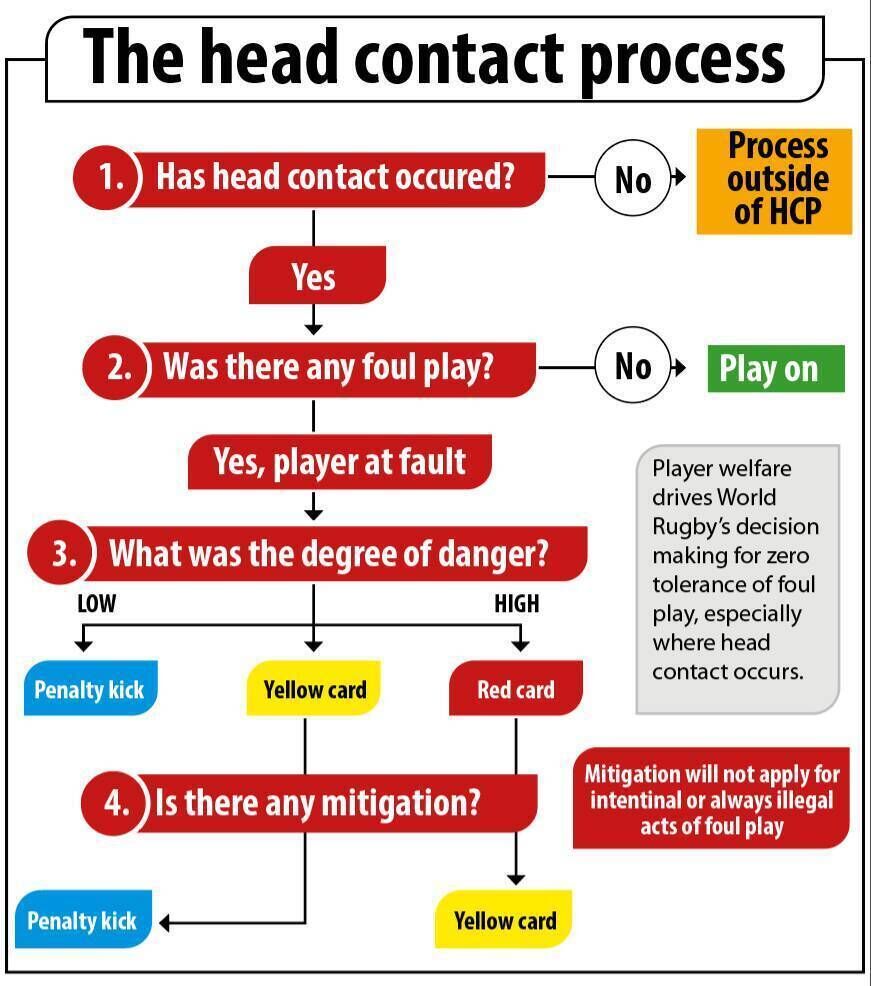
It’s also very important to understand that no mitigation can be applied if the act was always illegal.
Players must also make sure that when they are entering a ruck, they are using their arms, and not leading with either the shoulder or the head.
If players are attempting a chop tackle - this is where they tackle very low, as usually the ball carrier is also low, for example near the goal line - again they must be attempting to wrap. If they don’t and they target a joint (knee) then they are looking at receiving a card.
When chasing kicks, and jumping to contest for the ball, players must be in a realistic position to gain possession of the ball. Remaining on the ground is not seen as being in that realistic position. Then, should they not have gained possession of the ball they must not interfere with the opponent who has caught the ball. If they do, and that player lands on his head, or otherwise dangerously, they should receive a red card.
The same principle as above is also used when judging the severity of a tip tackle. That’s where the player's feet are raised above the horizontal, and he/she is then dropped, or driven into the ground.
At a tackle/ruck, it can be very difficult to legally remove the jackler (the player trying to get the ball off the ball-carrier after a tackle). The main way it’s done is by way of the 'Croc Roll' (This is where players wrap their arms on the Jackler below the shoulders, and roil him to the side). However if this action causes an injury the player will receive a red card.
When a ball carrier uses his arm that is away from his body, to fend off an opponent who is coming into tackle him, and the contact is to the head, or neck area, he will receive a card. The colour of the card will be dependent on the degree of danger.
Of course, there are other forms of foul play - thankfully seen less often - that will also be sanctioned, such as punching, kicking, placing a hand in the eye area of the face, tackling a player early or late, tackling a player without the ball, and various forms of obstruction.
The main aim of the match officials here is to ensure the ball is delivered as fast as possible, while still allowing for a contest by the opposition to regain possession.
Generally the order of focus will be:
1. Making sure the tackler(s) roll away. In doing this they should do it going East to West, in other words in the direction of the touch lines. Therefore not getting in the scrum half’s way.
2. Any player who makes a tackle, but is not after going to ground, must show a clear release of the tackled player, or the ball, before he can look to play the ball.
3. All arriving players must arrive into the tackle/ruck from the direction of their own goal line. Put simply they can’t enter from the side.
4. Players must remain on their feet, but may end up off their feet having (legally) removed an opponent.
5. When a player joins on his ball carrier and then engages the opposition, he can’t go to ground.
6. Players trying to gain possession of the ball must put their hands onto the ball, not the ground passed it.
7. The ball carrier can’t adjust his position on the ground to prevent an opponent gaining possession of the ball.
8. Finally when the contest is over and the ball is secured the referee will generally say “Use It”. The allowance is five seconds, or else it’s a turnover scrum.
Clearly there is a lot going on in a very short period of time at the tackle/ruck for the referee to have to deal with.
All teams will look to both create (when they have the ball), and deny (when they don’t have the ball) space to each other. The role of the referee, and his assistant referees (AR’s) is to get and then maintain the space that teams are entitled to. The key areas of space for both teams are:
1. At the tackle/ruck, and maul the offside line is the hindmost foot.
2. The offside line at a scrum is five metres back from the scrum.
3. At the lineout it’s ten metres back from the line of touch.
For all the above if it’s closer to the goal line, the defending team can be on the goal line.
4. For all other actions the ball, or the player who last played it, is the offside line.

CONNECT WITH US TODAY



Be the first to know the latest news and updates