How to win a World Cup: Does it all come down to the grunt, not glitter?
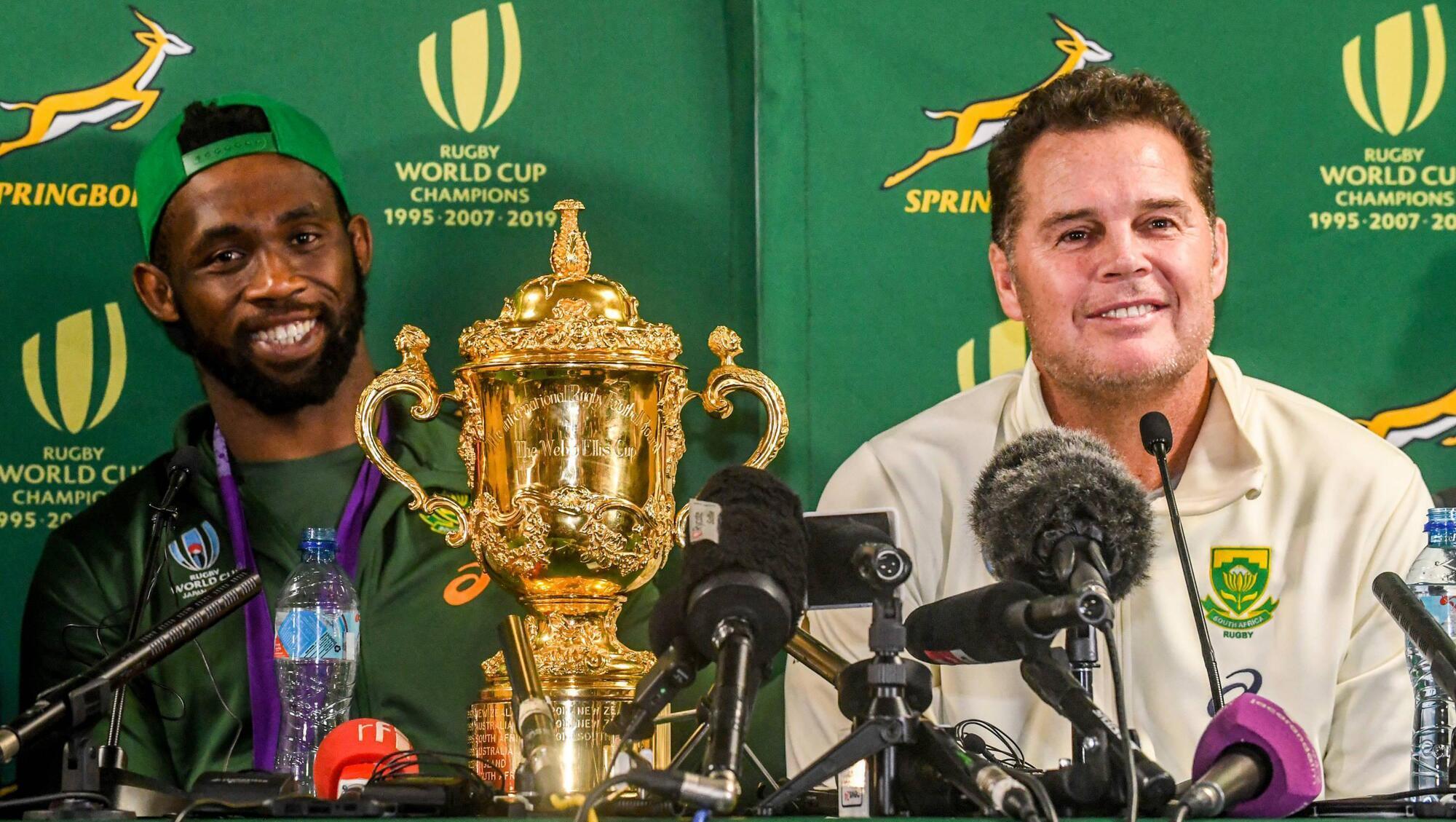
ALL THAT GLITTERS: South Africa's inspirational captain Siya Kolisi and head coach Rassie Erasmus with the Webb Ellis Trophy at their homecoming in Johannesburg in 2019. Pic: Sydney Seshibedi/Gallo Images
You can’t do it alone. Even Jonah Lomu found that out, single-handedly flattening England in the Cape Town semi-final in 1995, a black-shirted wrecking ball. Ireland’s current attack coach, Mike Catt, still carries the bruises. Yet the Mandela effect trumped the most destructive player the game has ever seen. Never mind galvanising a team, the South African president brought the entire rainbow nation together that day at Ellis Park to trigger victory against hot favourites New Zealand.
There was a similar appeal-to-country behind the Springboks’ triumph four years ago in Japan. England didn’t stand a chance. Whatever it takes, even railing against internal adversity as the Spanish women’s football team have just shown, as per England in 2007 by getting to the final after a 36-0 trouncing in the pool stages, likewise France in 2011, no team can win a World Cup without a strong sense of self. That can come from within or without, with the management or against them.
It is not a precise formula. Pressure can stifle as much as it can inspire. The All Blacks were desperately fortunate to sneak over the line in 2011, crippled with anxiety that the entire country would fall off the end of the earth if they lost. France have that same conundrum to solve this time around. And Ireland? It comes down to one man – Andy Farrell and his ‘hurt arena.’ Ireland go into the tournament prepared to go deep for each other.
The roll-call of World Cup-winning scrum-halves tells its own tale – David Kirk, Nick Farr-Jones, Joost van der Westhuizen, George Gregan, Matt Dawson, Fourie du Preez, Piri Weepu, Aaron Smith, Faf de Klerk… And Antoine Dupont?
If there is one single reason to make France favourites to win a World Cup for the first time, it is the presence of the Toulouse No 9 in their ranks, a player that has already acquired Messi-like status in the sport, a wholly different type but one blessed with the ability to change a game in a trice. By simple definition, a scrum-half is the pivot of the team, the driver, the tempo-setter, the slick distributor, the brains-trust, a force-field be it in a muscular van der Westhuizen sort of way, or a Faf de Klerk way, a right bloomin’ pest.
De Klerk is still there, of course, even if maybe not quite at his bothersome best, as is Aaron Smith who does appear to be back in the groove. If there is one (yes, yes, I know, there are hundreds) reason why England are so flat and lumpen it is because Ben Youngs is nothing like the player he was at the outset of his career. Ireland have good, if contrasting, options in Jamison Gibson-Park and Conor Murray.
Dupont, though, is the master.
There are exceptions to the rule - notably the Springboks four years ago when Rassie Erasmus’ side came from a long way back – but there is little doubt that momentum matters as the tournament starts. The only northern hemisphere team to have won the World Cup, England, achieved what was expected of them when they lifted the Webb Ellis Cup in 2003. They arrived in Australia as the leading side in the world and duly delivered even if it did take extra-time and a wobbly drop goal off Jonny Wilkinson’s wrong foot to seal the deal.
You might even argue that they hit peak form a few months before the actual event with an impressive Grand Slam clincher in Dublin followed by a double-bubble triumph over the southern hemisphere that summer with wins over the All Blacks in Wellington and Australia in Melbourne. Having such credentials augurs well for Ireland who have yet to win a knock-out match in a World Cup. Their recent record suggests that that dismal return might be put to rights even if their Pool B draw is a stinker. You’ve got to beat the best at some point and Ireland have that task from the off. They can approach such a daunting challenge in good faith. Their form is as impressive as England’s was in 2003 – 24 wins from the past 26 fixtures. That’s a whole heap of confidence to draw on.
Oh how we might thrill to the slalom runs of a David Campese or the jinking devilment of a Jason Robinson but it all comes down to the grunt not the glitter when it comes to winning a World Cup. Campo’s Australia did manage to get one over England in 1991 at Twickenham despite the Red Roses having some of the meanest hombres in the game in Wade Dooley, Paul Ackford, Brian Moore, Mickey Skinner, Mike Teague, and Peter Winterbottom, not blokes you’d typically want to meet down a late-night alleyway.
Yet England got suckered by Campese’s pre-match taunts that they were boring and one-dimensional into believing they could play like the Harlem Globetrotters. Buck Shelford, Kobus Wiese, John Eales (an aristocratic sort of gladiator), Martin Johnson, Bakkies Botha, Victor Matfield, Sam Whitelock, Eben Etzebeth – these have been the backbone of title-winning teams. England do not have the power-base that once was their forte as Ireland have shown time and again in recent encounters. The Irish forward pack is up there with the best, able to go toe-to-toe with the likes of France and South Africa. Tadhg Furlong, James Ryan, Caelen Doris, Josh van der Flier, all tough, smart and a right handful for any opposition in whatever style of forward play is necessary.
Yep. For all the science, for all the money poured into preparation, for all the hours of video analysis, you still need the bounce of the ball to go your way at key junctures. The rub-of-the-green factor was in play in 1995 when a violent stomach bug floored New Zealand on the eve of the final. A mysterious waitress named Suzie had supposedly appeared to serve food and was never seen again as a legion of All Blacks spent the eve-of-match with their heads down the gurgler.
There was less furtiveness about South Africa’s slice of luck as they won the title in 2007 in Paris, the rather rudimentary TMO system of the day with fewer cameras and less persuasive technology deemed that England wing, Mark Cueto, had a toenail in touch prior to him diving over early in the second half. TV match official, Stuart Dickinson, spent almost three minutes before disallowing the score. South Africa went on to win, 15-6. Four years later, New Zealand got away with daylight robbery in beating France, 8-7, thanks largely to extraordinarily generous refereeing by Craig Joubert. The All Blacks were not be denied. So, yes, fingers-crossed does play a part.. By that criteria, Ireland are due heaps of help from the Gods in France for their draw with improving Scotland and defending champions, South Africa, to overcome at just the pool stage is a beastly thing. Luck can be their 16th man.
CONNECT WITH US TODAY



Be the first to know the latest news and updates