Peter Jackson: Ireland the mentality monsters with two XVs of Roy Keanes
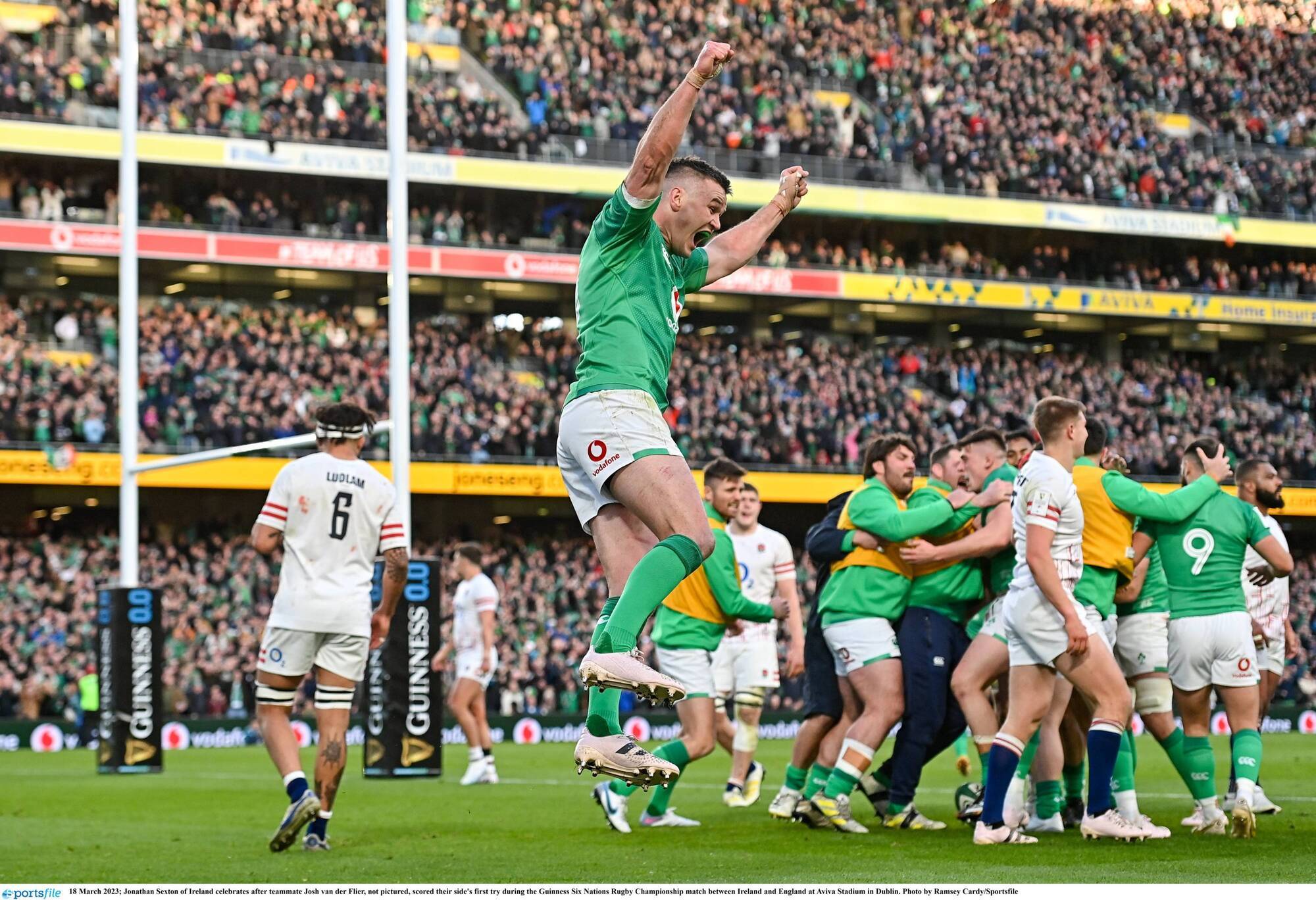
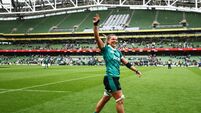
MENTAL STRENGTH: Jonathan Sexton of Ireland celebrates. Photo by Ramsey Cardy/Sportsfile
And so to France for the expedition of a lifetime, a shot at eclipsing Italia 90 and changing a narrative once so absurd that it could have been written for Father Ted.
At the risk of sounding a discordant note amid the merriment over the Grandest of Slams, it does no harm to point out that when it comes to flopping at the World Cup nobody has done so as reliably as Ireland: the only contender to be counted on being counted out of every knock-out stage over the last four decades.
SIX NATIONS CHAMPIONSHIP
Your home for the latest news, views and analysis of this year's Six Nations Championship from our award winning sports team.
SIX NATIONS CHAMPIONSHIP
Your home for the latest news, views and analysis of this year's Six Nations Championship from our award winning sports team.
It’s almost as if the embarrassment of their first match at the first global jamboree, May 25, 1987, and I write from personal experience, has dogged them ever since: a windy Sunday lunchtime in Wellington when they turned up against Wales without anything to pass remotely for an anthem, hence a cassette version of The Rose of Tralee as a soppy substitute for Amhran Na bhFiann.
Ireland’s coach, the late Mick Doyle, used it to his advantage. Whenever asked why a certain player had been left out, ‘Doyler’ would trot out the stock answer: "We couldn’t be sure he knew all the words of The Rose of Tralee."
The next World Cup was always going to be different, except it never was. The losing quarter-finals kept piling up: Australia in Sydney (1987) and Dublin (1991), France in Durban (1995) and Melbourne (2003), Argentina in Lens (1999) and Cardiff (2015), Wales in Wellington (2011), New Zealand in Chofu (2019).
They did make sure of sidestepping one losing quarter-final, in France in 2007, by failing to get there, finishing third in their pool behind the hosts and the Pumas.
This time, though it really will be different. This time Ireland are going as No. 1 in the world, the clean sweep of the Six Nations a glorious reaffirmation of their universal perch above France, the All Blacks, the Springboks and everyone else.
This time Ireland are the ones the rest will hope to avoid, France included. This time they go with a winning mentality en masse, the equivalent of not just one complete XV of Roy Keanes but two.
They are perhaps even closer to possessing 30 interchangeable players than Martin Johnson’s England were when they cleaned up 20 years ago.
England won 14 in a row going into that tournament, including one in New Zealand. Ireland have won 13 of their last 14, including two in New Zealand, three all-told and wins against every other current member of the top ten.
With the sole exception of Johnson’s exceptional squad, reigning Grand Slammers have come unstuck at World Cups: France, runners-up in 1987, England likewise in 1991, fourth in 1995 and Wales, fourth last time out in Japan. None had to cope with a schedule as demanding as Ireland’s.
What kind of a draw lumps three of the world’s top five, holders South Africa, Scotland and Ireland in Pool B? And two of the world’s top three, France and New Zealand, in Pool A?
How do you explain why none of the top five is to be found in Pools C and D? If Ireland keep on track, they will have to beat the Springboks, the All Blacks or Les Bleus just to reach the semi-finals. Andy Farrell, grounded as ever, isn’t exaggerating when he talks of his indispensable captain having ‘bigger fish to fry.’ England’s prospective route to the same stage looks a doddle by comparison, likewise Australia’s, Argentina’s and even Wales’.
The folly of basing the draw on how they finished at the last World Cup can hardly be overstated. Father Jack could scarcely have made a bigger pig’s ear of the draw had he made it himself during a drunken rage on Craggy Island.
Just as well, then, that the greatest of all Irish teams have been forged in the furnace of adversity. They also stand alone when it comes to keeping all 15 players on the pitch at all times, the only international team this season untroubled by a single card of either colour.
***
The longest of all Six Nations’ journeys finished on Saturday, not in the Grand Slam gold of Dublin but Paris where another 37-year-old reached the end of a road even longer than Johnny Sexton’s.
Alun-Wyn Jones had become a permanent fixture in the Welsh second row fully two seasons before the advent of his Irish contemporary and yet their final exits from the championship could hardly have been more different.
Hanging on in a team thankful for the small mercy of finishing above Italy, Jones would never have wanted a Six Nations stretch spanned 16 years to end the way it did, counted out inside the distance after the most punishing season the Welsh game has ever suffered.
The Stade de France being no place for old men, especially when Antoine and his confreres open their box of tricks, Jones’ championship farewell turned into The Requiem for a Narky Old Warrior.
Already the world’s most-capped player by some distance, he will hope to stagger on to a fifth World Cup by which time both he and Sexton will have turned 38. Only one is equipped to go the distance.
***
The Six Nations is rugby’s equivalent to five times round the Grand National course at Aintree in six weeks. Small wonder, then, that of the 200 or so who came under starter’s orders, barely seven per cent played every minute of every match.
The few who made the trip were fewer still because of the incident which eliminated two full-backs in one fell swoop; Freddie Steward, sent off for the dangerous hit on Hugo Keenan which left his victim missing in action for the only time.
In the end only 14 defied every hazard without leaving their post, an indomitable band made all the more so by the exclusion of every full back, every fly half, every scrum-half, every No. 8 and, of course, every front row forward.
The last men standing amounted to four Irish, three French, three Scots, two Italian, one English, one Welsh all drawn from four positions:
Five wings: Mack Hansen, James Lowe (both Ireland), Duhan van der Merwe, Kyle Steyn (both Scotland) and Damian Penaud (France).
Two centres: Gael Fickou (France), Juan Ignacio Brex (Italy).
Five locks: James Ryan (Ireland), Thibaud Flament (France), Federico Ruzza (Italy), Maro Itoje (England), Adam Beard (Wales).
Two flankers: Josh van der Flier (Ireland), James Ritchie (Scotland).
***
Scotland may be split over independence but their rugby empire truly knows no bounds. Ben Healy’s initiation at Murrayfield ensures that it now stretches from Toronto to Tipperary, from Stoke-on-Trent to Sydney and various points in between.
More than half of their 23 against Italy were born in six countries spread across four continents: Canada (Ewan Ashman), Australia (Sione Tuipulotu, Jack Dempsey), South Africa (Duhan van der Merwe, WP Nel, Pierre Scdhoeman, Kyle Steyn), England (Sam Skinner, Hamish Watson, Ben White, Ali Price), France (Cameron Redpath) and Ireland (Healy).
At 23, he becomes the third Irish fly half to find a Test arena elsewhere, emulating Dubliners Ian McKinley (Italy) and AJ MacGinty (USA). Another Irish-qualified ten, Shane Geraghty of London Irish, played six times for England between 2007 and 2009.
***
Despite a valiant attempt by the ageing Welsh eight in Paris, Ciaran Fitzgerald’s pack are still the oldest to have appeared in the Five/Six Nations. They have held that record since losing to France at the Parc des Princes in January 1984.
Fitzgerald, Phil Orr, Ray McLoughlin, Moss Keane, John O’Driscoll, Fergus Slattery, Willie Duggan and young pup called Donal Lenihan had an average age of 31 years and ten months, as verified by the noted rugby historian John Griffiths.
The Welsh pack, featuring a 37-year-old lock (Jones) and a 36-year-old hooker (Ken Owens), averaged 31 years, nine months, one week and three days. A recount is underway.
So many referees have emulated Wayne Barnes in affording France the simple courtesy of speaking to them in French, that those who don’t tend to stick out. Nic Berry, whose playing career included a stint at Racing, was not heard saying as much as a ‘merci mon ami’ in handling the France-Wales match.
His fellow Australian, the talkative Angus Gardner, appeared to avoid all Italian during their defeat at Murrayfield.
"Ireland are favourites to win the World Cup. The great thing is that they can win in a number of different ways” – Clive Woodward, still the only British-Irish coach who’s been there and done it.
"It’s amazing to come up to this hemisphere and see the quality of the rugby" – Scotland’s converted Wallaby back row forward Jack Dempsey.
"To me, desperation is an illness" – Andy Farrell on keeping calm in the madhouse of his profession.

CONNECT WITH US TODAY



Be the first to know the latest news and updates