What was gained by Wales’ structural change?
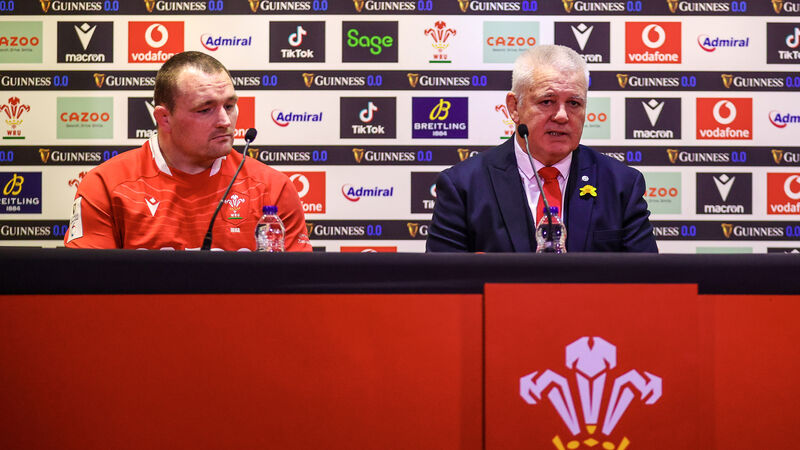
DEEP WATER: Wales' Ken Owens and Wales Head Coach Warren Gatland. Pic: ©INPHO/James Crombie
You could pick your way through any manner of metrics in explaining the mess that is Welsh rugby but Saturday’s loss to England in Cardiff gives raise to the sobering possibility of a first Six Nations wooden spoon for the Principality in 20 years.
SIX NATIONS CHAMPIONSHIP
Your home for the latest news, views and analysis of this year's Six Nations Championship from our award winning sports team.
SIX NATIONS CHAMPIONSHIP
Your home for the latest news, views and analysis of this year's Six Nations Championship from our award winning sports team.
Wales were already in some distress come that 2003 Championship with Steve Hansen having assumed the reins from Graham Henry midway through the previous tournament and on the back of a 44-point loss to Ireland.
Narrow defeats on the road in Rome and Edinburgh and a one-point defeat to Ireland in Cardiff were the ‘high’ points’ two decades ago, with England and France pouring on greater servings of misery with 19- and 28-point beatings respectively.
What’s really topical about all this is the fact that 2003 was the year their grand old clubs were superseded by a new regional structure that is in such a state of disrepair and disaster now that it threatens the very fabric of the game.
How poignant it is now to look back at those Welsh teamsheets from two decades ago and see players listed from Pontypridd, Bridgend, Llanelli, Neath and Cardiff. What was lost in that change? And what exactly was gained?
That Ireland’s modus operandi has changed is obvious. No team in the world was so reliant on attacking lineouts for its attacking thrust, especially during the Joe Schmidt era, but there has been a very obvious intent to keep ball in play of late and it speaks to their comfort in Andy Farrell’s ‘chaos’.
One of the standout stats through the first three rounds is a missed tackle count that stands at 79. To put that in context, Ireland missed 66 in the entire Championship last term. The percentage of successful tackles so far is 83.8%. Last year’s was 89.6%.
“The missed tackle count is too high,” said Ireland defence coach Simon Easterby ten days ago, “but sometimes there would be a missed tackle marked on data but actually what it has done is it’s affected what they’ve had to do. So that missed tackle might result in a turnover because you’ve forced someone to step inside or you’ve forced them to do something you don’t want to do by virtue of the pressure you’ve put on a team.”
No risk, no reward.
Hard as it is to imagine, the Six Nations is not the centre of the rugby universe. Not for everyone and not this year. The World Cup is just six months away and what used to be known as the game’s ‘Big Three’ find themselves in very different states of repair.
South Africa are, according to the City Press media outlet, hoping to co-opt Nigel Owens on board as a refereeing coach for France 2023 but if that is tinkering around the edges then their Tasman rivals are in the guts of more serious remedial work.
Eddie Jones hasn’t been back in Australia a wet week and is now without any assistants after forwards coach Dan McKellar brought a two-year stint with the Wallabies to an end for the top job with Leicester Tigers. Not good timing, or optics.
New Zealand may be even worse off. Head coach Ian Foster is sitting on a 67% win rate, the All Blacks’ worst in the modern era, and scrambling to save his long-term future as the union contemplates life post-World Cup.
Rumblings are that there may be an announcement by April although the picture remains fuzzy given the NZRU seems to have adopted a vow of silence taken directly from the GAA’s Kilamcud Crokes-Glen playbook.
A slew of players are leaving for Japan, France or retirement at the end of the year with more to follow and the feeling is that the union needs to act quick as they decide whether to stick with ‘Fozzie’ or make an overdue play for Scott Robertson or Jamie Joseph.
The conundrum of how best to give game time to young players on the fringes of their professional club squads is a common theme across the Six Nations. It was a reason behind Andy Farrell securing the release of 35 players from across the four provinces last autumn for an Emerging Ireland tour to South Africa and why United Rugby Championship chief executive Martin Anayi has spoken of plans for a Next Generation competition to run alongside the existing league.
Before kick-off on Saturday at Stadio Olimpico, Italian Rugby Federation (FIR) president Marzio Innocenti spoke of his own proposition, understood to have been discussed with IRFU counterparts in Rome for the Guinness Six Nations showdown. Innocenti, a former centre who captained Italy at the 1987 World Cup, wants A games between his country’s two professional franchises, Benetton in Treviso and Zebre Parma and the Irish provinces on same weekends as URC fixtures.
It is part of the FIR president’s play to improve Italian rugby’s elite development pathway, which has been the subject of some criticism following the departure of former IRFU employee Stephen Abboud from his position as the governing body’s technical director for player and coaching development.
Ireland’s fast starts in the early rounds of this year’s Six Nations have laid the foundation for the victories that have kept Andy Farrell’s men on course for a Grand Slam. So did the Italians attempt to take the wind out of the Irish sails take place before kick-off? There can be no other plausible explanation after the marching band which played the anthems struck a funereal tempo for its rendition of Ireland’s Call.
There was puzzlement on the pitch and in the stands as players and the sizeable contingent of Irish supporters among the 51,000 crowd heard the plodding opening bars of the song and quickly feared they might be forever standing tall, waiting for the dirge to finish.
Fortunately, there was a healthy disregard for the on-field conductor’s baton as both team and travelling fans picked up the pace and completed the tune in brisk fashion, Ireland captain James Ryan opening the scoring just a few minutes later.
CONNECT WITH US TODAY



Be the first to know the latest news and updates