Sean Cronin: Ireland under Joe Schmidt failed to innovate at RWC 2019
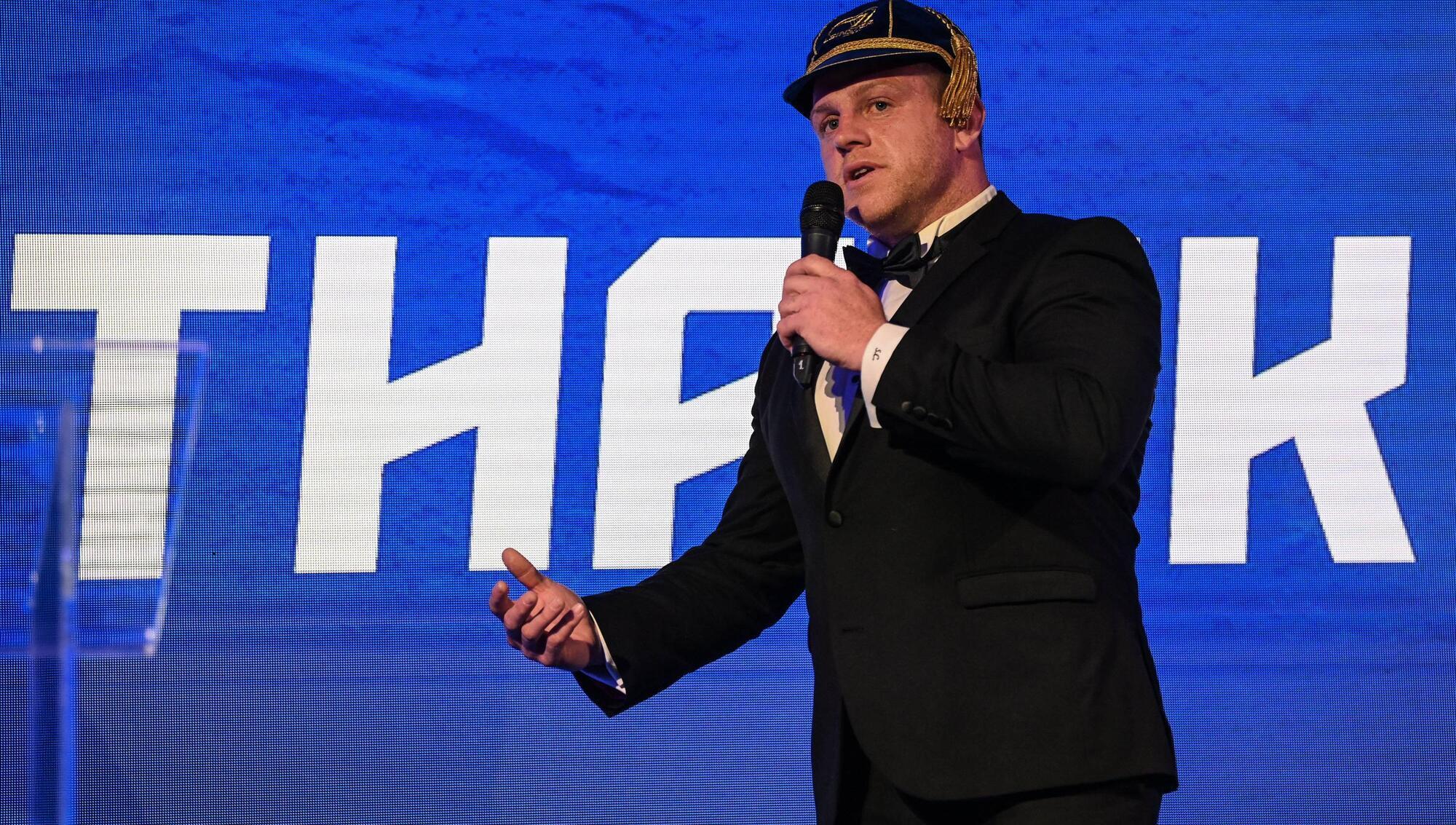
LEARNING ALL THE TIME: Retiree Seán Cronin speaks during the Leinster Rugby Awards Ball. Pic: Harry Murphy/Sportsfile
Careers end at a defined moment, a final whistle here or maybe an injury there, but retirement is a process that needs time and room to breathe.
The change is challenging as new rhythms replace established pillars but some find that the penny can drop in the most abrupt of ways after they’ve picked up that last pay cheque.
Sean Cronin had already cleared his locker at Leinster but was, technically, still under contract for another few weeks when he logged on to the Hudl performance app to download some of the province’s training clips to share with the St Mary’s AIL team he was coaching. Access denied. He had crossed over.
“In terms of being out of the group and out of the system, I don’t know if ruthless is the right word, but it’s very much, ‘that’s it’,” he says.
“I rang up our analyst but the call had been made and the coaches who had left as well, Felipe (Contepomi) and whoever, were the same. It was ‘wow’, that’s it, it’s done’.”
It’s not that he has struggled with this new norm.
Cronin had finished a business degree in Griffith College, sat some QFA (Qualified Financial Advisor) exams and put in a season coaching on the side with St Mary’s before finishing as a player. The choice then was whether to plough on with the financial exams, go teaching, or throw himself into the coaching world.
Only one of them had his heart.
How busy is he? Okay, so he’s head coach with St Mary’s in the AIL and he has been helping the school team out too. Add to that the two mornings a week with the Munster sub-academy, a supporting role with his son’s U6s and the Masters in coaching he is pursuing in the University of Limerick. Yeah, fairly busy.
It hasn’t all been plain sailing. Saturday will find him in Rifle Park in Banbridge with a Mary’s side looking to end a run of five straight defeats in Division 1B. That kicks off 15 minutes after Ireland and Italy get underway at the Stadio Olimpico in Rome but there is no sense of wistfulness or loss.
“Ah look, when I’m watching the games and seeing the lads play so well, yeah, but for me it brings back good memories. I can look on in appreciation at what they were doing and say, ‘gee, you were part of that at one time’.
“It’s more from a coaching viewpoint now in that I’d love to put on the boots with the club and show them what you mean [with the coaching]. I never sit back and look at the pro game and think I’m gutted. That ties into the fact that I had a great run in the professional game and other guys had to retire early through injury, or they weren’t kept on.”
Cronin mentions Dan Leavy by way of example. The flanker was forced into retirement by injury two weeks before he announced his own intention to finish up. By the end he had played over 350 games of top-class rugby for three provinces and his country, won two Heineken Cups, a Challenge Cup, six league titles and three Six Nations titles (including one Grand Slam).
Plenty of old teammates and opponents have made a seamless switch across the white lines of the pro game. Ronan O’Gara, Paul O’Connell, John Fogarty and John Muldoon all get a mention, but a chat with his old childhood friend Paul Kinnerk, coach to the all-conquering Limerick hurlers, persuaded Cronin to take a longer-term view.
Dr Phil Kearney, the course leader in UL, couldn’t have been happier to hear about the spread of teams currently operating under Cronin’s wing and that variety is supplemented in the two-year, part-time course by the presence of three GAA coaches and others drawn from rowing, basketball and athletics.
His own experiences will add their own colour to the collective knowledge bank given he spent 14 years in the pros and crossed paths with a long list of coaches with Munster, Connacht, Leinster and Ireland would fill an A4. A recent assignment made him realise that he has already co-opted ideas and actions from more than a few of them.
Ask him to pick out some of the best and he starts with Joe Schmidt, his boss with both Leinster and Ireland. Schmidt was ruthless, religious on the need for repetition and wedded to the importance of attention to detail. Cronin loved how one simple cue from Schmidt could cover a huge area of operations. Complex, but simple.
He adored how Stuart Lancaster’s training sessions were designed to include everybody, regardless of whether they were a captain or an academy rookie, and he took note of the Englishman’s curiosity about rugby league, American football and how he pushed the envelope on leadership and mindset.
Leo Cullen’s strength was his cultural awareness.
Kinnerk’s work has made it's mark too. Limerick have won four of the five senior All-Irelands since he began coaching them and when Cronin bumped into a few of the team in recent weeks he was taken by their enthusiasm for his old friend and the levels of innovation he was continuing to inject into the project six years on.
“From a player point of view, you want a coach to be coming with different points of view on the game, how you are going to attack something, or defensive systems. That’s where we came unstuck a small bit with Ireland at the 2019 World Cup. The players kind of wanted to develop the game and I suppose you have to admire Joe in a way and that he saw what had got us to that point, but to do it better.
“But the game had changed. That’s just unfortunately where we got a bit unstuck, so innovation is such a massive part of the game as a coach and then adapting to that and helping your players to adapt to that.”
Putting all that theory, experience and practise together is another thing and communication is key to it. He marries that with a concept that he believes is central to his philosophy: tying in personal development with the athlete and the team’s success. In other words, is the player learning life skills through sport?
There was one game where he left three or four players on the bench for the full 80. Cronin had been used as an impact sub far more than he wanted as a player so he knew how they felt. He told them to let things sit for 24 hours and then they could talk it through. Little things, big difference.
Schmidt dropped him more than anyone else but Cronin’s declaration that he finished as a player with a sense of peace and satisfaction is backed up by the admiration he expresses for the Kiwi. A large part of that is down to the painfully high standards Schmidt demanded, standards built on by his successor.
Andy Farrell was appointed Ireland defence coach in 2016 before taking over from the New Zealander three years later - and on the back of that disastrous 2019 campaign. It started slowly for the new boss but, while the doubters were multiplying, Cronin understood that the changeover would take time.
“I’ll never forget actually, we were running a play in Carton House, a set play. I can’t remember who the nine was. It was open to go down the blind (side) but he came back this way and I could see Andy was frustrated. Where is the heads-up? Can we not get the player to…
“So you could see that he wanted to go in that direction and it is just the detail around their play. It is very simple speaking to the (current Ireland) lads. What they are really trying to hammer home is to do the same thing all the time. That might be you being heel to toe with the guy who is carrying the ball so you can animate. And it is every time. Are you doing your job to hold the defender?”
His own animation needs no work. It’s clear when he dips into the detail about a tweak to a tactic with Mary's, or when he insists that all this ground work is just him scratching the surface. He is invested, prepared to give as much of himself as he can without letting it spill over into his family life.
That’s another lesson he learned as a player.
It’s a two-hour drive between his base in Limerick and Mary’s in Rathmines and he fills it by planning sessions, talking to other coaches or senior players, or listening to podcasts on performance or leadership. He might even sit there in silence the odd time, thinking about the roads that lie ahead.
“I would love to transition into some sort of professional setup but I want to build my knowledge and my experience so that I am the best prepared for when I make that jump. It’s a passion I have. I give a lot of time to it, to thinking about the sport. For me, that’s the end game.”
CONNECT WITH US TODAY



Be the first to know the latest news and updates