The Ireland rugby team won't be playing any games at Páirc Uí Chaoimh
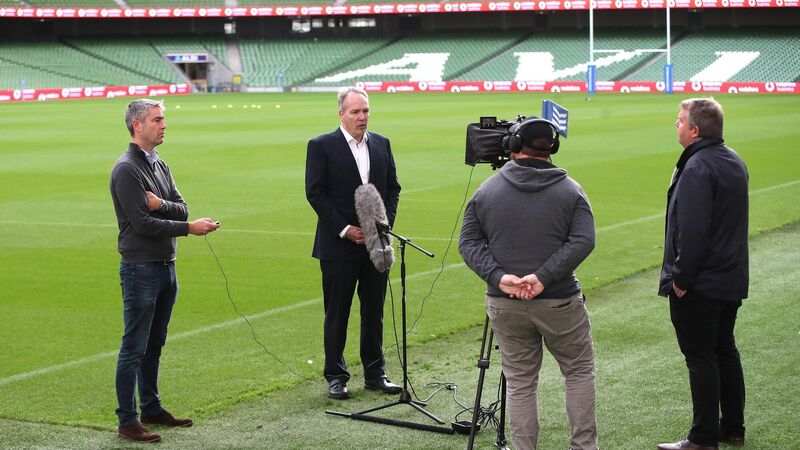
HOME GROUND: IRFU CEO Kevin Potts has confirmed that all Irish games must take place at the Aviva Stadium. Pic: INPHO/Bryan Keane
IRFU chief executive Kevin Potts has confirmed that the Ireland senior team will not play any home games away from the Aviva Stadium after the success of Munster’s Páirc Uí Chaoimh sellout for Thursday night’s visit of a South African Select XV.
Munster’s 28-14 win against the tourists was the cap on a hugely successful experiment for the southern province and one which will surely look to be repeated in the Cork venue with Leinster visits and knockout European ties obvious candidates.
Leinster, whose home ground is the RDS, have found enormous value in swapping their regular digs for the Aviva Stadium since the latter’s redevelopment but Potts explained that mixing things up isn’t an avenue open to the IRFU.
“All Irish internationals will be played here in the Aviva Stadium, which is the home of Irish rugby and of Irish soccer,” he explained on Friday. “The Ireland team must play in the Aviva and all of our various contracts would require that to be so.”
He was, however, perfectly happy to see Munster and others be creative.
“I always enjoy working with the GAA, we have a great relationship with them. Last night's game was absolutely phenomenal. It really is up to the provinces, if Munster wish to play more games at Páirc Uí Chaoimh, that's a matter for them.
“There's no obligation for any provinces to play at the Aviva Stadium, so if Munster wish to do that, or other provinces do something similar, that's up to them.”
Potts was speaking ahead of the IRFU’s AGM and he announced that the union’s finances have “stabilised” after the pandemic period while warning that stiff challenges still lie ahead in the years to come.
The body had budgeted for an expected deficit of €4.9m in the 12 months up to July of this year but it actually recorded a surplus of €5.9m. That compares with a combined loss of almost €47m over the preceding two years.
“Our key message today is that, in relation to the finances of the IRFU following a torrid period due to the impact of Covid 19, the ship has been stabilised,” he explained.
“There is however a cost to this in terms of dilution of the IRFU’s assets, together with a negative impact on our future cash flow, but we have survived and are now endeavouring to rebuild our financial resources to pre Covid levels.”
Potts went into detail on the reasons behind the better-than-expected numbers.
The earlier-than-expected opening of grounds to cater for full attendances at internationals from last November onwards meant that gate receipts could once again begin to flow into the coffers while a government Covid assistance injection of €18m was crucial.
“I want to acknowledge and thank the Government for their critical support during Covid,” Potts explained, “without which rugby, as we know it on this island, would have struggled to survive.”
Also included in the latest figures was the “exceptional item of €44.6m”, which relates to the proceeds received – and to be received across a five-year period – from the deal done between the Six Nations and CVC.
Potts was again keen to highlight the significance of receiving this money at such a difficult time but did warn that the flip side is a permanent reduction by 14% of the IRFU’s future takings from the Six Nations and Autumn Nations Series takings.
The union’s net assets are back to €105m, the same as pre-pandemic levels, and this after a recorded figure of €52m last year, but cash reserves have taken a serious hit with the €66m in the bank roughly two-thirds of what it would have been had Covid not happened.
“The €66 million cash reserves in the bank is made up of significant future earnings including the pre-sale of 10-year tickets,” Potts explained. “The monies paid up front for these tickets have to be honoured over the next decade, together with proceeds from the URC and Six Nations CVC transactions. The sale of these assets will result in a permanent reduction in the IRFU’s share of income from these tournaments into the future.”