New Zealand v Ireland: Big match talking points
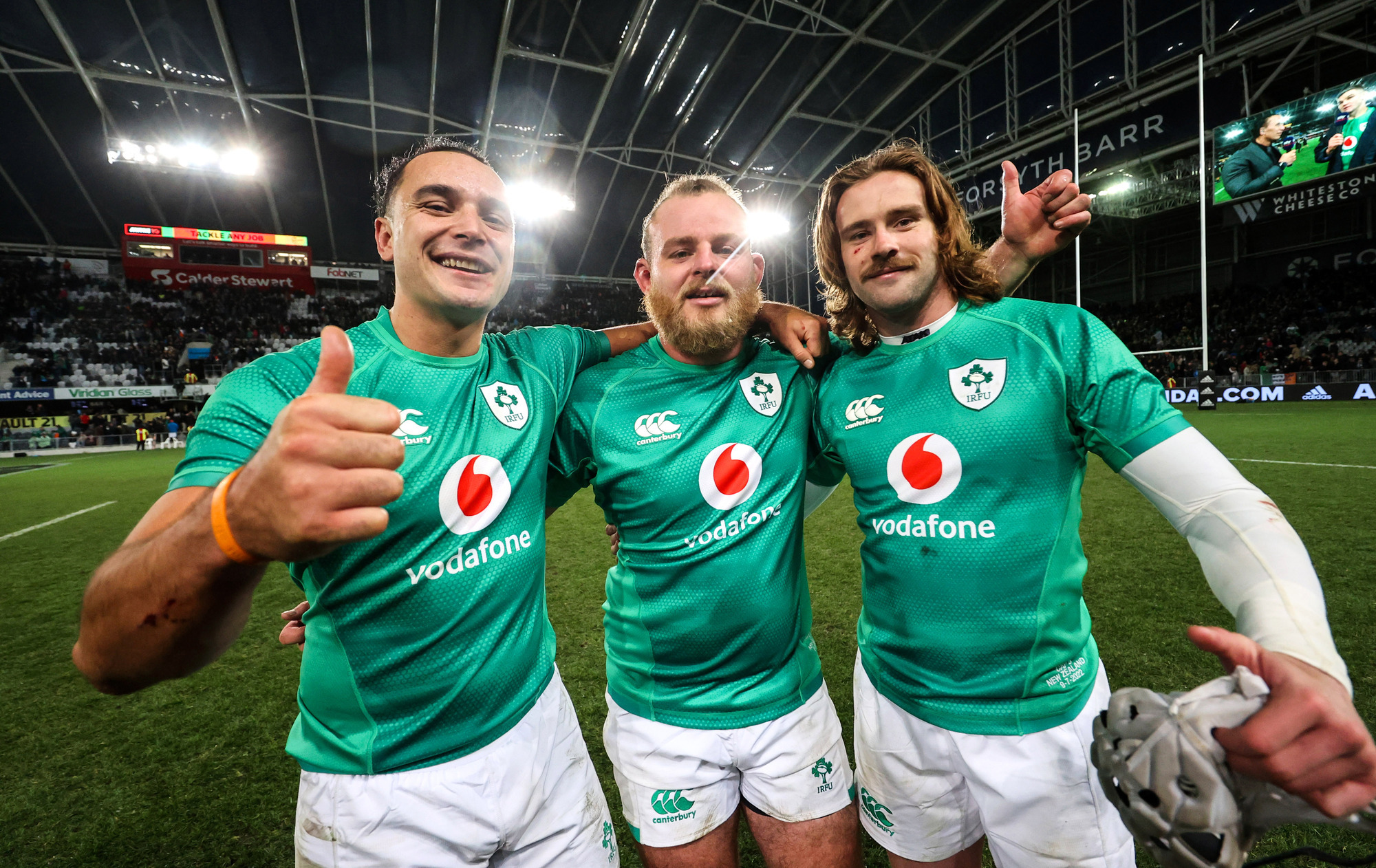
SATURDAY SMILES: Ireland's James Lowe, Finlay Bealham and Mack Hansen celebrate the win over New Zealand.
So the positivity which Andy Farrell exuded immediately after the 42-19 drubbing in Eden Park last weekend was not unfounded. He’s been around the block with enough teams to have seen enough to believe that he could fashion a first ever win on New Zealand soil in 14 attempts.
Hands up, most of us thought he was bigging it up just to keep up morale after a demoralising start to the tour, but that initial positivity from the head coach spread throughout the camp all week, leading to one of the most historic results in Irish sporting history.
It sets it up nicely now for next week’s third and final test in Wellington, but perhaps the real impact of this victory will come in over a year at the World Cup in France.
Ireland have never managed to get past the quarter-finals at the World Cup and with either hosts France or New Zealand set to provide the opposition in the last eight next year, few have been giving them much chance of breaking the glass ceiling in 2023. Until now.
Ireland have now beaten the All Blacks in Chicago, Dublin and New Zealand. Why not in France? And why should they fear hosts France? Certainly the aura of the All Blacks has been well and truly smashed now by Ireland. Four Irish wins in the last seven games against them can’t be ignored.
But winning at the bottom of the world in a Dunedin venue where the All Blacks had never lost a test game carries incalculable value.
All week the debate about who should be at No.10 centred around the possible damage done to the head by numerous collisions on the battlefield in recent years.
In the end, it all proved too much for Boris and he announced he was getting out next October, but Johnny Sexton is determined to last a year longer and go out on a high at the World Cup in France.
Sexton made light of his latest concussion/HIA/head injury/nothingtoseehere by steering the Irish quest for a first ever win on New Zealand in 14 attempts by leading from No.10, belying the fact that he will be 37 on Monday.
Ireland have won 15 of the 19 games in which he has been captain and his ability to make the right calls in the heat of battle is vital in these sort of contests.
Not just the big calls. Things like calling for a scrum after the opposition have a prop binned, thereby forcing them into further change, can have a big impact.
It certainly did in this one when a rattled New Zealand management pulled off Ardie Savea when Angus Ta’avao was sent off, and then realising they could not bring him back on it. All of that mayhem stemmed from Sexton keeping his composure and not just going for the corner.
The chaos on the New Zealand sideline was more akin to what eventually did for the occupant of No.10 in Downing Street this week.
Four cards issued in the opening half and the full outcome of two of them were incorrect, both going against Ireland. No issue about James Ryan’s yellow just before the break. He had been pinged a couple of times in the lineout and they were defending on the backfoot. No issue either about the red card for replacement prop Angus Ta’avao for his sickening head-to-head hit on Garry Ringrose.
But, goodness, how did the other two decisions come down in favour of the All Blacks. Winger Leicester Fainga’anukuk, who made his debut last week, came flying in high to charge down Mack Hansen’s clearance with his arms by his sides at the point of contact.
Yes, the initial contact was on the chest before spreading rapidly to the face and head — Hansen’s cut cheekbone should have told the officials what they needed to see to issue red. Most players — CJ Stander springs to mind — see red for that sort of challenge. Fainga’anukuku got away with yellow.
Then there was the off-the-ball tackle on Ringrose by Ofa Tuungafasi as he was about to take a pass from Sexton with a clear run to the line after both Aaron Smith and Jordie Barrett had taken themselves out of the line of cover in tackling the Irish skipper. All Ringrose needed to do was take pass — there was no way tighthead Tuungafasi was going to catch him, so a penalty try should have been awarded after he was pulled down before the pass was made.
Instead, Ireland opted for the scrum and then butchered the chance.
For all the advances and fancy moves developed by teams in the professional era, rugby remains a game where victory will never be achieved if the pack doesn’t deliver.
Last week Ireland were in trouble in the set-piece, this time round they set the agenda. The front row of Andrew Porter (who doubled his international try haul in this one), Dan Sheehan and Tadhg Furlong dominated with authority and unlike last week the panic was in the opposition front row.
Peter O’Mahony produced one of his finest Irish performances and men like Caelan Doris and Tadhg Beirne, on the periphery last week, delivered the big moments when it mattered, none more so than Doris’ ankle-tap on Jordie Barrett when there was still plenty of time from one of those famous All Black comebacks.
But this was Ireland’s game, a game to savour for the ages.


CONNECT WITH US TODAY



Be the first to know the latest news and updates