After 11 months as a Test coach, Paul O'Connell can't waste a minute
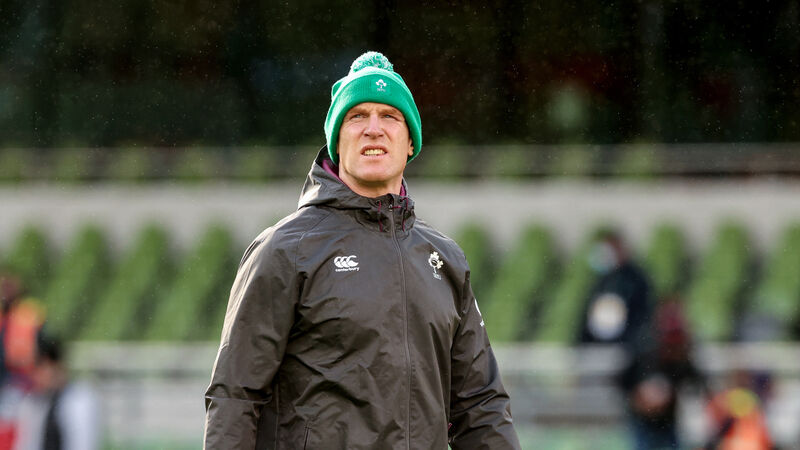
Autumn Nations Series, Aviva Stadium, Dublin 6/11/2021
Time. It’s always more time international coaches want with their players and you can understand why.
Such is the nature of this new season, with the provinces only getting their United Rugby Championship campaigns underway at the end of September and no time for the customary October rounds of European pool games, it was an undercooked group of players received into Ireland camp by Andy Farrell and his assistants 10 days ago.
As a result, the coaches had just four full training sessions together with the squad ahead of last Saturday’s Autumn Nations Series opener with Japan and now the three games in this window are coming thick and fast, there will be only two more before the team heads out against the All Blacks in Dublin this Saturday.
For Paul O’Connell, just 11 months into his first Test coaching role in charge of the Ireland forwards, that represents a significant challenge. The ex-Munster, Ireland and Lions captain may have graced the international stage as a player for 15 years until 2015 and experienced 108 different Test weeks that resulted in Irish selection but the former Stade Francais assistant said the biggest lesson on the other side of the coin as a coach was maximising the precious minutes you get to work with players within that narrow window.
"You don't get a lot of time with the players, you need to be pretty clear in what you want them to do,” O’Connell said. “You need to keep delivering that.
"We change little bits from time to time but players can't keep hearing different messages. They need to have the same messages thrown at them and said in the right way. That's the big thing for us, you get so little time to package it as best as we possibly can for the players, so that when they do come into us they are able to pick it up really quickly.”Â
O’Connell will have unit meetings with his forwards and time within squad field sessions dedicated to the different facets of forward play, but those opportunities cannot be wasted.
"Set-piece, it doesn't matter where you go; it's such an important part of the game for us. Kick-offs, scrums, lineouts. You can be very, very comfortable, competent on your own ball and put the opposition under pressure in those parts of the game then you can deny the opposition access and give your own team access.
"It doesn't matter what level you're playing at. Trying to make sure our ball-winning is good; our scrum, lineout, restart.
"Trying to figure out ways to do that take as little time as possible during the week, so we can work on other things as well.
"Certainly, when I first came into the Irish team the balance of how we trained in terms of set-piece was far too much set-piece and not enough of the other stuff.
"You're trying to make sure you look after that really important part of the game in as little time as possible so that you can keep the players fresh and work on other things.
"The big thing is the time challenge. Club coaching is tough, there's so many games in the year. International rugby, there aren't enough games.
"You'd love something smack bang in the middle, to allow you to put your head up and look around at what's going on in the world and see if there's anything to copy, paste and edit as we do.
"You'd love to be in the grind a little bit more and building. That's the challenge."
As integral to Irish success as an efficient set-piece is, it is the other stuff that is becoming the point of difference for O’Connell’s pack, as evidenced by a dynamic, hi-tempo performance in the 60-5 victory over Japan last Saturday.Â
Every one of Ireland’s forwards looked comfortable on the ball in open-field play, looking to pass the ball out of contact wherever possible and possessing the skills to do so with accuracy. O’Connell believes it bodes well for an exciting future.
"The potential in the forward group that we have is incredible. There's a few players that didn't make the squad that I think have been playing great as well.
"You want competition for places, you want guys knowing that when I come in I have to train and play well if I want to keep my place.
"You want guys just below them saying 'I have to train the house down because when I get my crack I have to perform'. That's great for any forward.
"The emergence of a few young players at the moment, older players looking after their bodies and staying in shape to allow them to keep playing has been great for us. It's an exciting time, training is exciting for us. As a forwards coach, it's hard to pick a starting pack, you've very competitive training sessions.
"Very often, it's the work you do away from us is what will get you picked. You want them in here competing with each other, seeing what the standard is and knowing what they have to do when they go away from us so they come back to us and get picked.
"It's a dynamic pack, big guys, but they also handle the ball incredibly well. They're quick to get off the floor, it's an exciting group to coach and be involved in."
Â