Laurie Fisher on his time at Munster: 'A full house in Thomond Park, there isn’t a better experience'
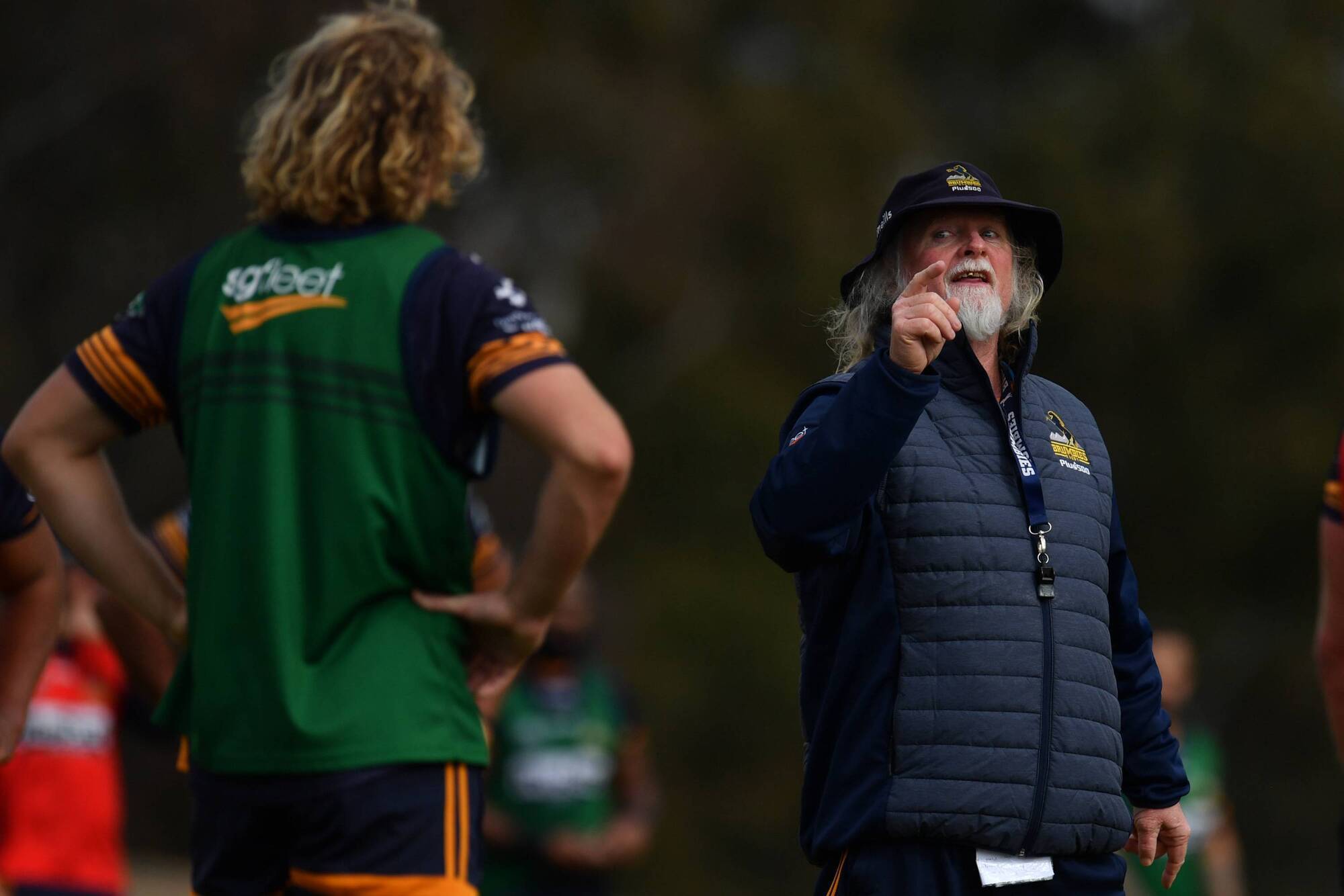
STILL LEARNING: Brumbies assistant coach Laurie Fisher, during a training session in Canberra, says he left Munster ‘a way better coach, thanks to the experience.’
When Laurie Fisher was first approached by Munster, the province was unforgettably frank about the nature of his role. It was a two-year gig, three tops. Mentor and move on.
The Australian was offered the forwards coach position. Part of his brief was to aid Anthony Foley’s education. The vision was clear; Foley would succeed the Australian and later go on to become head coach. They were forthright from the offset, just the way Fisher liked it.
He arrived in 2008 after eight years with the Brumbies. Over the course of three seasons, he was involved in two Celtic League titles and two European semi-final defeats.
“I left a way better coach thanks to the experience. I gave a lot and I got a lot,” he says now from Canberra, where he is currently based once again as a forward coach with the Brumbies.
“You go in with your eyes open. When I first met Garret (Fitzgerald), he said ‘I don’t know how long you will be here.’ They had a vision for Foley to work his way through the ranks. They went on and implemented that which was fantastic. It was ‘you can contribute to his evolution as a coach. That is part of your brief as well.’
“Everyone was up front. Everyone was honest. They wanted to do the best for the team and the community.”
Thanks to the exploits of former Brumbies like John Langford and Jim Williams, the Red Army’s reputation was well established Down Under.
That history, combined with their sustained period of success, meant expectations were sky high. In May, Munster overcame Toulouse to claim their second European crown. In July, a nervous Fisher and his family packed their bags and set sail for Ballincollig.
“As a coach you are always on your toes. I was coming into an environment that had just won a European Cup. Some real icons of the Irish game, the world game. It is hard to find a place to go forward in an environment like that. You want to add value, but you think ‘where do I do that? What can I change in a team that has 14, 15 internationals and just won a Heineken Cup?’”
Perhaps it was inevitable such a talented group would produce so many successful coaches. Denis Leamy, Felix Jones, Jerry Flannery, Ronan O’Gara and Paul O’Connell are all currently at work. It is something Fisher saw coming.
“There were clear indications. Their game understanding, love of detail. The work they are prepared to do on computers and willingness to help other players. Not every player has that.
“Paul had a wonderful eye, particularly around set-piece. He also had a thirst for knowledge. He sat down and had long conversations, always wanting to know more.”
The 62-year old’s last campaign in Ireland climaxed with a Magners League final win over Leinster though a cloud loomed in the form of European disappointment.
Fisher still lives and breathes the game. Over the course of our conversation, he chats knowledgeably on everything from the impact of pay-per-view to the role coaches play in concussion prevention.
This can be traced back to his original profession, teaching. Now he studies every aspect of the sport. Often he reflects on that three-year tenure in Ireland. A severe feeling still protrudes.
“Unfulfilled. I get the feeling… I was disappointed mate.
“I am disappointed we didn’t take the extra step. I enjoyed my time, learned plenty. I still stay in touch with loads of them. I just think we let some opportunities go. That injury to Tomas O’Leary, he was playing the best rugby he ever played but broke his leg the week before that semi-final against Leinster at Croke Park. That was a massive blow.
“Then later Paul was out injured and missed that semi-final against Biarritz.
“Sometimes it can change on a pin.”
Nevertheless, criticism was inevitable. Every coach will face it at some point. For Fisher, there is a big difference between honesty and negativity. He stresses the Thomond Park faithful found a balance. If ever a fanbase earned the right to react, it was them.
“It is easy to complain, it is easy to bang the keyboard. ‘We need this, we need that.’ There was a lot going on. A lot went on behind the scenes around who you could select, who you couldn’t select. Who you had to rest. There is a lot of moving parts to it. What I love about Munster is their supporters vote with their feet. They well and truly deserve to have opinions.
Which brings us on to lessons. For Fisher, it is that parochial bond that binds the club. He was lucky to be surrounded by players and coaches born and reared in red. That is crucial, he maintains.
“I really think it is important to have indigenous coaches in Munster or Ireland. I’m not saying it has to be a head coach, but particularly provinces.
“It is more than nuts and bolts of a game. It is about emotions, passion, the parish you represent. I understand what Munster is about but someone who is born and raised, lived and breathes it from cradle to grave, that is a real in-depth understanding that is so important.
“That extends to players. I think if you are truly from the area, you represent your family, parish, community, province. That cuts deeper. Those are your roots. I’m not saying foreign players do not give their all, but something roots you deeply if you are from the area.
“Nowadays, the difference between teams isn’t massive. Conditioning, thinking, it is fine margins. What is your point of difference?
“At the forefront of Munster minds is who they represent. I remember Paul would be nervous about not putting on a performance for the people of Munster. A performance people could be proud of.
“That was the heart and soul of it.”


CONNECT WITH US TODAY



Be the first to know the latest news and updates