New research is moving the goalposts with groin injuries
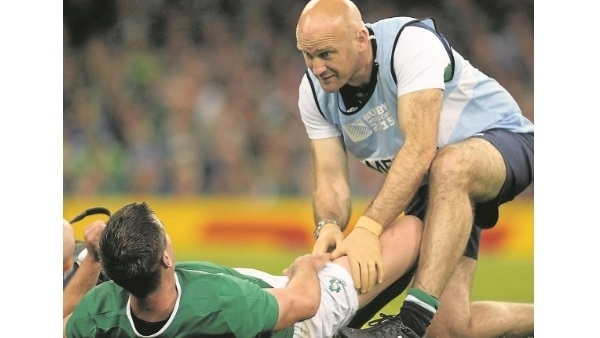
New research from the Sports Surgery Clinic in Santry backs a seismic shift in rehab strategies for hip and groin pain, writes
While traditional approaches focus on anatomy, the use of 3D biomechanical analysis of how athletes move has proven extremely effective in the treatment of groin pain and may yet prove a key factor in the prevention of the high prevalence of athletic hip and groin pain in Ireland.
The Sports Medicine Department at SSC sees over 700 patients with groin pain per year, and a new research paper from its head of performance, Enda King, shows a return to sport rate which is 50% faster than any published study to date.
“We’ve lots of hip and groin pain from sports in Ireland,” says King.
That’s due to a combination of the sports we play, predominantly change of direction sports such as GAA, rugby, and soccer — as well as high or inappropriate training loads, commonly throughadolescence into the elite level.
“These are all so-called ‘external factors’ which have become a real focus over the last few years. Research from the Netherlands has shown that high training load in the adolescent years results in altered hip morphology or shape.
“It’s been shown that the efficiency of our movements on the field, how well or how badly we move, adds to this overload seen through the hip and groin. I’ve been working for a long time in this area in the clinic, with Dr Eanna Falvey (Director of Sports Medicine).”
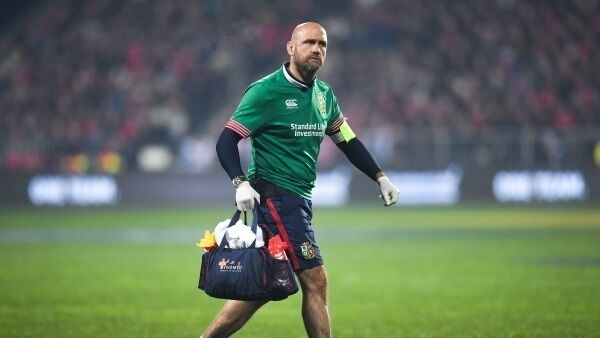
King, a former Cavan footballer, had personal experience in this area: “I had my own hip and groin trouble as a footballer — this greatly curtailed what I was able to do already.
“I always had an interest in the area, I had groin and hip surgery but never regained full function. Due to the volume of hip and groin injuries we would see at SSC, when I got back from doing my masters in Perth, Australia I quickly got my teeth into this area.
“I noticed there was this consistent theme of athletes looking for a surgery or injection to ‘fix’ the pain rather than focusing on the movements that were driving their symptoms.
“What you often find with these guys, they’re sore in three or four different areas.
The question then is are you unlucky enough to have three or four different problems or is it one problem with different symptoms developing across the groin and the hip at the same time?
Finding the root cause of groin pain is the key, King adds: “It’s quite a debilitating injury in that a lot of athletes play on with groin pain — they’re not out injured but they’re not able to perform, and they’re taking anti-inflammatories or taking time out between games, so it’s having a massive influence on their ability to perform and on the team as a whole.
“Time and again you would see athletes advised to take six months’ rest for groin or pubic pain, only for their symptoms to return as soon as they went back to sport as they hadn’t targeted the movements causing their symptoms.”
King points out that the athlete’s inclination to get surgery isn’t surprising: “You want someone to make it better rather than having to do something to make it better.
“We all want that — ‘can you inject it and take it away?’, or ‘can you cut it and make it better?’
“This is particularly the case in hip-related groin pain, where there’s been a huge spike in surgical intervention over the past number of years without necessarily any improvement in outcomes.
“We’re finally getting some quality international research around hip surgery in particular, and while it has a role, rehabilitation is the recommended first step for groin pain.
“Similarly, there is no evidence to date to support that hip surgery can prevent arthritis in the long term — a commonly pedalled misconception.”
The basics of movement are another key area, he says.
“Clinically we put a heavy focus on how athletes move as a method of understanding and rehabilitating hip and groin issues, and with our colleague Dr Andy Franklyn Miller (Director of Rehabilitation and Research) over the last five years we have focused on using 3D biomechanical analysis to identify the best way of managing one of the most debilitating injuries in Irish sport.
We’ve published extensively in the British Journal of Sports Medicine (BJSM) and our most recent study outlining our rehabilitation of these athletes focusing on their movement and control reported not only the fastest recovery time, but that it doesn’t really matter where the pain is coming from, only that you address why you’re getting sore.
“We’ve focused on an evidence-based approach to this problem, trying to be scientific and remove the emotion from the problem.
“Athletes with groin pain for months on end will do anything to get better — I know personally how that feels — and there’s a lot of scaremongering out there right now, much of which is not evidence-based at all.
Delighted to have our latest paper @sscsportsmed on the rehabilitation of Athletic Groin Pain published open access in this months edition of the @BJSM_BMJ https://t.co/n8Q6viV18m pic.twitter.com/Yz0BYryghP
— Enda King PhD (@enda_king) July 31, 2018
“The fact that our work has been consistently published in prestigious journal like the BJSM speaks for the quality of our work.”
Significantly, King differentiates between training and changes in training load, which can lead to issues.
“The training load exposes the problem, so if you’re not playing sport you don’t get groin pain. It’s not always the total amount of training, it’s the spikes in training, the changes.
“Frequently athletes going back into pre-season or have a big spike in training, there’s a lot of groin pain; lads going from minor or U20 to senior — big jump in training and there’s a lot of groin pain.
“January and February are great months for groin pain because students are trying to fit in pre-season competitions, U20, third level competitions, club league games... that overload is giving players a lot of injuries not just at the groin, though there are loads of players who do that and don’t get groin pain.
“But if you’re moving in a certain way that overloads the groin and then you put that load on top of it, you’ve nowhere to hide.”
Does that mean basic running mechanics can sometimes be an issue?
“Running is a skill, a movement skill,” says King. “Change of direction is a skill, and if you practise you’ll improve.
Every Gaelic football centre-back doesn’t need to be able to run like Usain Bolt, but if you can implement even moderate changes in running mechanics, that will be enough to reduce the overload on his hip and groin but also improve his athletic performance.
“It’s about making some small changes that will take the extra load away from the hip and groin and move it to bigger muscles like the glutes and quads, the muscles meant to be doing that work. We see a lot of elite athletes from across a range of sports and it’s surprising how many you need to go back to the fundamentals with, to almost wipe the hard drive and build back up again.
“You want to develop strength and power, but the underpinning good movement quality is what will make you a better athlete — and a healthier athlete over the long term.”
All of that means a move away from a general fitness programme to a bespoke approach for the athlete.
“We’re moving away from a groin programme, a hamstring programme, an ACL programme to a sense of what an individual athlete needs.
“The groin and hip research suggests trying to look at the anatomy or the source of pain to solve the problem isn’t working.
If you and I had the same pain that doesn’t mean we have it for the same reason, and the rehab programme that worked for you mightn’t work for me, or you might be very compliant with the programme and I might be scratching my backside instead of doing it.
“It’s essential that we individualise the rehabilitation according to how the individual athlete moves, not where his pain is coming from.”
This, says King, is one of the key takeaways — the interplay of anatomy, biomechanics and spikes in training load in causing groin pain: “We now know that training load and poor movement patterns are the main causes of some of the hip problems we are seeing in athletes.
“But it’s important in the adolescent years, this is where we need to intervene to prevent the problem.”
If we’re talking about players needing surgery for hip problems, then, have we missed the point?
“Completely. It’s multi-factorial, if you move more efficiently, but you have massive spikes in training load, you’re very susceptible to injury and groin pain.
“If you move less efficiently but your training load is very graduated you’ll get away with a lot of that.
“It’s not about being perfect, it’s about giving yourself room for error, because the more room you have for error the better chance you have of staying healthy and performing to the best of your ability.”
CONNECT WITH US TODAY



Be the first to know the latest news and updates