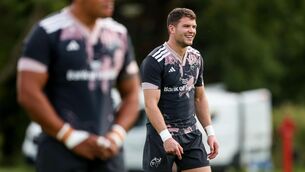
Munster rocked by Wallace illness
Munster have been dealt a major blow ahead of tomorrow’s Heineken Cup semi-final showdown with English champions Wasps.
Flanker David Wallace has withdrawn from the Munster line-up on medical advice after being laid low by a bout of chicken pox.
It was hoped he would recover in time, but the 27-year-old Irish international’s condition worsened overnight.
The experienced Wallace, who has made more than 30 Heineken Cup appearances, is likely to be replaced by Eddie Halvey or Ireland Under-21 prospect Stephen Keogh.
Wasps, meanwhile, arrived in Dublin yesterday, reporting no late injury worries and ready for everything Munster can throw at them.
Lansdowne Road will be packed to its 48,000 capacity – a Heineken Cup semi-final record attendance – for Wasps’ biggest game since the club was formed 137 years ago.
“We are all very excited,” said Wasps and England captain Lawrence Dallaglio. “We deserve to be in the semi-finals because we’ve worked so hard to get there.
“There are not many semi-finals in any sport played in front of a 48,000 crowd, so this is going to be special.
“But we are all ready for the challenge, and we know what we’re up against. It’s going to be a fantastic test, playing in Dublin.”
Just over a year ago, Dallaglio was part of an England team that secured the RBS 6 Nations title and Grand Slam by smashing Ireland 42-6 at Lansdowne Road, but the Irish avenged that defeat by ending England’s long unbeaten Twickenham run last month.
But even though there are more than a dozen players involved tomorrow who were on World Cup duty in Australia last autumn, Dallaglio has dismissed the international angle.
“This game is about Wasps, not England,” he added. “It’s a special day for Wasps supporters who have managed to get tickets.
“Ireland deserved to beat us in the Six Nations, but now we are looking forward to a different occasion.”
Munster will contest their fifth successive Heineken semi-final – the record reads won two, lost two – while Wasps have already eclipsed previous best performances of quarter-final appearances in 1998 and 2000.
Although European experience heavily favours Munster, Wasps have moved effortlessly into top form, highlighted by resounding victories over Perpignan (34-6) and Gloucester (34-3) on their last two Heineken Cup outings.
“Look at our forwards – we have five players in their 30s, and I am happy that we have enough experience to compete,” said Wasps rugby director Warren Gatland. “We’ve enough experience to handle whatever materialises on Sunday.
“We were delighted when we beat Gloucester in the quarter-finals, because playing at a packed Lansdowne Road where most of the fans will be supporting Munster is something we will relish.
“It was a daunting task going to Perpignan, but we came through that well. There is no trepidation among the players over the task facing us – it is a massive challenge, and the team will respond to it.
“If we play to our potential, then we can beat Munster, and that is what we are setting out to do. They are the heart and soul of the Ireland side, so we are familiar with them,” he added.
“We know their strengths and weaknesses, and we will look to exploit them.”
Gatland, who was sacked as Ireland coach in November, 2001, will undoubtedly afford himself a brief smile of satisfaction if Wasps come up trumps.
Dallaglio added: “This is the biggest match in the club’s history, there is no doubt about that. If we win, we reach the final, so the potential of that occasion makes tomorrow enormous.”
Wasps will relish the physical intensity of tomorrow’s forward battle, and Munster won’t have faced anything like it on their European or Celtic League travels this term.
Where they could have an edge is the lineout, given that ball-winning colossus Paul O’Connell stands head and shoulders above any other lock in northern hemisphere rugby.
If Wasps, though, can gain parity in that department then a first Heineken Cup final appearance – against Toulouse or Biarritz at Twickenham on May 23 - beckons.
“Every team’s lineout is a possible weakness,” Dallaglio said. “A good lineout can turn into a bad one very quickly.
“If your lineout is going well, then it guarantees possession and allows you to start playing the game you want to. If it doesn’t work, then you must find ways around it.
“We’ve been to Perpignan and Bath this year and had good days at the lineout - we won both games with a bit to spare – so we are confident in our set-piece. It’s a key area of confrontation, and we are ready.”