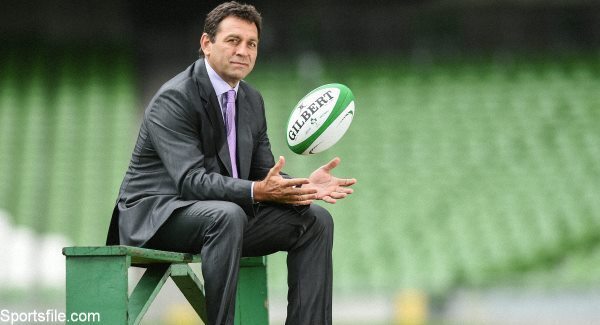
IRFU performance director David Nucifora: ‘Players first’ approach key to retaining talent
Irish rugby’s big names will always be the subject of interest from overseas clubs, with the money being offered to play in the English Premiership or French Top14 usually beyond the payscale Ireland’s provinces or their paymasters at the IRFU can compete with.
IRFU performance director David Nucifora is the ringmaster trying to keep all his stars out of English and French clutches and the Australian understands that retaining players on this island is a question of offering incentives other than just money.
The governing body’s player welfare programme, which regulates workloads and game time over the course of a season, is at the heart of those retention objectives and Nucifora is hopeful that cornerstone can help persuade most, if not all, Ireland’s frontline stars to commit their short to mid-term futures to their current employers.
This season, midway through a World Cup cycle, will see a number of stars’ contracts up for negotiation, Zebo included. Also understood to be ending their current deals next June include Ireland captain Rory Best and fellow British & Irish Lions Rob Kearney, Iain Henderson, Peter O’Mahony, Jared Payne, and CJ Stander. There may be other big-name players on that list but either way it adds up to a busy period of talks for Nucifora, who conducts all player negotiations.
Having implemented a number of programmes that buttress the IRFU’s player welfare programme as well as complement it, such as the Irish-qualified talent identification programme in Britain and beyond known as IQ, Nucifora this week sounded a confident note that deals will be done to keep the majority of those players in Ireland, augmented by strong development pathways that increase strength in depth in the provinces.
“A lot of them will be (retained),” Nucifora said during a media briefing at Aviva Stadium this week.

“Hopefully we can continue to maintain our high retention rates. We’re realistic. We know we won’t always retain everyone. People have different motivators as to why they might be looking for a change or to leave and you can’t always manage those things. But to the best of our ability, we make sure that the players are the centre of what we do and are very well looked after, so when decisions are to be made around where they want to play their rugby, we’re investing a lot of money into making sure that they’re very well catered for, that they can be the best that they can be and they can play the game for as long as they possibly can at the highest level.”
The IRFU is undertaking an ongoing tailoring of its player welfare programme and broadening its reach beyond the Test players.
“We’re really trying to expand this system down, that we’re trying to manage guys right through,” Nucifora said. “That’s because a lot of the time it’s the management you do at the front end with the young guys that has the greatest point of difference later on.
“If we let them get beaten up and busted now, then they’re probably always going to be beaten up and busted right through their career. The other part of that is opportunity. Players are looking for opportunity. Guys who are looking to re-sign, you know, asking ‘where do I fit? Where do I sit?’
Those questions of opportunity are being asked by professional players all over the world and the current disquiet among England’s finest over the pressures they are put under to play more and more rugby offers Nucifora and the IRFU what they believe are the best possible arguments in persuading their players to stay put and sign new deals.
Nucifora’s media briefing came a day after Saracens and England No.8 Billy Vunipola was facing up to another four months on the sidelines after succumbing to yet another injury in the notoriously attritional English Premiership.
Amid noises in England that a players’ strike is on the cards unless the issue of longer seasons was addressed, Vunipola said he would take a pay cut to play less rugby and spoke of his fear that players were at risk of burning out.
“We owe Billy a cheque in the mail, I think!” Nucifora joked.
“Our best weapon to the greater amounts of money that exist in the UK and France is the welfare system. The players won’t come out and tell you that but I know when we sit down to negotiate contracts that it is at the forefront of their mind.
“They know we care about them. They know we manage them really well and investment is for all parties, primarily them. That makes a difference for us to be able to compete with the bigger cheque books. For us, our investment is extremely important. For, that’s money really well spent because it does have an outcome for us in that area.
“There’s some fairly high-profile guys across in the UK at the moment, voicing their opinion around what they think and those players with those sorts of comments only endorse what we’re doing here, and how important it is for us to make sure that we keep investing in this particular area.”

IRFU’s latest player welfare developments
Previously the four provinces did their own thing concerning the recording of training and match loads. Now the IRFU has a centrally coordinated programme monitoring all 180 Irish professionals and 88 academy players through a unified GPS system.
“Every professional rugby player in Ireland is being tracked through the same system and we’re able now to learn a lot more around how much they’re doing, how intense it is, how often and ultimately that makes us make better decisions about the players,” Nucifora said.
“Having the hardware wouldn’t be any use if we didn’t have people to actually interpret it,” Nucifora said.
“That person is working very carefully with the provinces, out about making sure that the system works, is standardised and giving us the information that we want.”
Recently appointed and soon to be announced, the role will oversee and coordinate the IRFU’s physio and rehab programmes nationally, similar to GPS programme.
“We’re looking to prevent injury as much as possible,” said Nucifora, “and also to upskill our physiotherapy staff to make sure we’ve got the best programmes running and best practice is being delivered right up through from our underage teams to the national team.”