Munster’s emotional road back to Paris
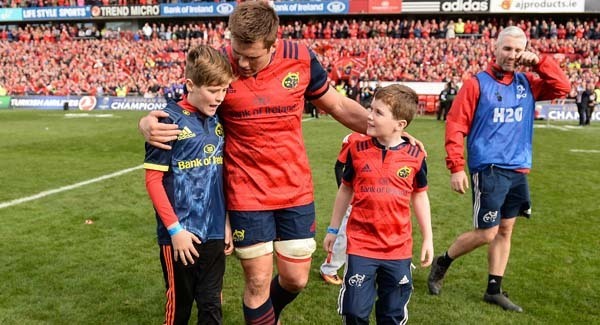
Here, four people with close connections to Axel, and the game, reflect on the last few months since the Clare man’s untimely death, and trace a selection of moments from that fateful autumn day in Paris to the return of the Red Army to the French capital for the European Cup refixture.
I was at home when I heard the news. I’d just come in from Shannon underage training where I help out with the U13s. My young fella, Aaron, is involved. I got a call from Ger Mulcahy, a club member. ‘Foley has died in Paris,’ he said. My initial thought and reaction - and sad as it was – THAT Ger meant Brendan, Anthony’s father. I said, ‘Jesus! Brendan. I’d only spoken to him a couple of weeks ago’. I was in shock. Ger then said, ‘It’s Anthony, Andrew’. ‘It couldn’t be, Ger,’ I replied.
When I got out of the taxi I started talking to Len Dineen from Limerick 95FM. Everybody was just in shock really. The story going around was Anthony had passed away that morning but there was no official confirmation. Rumours were circulating, nobody was prepared to say anything; you were hoping and praying it wasn’t true. In the past there’d always be rumours on the morning of rugby match regarding injuries to players but this was different to the norm. I’d say within 15 minutes the statement was released by the IRFU. There was complete sense of shock and horror amongst Munster supporters. They were standing around bewildered.
I was in Killarney covering the Kerry football final. I remember getting a text about it. It was quite a shock. I wasn’t close personally to him but it was still quite a shock as he was pretty much the same age as me.
We were making our way to the Racing ground on the Munster Travel coach. We thought the game was still going ahead. We hadn’t heard anything about the death of Anthony Foley. When we were lining up to get our press accreditation, I got a phone call from Limerick to say that Anthony Foley had died during the night. The hair stood up on the back of my neck.
Declan Kidney’s wife, Anne, was laid to rest on the Friday before the match. I saw Anthony at the funeral. I didn’t get a chance to speak to him, but we caught each other’s eye and we just nodded from a distance. That was the last time I saw him.
He was in his Munster ‘number ones’. It did hit me how well he was looking. He had lost weight. Someone had said he was back doing a bit of training. I think what made it even more surreal was that he was with Brendan, his father, at the funeral. We were 20, maybe 30 yards away from each other. But to go from that to what happened 48 hours later was just surreal really.
I was on the same flight to Paris as the team. The last time I spoke to Anthony was when he was waiting to take his luggage off the carousel in Charles de Gaulle airport. I just said, ‘All the best in the game, Anthony’ and he just looked at me and said, ‘Thanks Len’. Those were the last few words we had.
Three weeks earlier, Anthony was at the clubhouse at Thomond Park to help Shannon promote Barnardos being emblazoned across the senior jerseys. That was the last time I spoke to Anthony. It was probably the same for many people in and around the club. He probably wouldn’t have been around his club as much as he would have wanted to be or liked to be. He was in a very demanding job. We used to see him at (Shannon) matches every now and again keeping an eye on players.
The press room at the Stade de Colombes was right next door to the entrance. We heard this round of applause and that’s when we heard the singing – the supporters were singing ‘The Fields of Athenry’ followed by ‘There is an Isle’. Soon after that I was doing a piece with Sky Sports.
As I was standing preparing to do the piece on the track around the Stade de Colombes, Racing’s owner, Jacky Lorenzetti - who I sat next to the night of Ronan O’Gara’s testimonial in Cork - saw me. He came over, I put the microphone aside and he just hugged me, nodded and just walked away. He sensed immediately just how central Anthony Foley was to the Munster story, to everything that is Munster. And that moment for me just captured that Racing had ‘got it’; they understood the significance of the moment.
When Anthony was Munster Director of Rugby, I used to meet him every week at press conferences out in UL. Then Rassie Erasmus took over and took over the press conferences also. A few weeks before he died, Anthony came down to us as Rassie was unable to attend it and I asked Anthony, ‘do you miss the press conferences?’ He looked at me and I knew he was ball-hopping when he said, ‘The only thing I miss is the weekly cup of coffee with you, Len!’. On the outside, Anthony could sometimes be a bit grumpy. Until you get to know him, he had a hard exterior. Inside that, he was quite a soft man. Once he gained your trust, then you were ok. Antony’s Foley’s office in UL is right alongside Rassie Erasmus’ office. They have yet to go into Anthony’s office since his death.
All of sudden you say to yourself, ‘alright, in terms of the club’s professional approach to things, this is going to be a big story, so Katie McCloskey, our current PRO, and I thought to myself that she may need a hand out here. Obviously, there would be a lot of media attention, people would need interviews, so we sort of put the wheels in motion fairly quickly.
In Shannon we’ve dealt with big funerals in the club, for example Colm Tucker. Sadly Colm passed away too early. That was a big funeral. But I said to people, ‘this is going to be bigger’ because people have a tangible grasp of Anthony as a player and coach – people felt they knew him.
The stream of people was a constant presence in our club all week. It was open at 10 in the morning until late at night. People were coming in to sign the books of condolence and to look at photographs.
When covering funerals there would generally be a bit of liaison between the gardaí and the photographers who are there because they (gardaí) would liaise with the family. Some of the people who were involved like Keith Wood and others were understanding in that they knew the media had a job to do but you didn’t want to intrude either.
In Killaloe, there was a section they decided to put the media in, far enough away so as not to intrude too much. It was close enough so you could do your job properly. I’d gone to the removal the night before in a personal capacity. I’d have known the players who were playing around that time as well and pay my respects to a guy who I thought was a brilliant player.
I was at the funeral Mass with my son, David. I met Alan Gaffney, the former Munster coach who came all the way from Australia. John Langford also came. I’ll never forget the funeral mass and Olive, Anthony’s wife, standing up before a packed congregation and speaking. Olive showed great spirit. I thought she showed Anthony’s spirit. Olive appears to be a very religious person and that has stood to her obviously. It must have been a terrible Christmas for the Foley family.
The Mass was very moving. The Leinster players came down and they took their place underneath the coffin on the way to the graveyard which was about 800 yards from the church itself. Olive herself sang ‘There is an Isle’. There wasn’t a dry eye in the place and Paul O’Connell and Anthony’s teammates took it in turns to shovel earth onto the coffin… it was heart- rending.
Photographers and the media would never feel comfortable covering funerals because there’s something that’s real life, not something that’s staged. There was a thing where we didn’t photograph the kids on the day. We covered it to an extent, as a matter of fact, but we wouldn’t be intruding on the family. On a human level you just can’t.
I was at the funeral on the Friday. I remember just thinking, ‘how in the name of God can these players who were all there in the church in Killaloe – I was sitting behind them - how can they get their heads around playing a match?’
We wanted to do something with our underage to pay tribute and, in fairness to Munster Rugby they said you can have as many tickets as we liked for the match. So we organised that 300 kids go to the match. We had our own corner in Thomond Park, we had flags and we wanted to create some kind of a tribute through the underage. One of the clubmen, who has a textile printing company in Limerick, very kindly organised to have the No 8 printed on all the underage jerseys the kids were wearing.
For about three hours that morning, myself and a few other members were outside the back of our clubhouse printing No 8 on hundreds of jerseys.
On a day like that it’s not necessarily about the match. It was a difficult thing for Munster to do, to play the day after the funeral.
We had heard before the game that the West Stand was going to have a mural; that all the fans would each hold up a card displaying the name ‘Axel’. Myself and my colleague, Diarmuid Greene, figured that this was going to be the picture of the day and spoke about how we were going to execute that. Diarmuid went up into the East Stand and tried to do an overall view of the whole ground, the minute’s silence, the two teams and enormity of it.
Thomond Park had lost a bit of its aura. The old traditional Thomond Park had begun to slip in the last number of years even on the big days. Heineken Cup or Champions Cup days just weren’t carrying the same buzz around them.
Because I was doing the match on radio I had to be in my seat. I’m normally in the commentary seat early because I like to watch the warm-up of games. I’d say I was sitting down 35-40 minutes before the game. It was different. People were in their seats whereas normally they’re filtering into their seats. The team did that half-lap on their way back into the dressing room before coming out for the kick-off and the whole place just erupted It went from there really; an incredible match.
I positioned myself on the touchline trying to get a picture of the team lined up with ‘Axel’ above their heads. Sixty seconds seems like a short amount of time when you have a minute’s silence. You’re trying not to make too much noise; you’re trying to blend in with the background and not create too much fuss. Once I got my picture of the two teams lined up I switched to a long lens and got a few pictures of the players.
You’re shooting and it was just a case of watching to see if any player would react. Players generally don’t always react. They stand there, they have a job to do, they’re thinking about the person and thinking about how they can honour them, that they’re not going to lose the game. He was, after all, their head coach. It was only as the match was kicking off and I was editing pictures that I spotted a tear in Simon Zebo’s eye. It was an unexpected picture.
The planting of the Shannon flag on the ‘22’ was one of my abiding memories. Jerry Flannery planted it.
We were all down in the corner of Thomond in the Ballynanty End and after the match the Munster players came around to thank the fans. The kids were delighted of course to meet the likes of Donnacha Ryan up close. A couple of our club players came over and a couple of the flags were handed over. Jerry came over. He took one of the flags and planted it on the ‘22’. And it just struck me then… Alone it Stands... because that’s part of our club anthem, ‘There is an Isle’. And we got thinking, ‘how many times did Anthony score in that corner for Shannon, for Munster?’
I think Ian Keatley picked up a Shannon flag and he started waving it. Ian Keatley is associated with Young Munster so there you had a young Munster man waving a Shannon flag, a moment that stood out in my mind. I didn’t see the flag being placed. I just thought it was apt. Anthony was brought up in the Shannon tradition and was always very much a huge Shannon man.
It was probably one of the few times when real life crosses into sport. Munster were probably never going to lose the game. They won it easy. On another day the talking point might have been Keith Earls or the fact the victory was huge.
The win against Glasgow was just raw emotion. I was commentating on the match alongside my son Len Jnr. It was a surreal atmosphere. We had to bite our lips a number of times. It was like pageantry really. It was just a total surreal atmosphere. To see the way the players responded, the way they played. The fans were the famous 16th Man. It was like days of old. Since Anthony’s passing there have been sold out signs a number of times.
I would have been aware that on the big days you win, in the sanctuary of the dressing room everyone comes together – the team, the management, and they do a verse of ‘Stand up and Fight’, standing the ground in rhythm. Particularly a game of that magnitude. So to come out and do it on the pitch I thought it was significant, the whole of the Munster family coming together.
The Munster crowd were, I think, emotionally attached to the game from way before the kick-off. This was like the ultimate unification of the team and the support. I think it was an acknowledgement of the significance of the day happening within 24 hours of the funeral. It was one of those in sport that will live with you forever.
The circle was done because they felt at one with the fans. It was like a prayer for Anthony.
The day after the Glasgow match we were having a training session out in Coonagh with our underage. What we decided to do is was that instead of having a minute’s silence beforehand, halfway through the training session at 10:30 or 10:45 we stopped everything. Everyone gathered up in the main pitch, 200-300 kids all linking arms, flags in the centre and we had a lovely minute there for Anthony as well.
Life goes on no matter what you want to do. The team harnessed it. It would be an amazing story if they went on to win the trophy. And it’s a possibility.
Maybe at the back of their minds all the time is that they are playing for a man who gave them so much and invested in them so much so it’s their way of paying back in constantly remembering him. I think the mental fortitude of this team has been exceptional. Munster never needed galvanising in the past but, if anything, unfortunate events have seemto give these guys something extra special.
To be fair to Munster they’ve embraced everything that’s happened right from the day Anthony died. They haven’t avoided anything. They just embraced what has happened. To be fair they’re not saying, ‘we go out and we play for Anthony’. I’ve been incredibly impressed with the way Erasmus has handled this whole thing.
I think they’re hugely cognisant of the role Anthony was involved with the vast majority of those players from a young age. So many of those players have come through the Munster Academy – and he had a lot of them on U20 sides so he would have been hands-on with many of those players. Every challenge that they have taken on since that day, they’ve done it with huge maturity and with a huge amount of dignity.
I know for this match in Paris a number of the fans are going over and a lovely gesture I thought from the Racing supporters is that they’re putting up the Muster supporters free of charge. It’s a magnificent gesture of rugby people to rugby people.


CONNECT WITH US TODAY



Be the first to know the latest news and updates