Donal Canniffe: ‘A huge win and a huge loss. I can’t separate them’
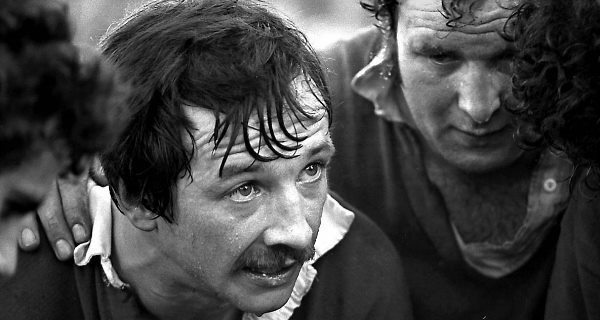
Donal Canniffe, half time, Thomond Park, October 31, 1978
It no longer stands alone. And neither does he. For 38 years, Donal Canniffe held the distinction of being the only Irishman to captain a senior team to beat the All Blacks. It was he who led them out that day, a day that’s been immortalised in song, books, documentaries and even a brilliant stage play; a day, that even if there had been no songs, books or even victory, he could never have forgotten anyway.
He wasn’t just at the GPO that day. He was Pearse, the one who proclaimed this was the moment. When the new Thomond Park hosted the All Blacks 30 years later and the Air Corps delivered the match ball by lowering a rope from a helicopter hovering over the pitch, it was Canniffe the ball was presented to, as fitting a nod to the Munster rugby tradition as the Howlett-Tipoki-Mafi-Manning Munster haka was to New Zealand’s in another memorable pre-match ceremony that night.
Now there are other heroes and victories to honour, and Canniffe is more than happy for any such ball or torch to be passed on to someone else.
Staring out at you on the coffee table of his living room is a Sunday newspaper with a large front-page photograph of Conor Murray, diving across the line in Soldier Field. Though the paper is well over a week old now, Canniffe still has it about, something to pick up and browse through and savour again.
“Only seeing the [pen pics] there, I didn’t realise he [Murray] is as big as he is,” says Canniffe. “He’s 6’2 it says there and almost 15 stone.” They used to say something similar about Canniffe. He wasn’t anywhere near as heavy as Murray and was a little bit smaller too, but he was hardy and for his time, like Murray, he was unusually tall for a scrum-half, standing a little over six foot.
He’s still a sprightly, active man, someone who plays tennis weekly, but though he looks a decade younger, he’s now closer to 70 than he is to 60, and is retired from his job in the insurance industry. The day Rory Best joined him as an Irishman that captained a victorious team from these shores to beat the All Blacks, he was at a celebration of the christening of his third grandchild, little Anna. It was down in the east Cork coastal village of Garryvoe where the local hotel that held the function kindly provided a big screen for Canniffe and family and friends to watch the match.
“It was great to see them win it,” he says in his gentle, genial way. “It’s another big mental barrier broken down. It’s more progress. It took a long time to get there.”
Forty years ago, he was part of a touring Irish squad to New Zealand. Earlier that year he had won his first cap for the national team, starting in a rare win in Twickenham in which he’d throw the ball out to Barry McGann for the match- winning drop goal, just like Michael Bradley would to Michael Kiernan almost a decade later, Corkman to Corkman, old Pres boy to old Pres boy.
In New Zealand though, he injured his ankle in training, ruling him out for the rest of the tour. Instead, he was in crutches as Ireland pushed the home side close in the Test match before losing 11-3.
He wouldn’t play for Ireland again. But he didn’t need to in order to show a team from these parts could beat the sport’s supposed invincibles.
For all the differences between then and now, there were certain similarities between what happened in Thomond Park, 1978, and what transpired in Chicago a fortnight ago. Although Munster’s recent overall record had been very patchy at best, they relished the challenge of taking on the All Blacks, just as Joe Schmidt’s squad did. They had pushed the All Blacks close before, in the Mardyke and Musgrave Park and Thomond, just as Heaslip & Co had pushed Carter & Co in Christchurch, and most memorably and agonisingly, at the Aviva two years ago.
“We loved playing touring sides. That was the big thing as a Munster player, because Munster always had a very strong tradition of doing well against them. The older generations had passed that down to us. Munster had beaten Australia. In ’73 I was on a team that drew with the All Blacks in Musgrave Park. So that was definitely something inoculated into me: that this was a big opportunity. This wasn’t something to be afraid of or worried about. It was something to be cherished.”
Canniffe, in particular, was emboldened that day. In the lead up to the game, he was chosen as team captain.
“[Team coach Tom] Kiernan believed he had the right captain,” Alan English would write in Stand Up And Fight: When Munster Beat the All Blacks. “He mightn’t have been the slickest or quickest or have the most natural ability, but he was durable and he could lead men. A thinker, not a shouter; an organiser, not an agitator; a leader in his own [Kiernan’s] image.”
Some of that authority and self- initiative he’d have gotten from his own father. Dan Canniffe’s day job was as a garda sergeant, while in his spare time he had played hurling for Cork and for Dublin with whom he was entrusted to mark the great Mick Mackey in the 1934 All-Ireland final. The greatest test of his leadership and resilience though would happen well away from something as trivial as a sports contest.
In 1951, he was stationed in Dromod, County Leitrim, when the local priest and a garage man knocked on the station door to inform him his wife, Maisie, had been killed in a bike accident, making her way home from a local Irish Countrywoman’s Association meeting. Canniffe was a strong, striking man whose looks had him confused on his honeymoon for movie star Robert Taylor, but upon hearing the news of Maisie, his legs gave way. At 42 he was now without a wife and he now had seven children without a mother.
Donal was the youngest of them, along with his twin sister, Deirdre. They were 10 days short of their second birthday.
“I don’t really know anything about her as a person. Back then it wasn’t the done thing, to bring those things back up with children. I heard very little about her. It just wasn’t spoken about it in the family.”
For the family to survive, the family had to be split up. The eldest child, Kieran, along with the two youngest, including Donal, moved in with Dan’s older married sister, Bridget, in the centre of Cork city, in a terraced house in the shadow of St Finbarr’s Cathedral. The middle four children stayed with Dan and another sister in Rathcormac, where Jack Lynch, his former Cork hurling teammate who was a government minister at the time, was able to get him stationed. With it being 20 miles away from the city, it was close enough for Dan to see his other kids occasionally, but in those days with those roads, too far away for it to be any more frequent.
“When I was very young, I used to cry and sulk when he would come up, because I didn’t know who this man was, coming into our house! He was my father but I was like, ‘You can’t stay here! This is my house!’”
There was no disputing who he thought his mother was; Aunt Bridgie was Mom, something he called her for the rest of her life. And with no children of her own, Donal as well as Deirdre and Kieran became her children. Her husband Jim became a father to him too. And in time, so would Dan. He’d see him at weekends. At Christmas. And summer holidays would be spent in Rathcormac. Whenever they could see each other, they would see each other. And often when they couldn’t, Dan would look over and update the scrapbook he had charting how his boys’ rugby careers were progressing.
Kieran paved the way. Playing for Pres. Playing for Con. Playing for Munster. Donal would follow in those footsteps before joining Lansdowne upon his work with Norwich Union taking him to Dublin. Shortly after arriving up there, he’d meet his future wife Mary, an economics student who would later write for the Irish Times. He’d marry in Dublin and his two children were born up there and he’d play his club rugby with Lansdowne, but there was never a chance of him playing for any other province than Munster.
t half-time against the All Blacks, he could see what was opening up for them. Munster were 9-0 up. In the huddle, his teammates gathered around him. This wasn’t like Soldier Field, 2016, where Best and Murray were able to go to the sanctuary of the dressing room and get treatment from their medical team and feedback from Schmidt and his army of support staff. Rugby in 1978 was like doubles tennis: the players had to stay out there with just themselves and their thoughts. In Thomond that day, Canniffe was Schmidt. Just as Schmidt told Leinster at half-time in the 2011 Heineken Cup final they’d be remembered forever if they came back from 16-down to beat Northampton, Canniffe told his teammates they’d be immortal if they held on to beat the All Blacks.
“As soon as I said it, I was aware it was an unusual thing to say,” he’s since reflected. “But I knew what had happened to Munster teams in the past, how close they had come without doing it.”
At the very same time he was urging his teammates to grasp their shot at rugby immortality, his own father was confronted with his mortality. On his way to his car to catch the second half of the match on the radio, Dan Canniffe collapsed. About an hour later, just minutes after captaining Munster to an historic victory, his son Donal was told in the dressing room there was a phonecall for him.
“The phone was out in the hallway of the pavilion under the stand, under the main stand. I didn’t know who it was. I picked it up, still in my top and shorts, and it was a fella called Ken Stanton, a business partner of my brother Kieran. ‘I’m very sorry, Donal but your father is after having a heart attack and is now in the North Infirmary Hospital.’”
Canniffe went back in, showered and got set to go to Cork when he got another call. It was Ken again. Dan had passed away.
The journey back home with Mary in the car was a blur. It still is. The best day of his rugby career was also one of the saddest of his life.
“It was incredible, going from one extreme to the other in seconds. There was the huge euphoria of the match to then this completely shattering news. When I think of that game, of course I think of my father. The two things are inextricably linked. They’re the same thing. A huge win and a huge loss. I can’t separate them.”
Afterwards, at the post-match meal, the vanquished invincibles, led by their winger Stu Wilson would honour Canniffe’s late father with an old Maori ritual prayer for departed loved ones. But of course Canniffe missed it. By then he was either on his way to or in Cork.
Two years ago, he’d finally see it for himself. Mary and himself were heading to Australia to see their daughter who was working there for the year. While they were there, they decided they’d pop over to New Zealand. Mary, in advance, without the knowledge of her husband, had been on to Wilson, who they’d remained friends with through the years. “Leave it to me,” Wilson had said.
And so, when Mary and Donal arrived in Wellington, who was there to greet them and take them to dinner but Graham Murie, the captain of the All Blacks the day they were felled by Munster, and some of his teammates. Wilson met up with them too and re-enacted what he did at the post-match reception 36 years earlier, out of respect for Dan and Donal Canniffe.
“They’re very spiritual about who and what has gone before them,” he says.
Munster and Irish rugby don’t forget either. Canniffe hasn’t really been involved in the game directly in a long time; he was a coach and selector with his adopted club of Lansdowne for a few years upon his retirement in 1982, and while he remains a club member, he’s an infrequent enough visitor. He’s not big into going to internationals in the Aviva either; he prefers the comfort of his own sitting room, believing he sees more from there than he can in the best seat the stadium has to offer.
But today he’ll join Donal Spring and some of his 1978 teammates for a get- together and watch the match together in town not too far from the Aviva itself.
‘Plant trees you’ll never see’ is a saying the All Blacks have adopted in recent years as part of the renowned culture they’ve established.
Thirty-eight years before Chicago and today, Canniffe did just that.