Peter Jackson: Ireland beating New Zealand in the style they did is a staggering achievement
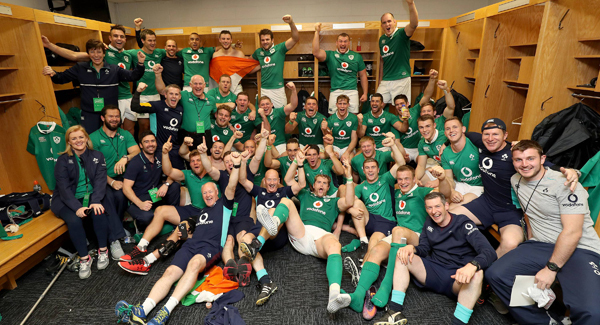
A staggering fact in keeping with a staggering achievement, it puts the victory into a historical perspective far beyond the dreams of those who witnessed ‘The Originals’ at Lansdowne Road 111 years ago and every generation since.
The result from Chicago hit poor old Charlie Richter’s Scale so hard that it’s been on the blink ever since.
No European country had ever dared to run five tries past the All Blacks, let alone succeed.
For Ireland, even the most prosaic of wins through a lucky penalty or a half-shanked drop goal had long been dismissed as Mission Impossible.
On those rare occasions when New Zealand condescended to offer a fleeting ray of hope, fate would always play a dirty trick as President de Valera could have seen for himself had he not been blind, as will be explained.
England and Wales managed four tries each during different World Cups south of the equator but on neither occasion did they add up to anything meaningful. By the time England got their fourth during a one-sided 1995 semi-final at Cape Town, they had conceded six. In delivering their quartet in Sydney eight years later, Wales conceded eight.
Even when France famously ran riot at Twickenham to knock New Zealand out of the 1999 semi-final, winning the second-half 33-7, they made do with four tries. England’s record romp, 38-21 four years ago, contained only three.
Ireland’s first three required ten attempts over a period spanning 84 years.
George Beamish got the first in 1935, Johnny Fortune the second in 1963, and Tom Grace the third 10 years later. All three had the advantage of knowing their way round the most familiar of blocks at Lansdowne Road.
But five tries in Chicago against the best team the world has seen? If the All Blacks assumed it would be a neutral venue, they didn’t know their history. Had they done so they would have appreciated how much the Windy City owed to the immigrants from the old country, among them the ancestors of Michael ‘Riverdance’ Flatley and Walt ‘Meet the Muppets’ Disney.
How fitting, therefore, that there was a time on Saturday night when the dancing Conor Murray made his opposite number, Aaron Smith, look like Kermit the Frog.
That a Dublin wing called Fortune should score on his debut made it all the more ironic that a team containing such all-time greats as Tom Kiernan, Ray McLoughlin, Willie John McBride, and Noel Murphy ended up cursing their luck as though they had been robbed.
Wilson Whineray’s besieged Kiwis, two points down at half-time, were clinging desperately to the narrowest of leads provided by a Don Clark penalty when flanker John Graham lost the ball in a tackle. As it spun loose, Galwegians No 8 Tony O’Sullivan reacted fastest of all to touch it down. According to the most respected of all Kiwi rugby reporters, TP (Terry) McLean, the chairman of the NZRFU, one Cuthbert Hogg leapt to his feet and bellowed: ‘Knock on, ref!’
The president of Ireland, Éamon de Valera, touched Hogg on the arm. ‘I quite agree with you, Mr Hogg,’ he said.
Mr de Valera had been blind for years.
The English referee, Mr H Keenan, gave his decision to disallow the try from a distance of some 15 yards. O’Sullivan, who died seven years ago at the age of 76, had been denied a unique place in rugby history. His brother Vincent, speaking from his home in Galway, recalled the incident yesterday. “Tony thought he’d scored fair and square. He never made a big thing of it but there was no doubt Ireland deserved to win that match.”
Had the TMO been invented by then, Cork’s Barry McGann might have been proved right in what he has said all along, that his attempted touchline conversion of Tom Grace’s last-minute corner try went over. Then again, he might have been proved wrong.
Most of the scribes reported that a nasty gust of wind blew the ball fractionally off line, enough to miss by a few inches. The only men who mattered, the touch judges, kept their flags down and the referee, Welshman Meirion Joseph, duly blew for time. The All Blacks had got away with another.
Philip Danaher’s team, written off without a hope, responded with three converted tries, two from Vinny Cunningham, the other from Jim Staples. And they finished up desperately close to a fourth from the newly capped Ulster wing, Ronnie Carey. Like O’Sullivan and McGann, history had given him a mocking cold shoulder.
“It’s all very well being gallant loses,” Carey said at the time. “But we still haven’t beaten them.”
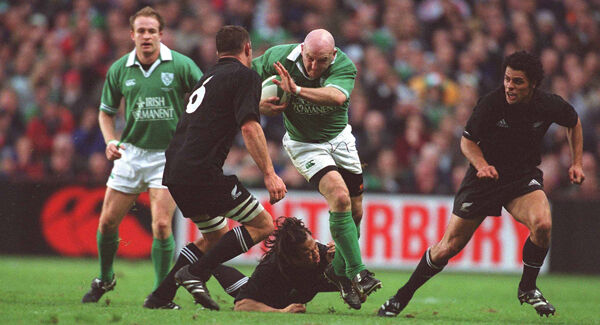
Ireland under Keith Wood lead 21-7 going into the second half and it’s all going horribly wrong for the new All Black at No 7, Richie McCaw. The game turns on New Zealander Norm Maxwell blocking Peter Stringer’s probable scoring pass to Anthony Foley from an offside position. Maxwell somehow avoids the sin bin and Ireland are swept away by five second-half tries.
Murray’s try and two Jonny Sexton goals put Ireland ten clear. A draw would have been anti-climactic enough after such a flying start and the draw was a minute or so away from being confirmed when McCaw gave Dan Carter the platform for one of his rare drop goals.
When the boot turned out to be on the other foot, at the Aviva Stadium the following year, Sexton’s missed penalty opened another escape route for the All Blacks, reinforcing the popular view that, in a rugby sense, there wasn’t a jail big enough to hold them.
How splendid that in a city where they banged Al Capone to rights, the best team in the world should end up on Saturday night under lock and key in the same place, not merely beaten by Ireland but, ultimately, stuffed out of sight.
As the All Blacks’ favourite Irishman, Dave Gallaher from Ramelton on Lough Swilly in Donegal who was killed in action on Flanders’ fields at Passchendaele in 1917, might have said of his compatriots: “Why has it taken you so long…?”
CONNECT WITH US TODAY



Be the first to know the latest news and updates