Paul O'Connell: Towards the end, I got it right
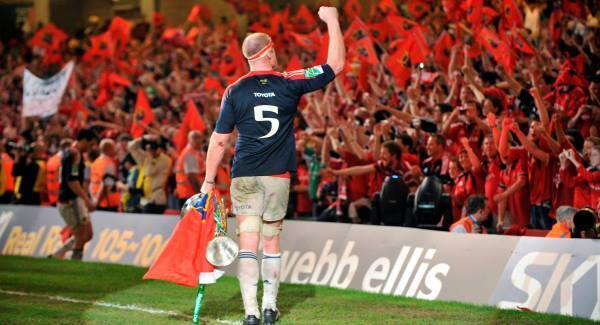
e tend to forget it now, and he’d nearly forgotten too, but only for a key conversation, Paul O’Connell’s career would have ended in 2012. His back was killing him. He had only played two games in six months. Had he listened, his body was telling him it was time to go. He was 33, a two-time Heineken Cup winner, a 2009 Grand Slam winner, a Lions captain, his legendary status assured. What else had he to prove? Why bother putting himself through any more unnecessary anguish?
But as O’Connell tells in his new autobiography, The Battle, he did seek a second opinion: from a surgeon in London, Damian Fahy. Their meeting wasn’t televised. Ryle Nugent or Michael Corcoran weren’t excitedly relaying what happened like they would another lineout or match O’Connell had grabbed out of sheer will and personality as much as stunning technique and physique. Ryle and Michael weren’t there. You weren’t there. And so none of us asked him about it the way he’d be constantly asked about those big games and trophies won in Cardiff.
“That was one of the nice things about doing the book,” he says. “To have my career down on paper, and trigger moments I hadn’t even remembered having. Sometimes we remember something really well because it features a lot in the media or in conversations and that preserves the memory. But there are other things that happened then that were cool or important but because you didn’t spend a lot of time dwelling on them, you nearly forgot about them straight away.
“It was only going back through my journal notes I realised meeting with Damien was one of them. He told me I could be back playing in a couple of months after an operation he could do. For whatever reason, I didn’t end up talking to a lot of people about that conversation, and so I had nearly forgotten all about it. But considering I went over thinking my career was over, it was a really important meeting.”
Not in terms of his legacy or status, though he’ll say otherwise. “If I had gone then, after a few bad years with injury, I don’t even know if people would have remembered me as a good player or not.”
But for the man’s own peace of mind, it made all the difference. Why put himself through more physical anguish? Because of all the mental anguish he had put himself through prior to then. He owed it to himself to enjoy the game and the journey more without being a hostage to winning or losing. That to him was The Battle.
“If I had to have retired then (in 2012), it would have been a devastating thing for me. I felt I had been limping to the end of my career. When the injury happened in the [2015] World Cup, it wasn’t ideal, but it wasn’t a devastating thing for me.” His mind was at peace.
That’s what he’d come to regard as success. A few months after inspiring Ireland to the Grand Slam and captaining the Lions, he came across a quote from the legendary basketball coach John Wooden that up to then he had somehow missed.
“Success is peace of mind which is a direct result of self-satisfaction in knowing you made the effort to become the best of which you are capable.”
It’s the main narrative of his story, and what makes The Battle such a worthwhile and important read. It’s not one of those yarn-every-page efforts, more driven by insight and reflection than anecdote. But that is its strength. In that regard, it is pure O’Connell.
His observations of the various coaches he worked for are intelligent, measured, fair, even compassionate. Again, totally in keeping with the man’s character and personality. For a man who still questions how well he conveyed and phrased criticism to people as a player, he could not be fairer in his book. He shrewdly observes the different coaching styles of Eddie O’Sullivan and Declan Kidney. “Eddie didn’t want anyone else thinking he wasn’t running the show. Deccie wanted players running it.
“But the way O’Sullivan himself ran sessions, having his players run switches and loops every day, made me and everyone a better player.”
It’s O’Connell on O’Connell though that is most fascinating. Players and coaches from all sports will have the pencil out, finding nuggets in how he kept raising his mental game. One of the most intriguing discoveries is how someone we had seen in the mid-noughties as the personification of mental toughness actually found his own mindset needed improving. He wasn’t enjoying rugby as much as he should. He wasn’t being as effective as he could.
He’ll say his mindset was not that much advanced from when he was a young swimmer.
Childhood
The chapter on your childhood and especially your time swimming is very interesting, especially when you’d tell the parents of opponents you were going to beat their son! There’s also that passage where you’re in a gala and in the pool, and you’re looking up at your club coach poolside, and surprised how nonchalant he is, and you’re sure then that you’re still ahead in the race. It’s only afterwards you realise you were beaten – by a clubmate. As you put it yourself, “I’m not sure I ever loved swimming for itself.” You seemed more extrinsically motivated. When you look back on it what would you say to that young swimmer?
I think that young swimmer was extremely focused and that winning and losing was all that mattered. As time goes on and you become more involved in teams and deal with the ups and downs of injuries, you become a more rounded person and end up with a whole lot better perspective. But I’d say when I started my professional rugby career I was probably very similar to that young swimmer. There was only winning or losing; there was nothing else.
You still have an affinity with swimmers, being a mentor to some of the swimmers in the high performance unit in UL. What did swimming give you that served you well in your rugby career?
The one thing I noticed was the best guys in our clubs were the guys who never, ever missed training. They were never even late. The Kearneys. The Mulcahys. They always had the right attitude at training. That was my example and I followed it.
Everything in swimming is measured. Everything you do in training is measured. And what I found was the more time you put in, the better your chances were of having the seconds come down.
Was it at easy to bring that to rugby, especially outside the gym?
I tried as much as I could, especially towards the end when we had GPS. I’d have little goals in training; if I ran over a certain speed that was considered high-speed running, so I’d have a certain target for the amount of high-speed runs I wanted to do in a game. Over another certain speed was considered a sprinting effort, and again I had a goal for that. And I knew if I trained or played well when I hit those numbers.
Later in my career I got to the stage where time on the pitch was very valuable to me. When I was young I could do the full rugby session and then stay on for another 20 minutes and do extra fitness. But with my injuries towards the end, I had to figure out how I could turn a rugby session into a fitness session. I was saving myself 30 minutes on the pitch for my body to be able to look after itself.
You’re dealing there with habit change. I spoke to Fergus Connolly, the S&C coach, who was working with Munster at the time and I said, ‘Look, I’m struggling to change habits here.’ And he spoke about Closing The Loop. You need to have a loop where you figure out what do I want to get better at; what am I going to do to get better at it; and then afterwards, sit down and actually ask yourself did it work and what I should do differently. That’s the reason why I used to set other goals on skills for training.
That was about 2011. I’m surprised from the book how late you were to some concepts, like that reflective practice Fergus spoke about. Or how negative your thoughts could be prior to you meeting [performance coach] Caroline Currid in 2008, a few months after you’d won your second Heineken Cup. Or even the performance triggers that Joe Schmidt would use in his coaching; that was all new to you.
The game was very different before then. There was very little structure in how we played and prepared. You played on instinct. It was around 2009, 2010, 2011 it started to change.
What habits did you change?
Well, how we rucked. Before, you’d just shift people out of the way. Towards the end, we actually had a really technical rucking style. But when you’re doing something a certain way for so long, that means you’ve to change a habit. And most of the time in rugby, you’re executing a skill when you’re tired and under pressure. So, if you’re in a match and you need to plant a shoulder into someone to remove him in a ruck, well it’s very hard to do it aggressively and technically correct if you’re having to think about it and process it right there. But if you have changed the old habits so that the new ones come naturally, when the picture unfolds in front of you, you just react and do it.
How do you think your mentality improved from the time when you were winning Heineken Cups?
I was probably very hard on myself and my teammates back then. I used to think there was only winning or losing; there was no actually getting better. I mean, I certainly do think I was getting better but I didn’t pat myself maybe enough on the back for getting better. Whereas towards the end, I loved it. I always loved training, but I loved that I was doing everything I could to be as good as I could be and to help us try to win the game on Saturday. I got to the stage where that was good enough in itself.
You say you were maybe too harsh on teammates. How did you find was the best way to offer critical feedback?
It’s something I probably wasn’t great at in my early days. Towards the end, I was probably still tough enough, but I hope people saw I was tough on myself as well. And that I was a team man; that I wouldn’t have been saying it for any agenda other than to try to make the team better. I think sometimes some people have to be that guy. There were times in lineouts or mauls that I felt it was my job and whether we did it well or not, I’d be judged on it. So if someone did it wrong four times in a row, it was my job to tell them. I think I was quite good at the end.
Well, it has to be done. So how would you do it?
I think you have to phrase it the right way. I didn’t always do that. I think I got better at it.
There’s the bit in the book when as Munster captain you say to [CEO] Garrett Fitzgerald, “Look, I know how hard your job is… but can we have a look at this?”
[Smiles]. Yeah, you’d put a lot of thought into how you phrased things. But it all comes back to, “I’m doing this for the right reasons, not because I love giving out to people. I’m doing it as a team man.”
Why did the John Wooden quote resonate so much with you?
I look back at when we won things and the feeling would be very fleeting. You’d have three of the best days of your life where you’d be on the beer with your friends, but after four or five days you’d be already feeling bad about drinking for that long and wondering about your weight and fitness and what other people [opponents] are doing. And then there’s next season and it just moves on. So I realised, ‘Wait, there has to be something else.’ That’s where the idea of just being your best came in.
I’d read quite a bit, I suppose. I like Stephen Covey. I like [late Superbowl- winning coach Bill Walsh’s] . I think that’s a great title for a book. I know this sounds cheesy, but you’ve got to find satisfaction in the journey. Because only a small handful of people get to where they set out to get to at the start. Even those of us who have been lucky enough to win, a lot of years we didn’t. Does that mean it was wasted? If you look at it only like that, you can miss all the brilliant experiences and tools you can take from it for the rest of your life.
But the journey goes on, even after you reach a destination. I liked when after winning the Six Nations in Paris in 2014 that you still felt that the team could have managed the last 10 minutes of the game against France better; that even in victory, the process went on, just like after the loss in Twickenham two weeks earlier.
Ah, I think it was a bit silly! Sometimes you have to enjoy it there and then and shut up for a while about it! I’ve only beaten France a handful of times. That was my first time beating them in Paris.
The only thing was Joe talked about improving from campaign to campaign, from game to game, not to worry too much about the big picture; let’s just get better week by week. And the reason that match took me was to the last campaign, the autumn internationals, and the New Zealand game, and it still bugged me that had happened [blowing a lead late on]. But when you look back on it [Paris], there were a couple of crazy refereeing decisions at the scrum where we should have had two scrum penalties. If we had got them, we’d have kicked the ball 60 metres down the pitch and you’d be playing out the last five minutes down there. But just how close it had been, it frustrated me.
Your previous championship win in 2009. I was always struck by a comment you made in the Dave Berry documentary, that at half-time against Wales in Cardiff, you weren’t particularly bothered you were 6-0 down at half-time; that you were still doing a lot of things right, and that while it hadn’t shown after 40 minutes, it would after 80.
Yeah, though I don’t think I would have been as tidily process-driven then as I as I would be later in my career. But we had a very good confidence about what we were doing at that stage; we had beaten France, we had beaten England. At the start of that second-half then we got a bounce of the ball for Tommy’s try. But when you’re working hard and preparing well you’re in a position to take those bounces of the ball.
Before a game like that, you’d find yourself in the hours before wishing it was already over. Brian O’Driscoll, in contrast, was more relaxed . Ronan O’Gara basically said, without using your name, he used to be more like you, but eventually found a good medium. You found it, too?
Yeah, by the end I was good. I had the odd bad day where I would descend back into wanting to retire, but it was very rare. For the Six Nations decider in Murrayfield, I was so relaxed, I was travelling on the bus, looking out the window and exchanging a laugh and a joke with fellas. I remember thinking to myself ‘This is the first time in my career I’ve done that.’ But I was in a very good place because I knew I had prepared as well as I could. I became like that in general. When the time comes to work and train hard, work and train hard. But when the time comes to spend time with your family, don’t keep checking your phone.
When did you get there?
Towards the end.
Would it have made a difference if you had discovered that zone earlier?
Oh, yeah. Big time.
Because you’d have enjoyed it more?
I’d definitely have enjoyed it more. I would have been a better player. I wouldn’t have been wasting as much energy. There were a lot of games, really big games, when I was actually quite flat. I think players that can train hard when it’s required, then relax, they’re the guys that are in a good place, come Saturday.
But you’d get to that place. That was the journey.
Yeah. That was The Battle.
- The Battle by Paul O’Connell is published by Penguin Ireland at €25.00. He will be signing copies of his book today in Eason’s, O’Connell St, Dublin, at noon; tomorrow in O’Mahony’s, O’Connell St, Limerick, at 2pm; and in Eason’s, Patrick St, Cork, 2pm, next Saturday, October 15.
CONNECT WITH US TODAY



Be the first to know the latest news and updates