Schools should teach tackling, not ban it, says Anthony Foley
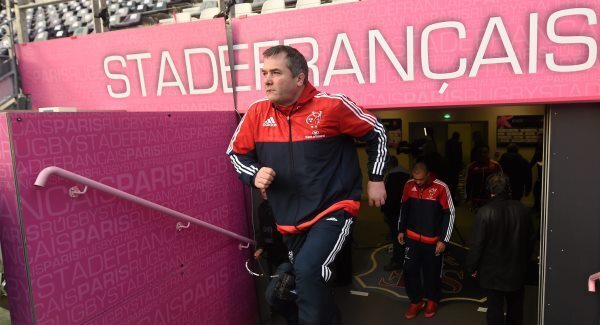
Yesterday, more than 70 doctors and medical experts sent an open letter to the British government calling for tackling to be banned in schools and youths rugby and went so far as to urge educational institutions to instead adopt touch or non-contact rugby. That is unlikely to ever come to pass although Anthony Foley doesn’t underestimate the problems facing the game he has graced since his youngest days at St Munchins College.
Indeed, in his time there he played three seasons of senior cup rugby and picked up eight Irish schools caps so should know the impact rugby has on young bodies.
Foley isn’t closing his ears to what the doctors are saying, wondering instead how much time kids spend learning how to tackle.
“How many times do they learn how to carry a ball into contact, how many times do they learn how to protect themselves in contact.
If we have exhausted every avenue around teaching and learning and making sure kids have the skill of tackling, which is a skill, then I would look at it. But I don’t think we have put enough time to teaching these kids how to tackle properly.”
In Foley’s own case, it helped that his coach from the outset was his father Brendan, one of Munster’s and Ireland’s most respected players. In spite of representing his country on 62 occasions and Munster 202 times, Axel was rarely struck down by injury.
“Kids need to be taught how to tackle... whether you out-law above the waist, anything from the chest-area tackling at underage, or every tackle needs to be around the legs... that could be a way forward”, he says.
“We had it in scrummaging where props aren’t allowed push, so that when they come out of school now, they can’t push and the scrum is a disaster. Teach them the skill, teach them how to do it, and then you won’t have a problem.”
Foley was at his father’s knee since he was a kid and so remembers all the different steps rugby took to look after its players safety.
“The game always had a way of protecting itself,” he stresses. “You go back to the 60s, no substitutions. Then up to the early 90s, no substitutions unless there was an injury, no tactical substitutions. The intensity of the game would naturally drop before half-time and towards the end of the game which is when most of the scores would come.
“The game through ELVs made it more high-octane, more entertaining for the want of a better word. Collision numbers have gotten higher. In the southern hemisphere the ruck speed is a lot quicker so the collisions aren’t as much. Up here there is a lot more emphasis on the breakdown and there’s a lot more fight, a lot more slowing down of the ball and a lot more collisions around the corner with the big bodies so there needs to be a balance found somewhere.”
Asked if he understood parental concern, Axel Foley came up with an interesting analogy: “I do but (it’s like) an electrician going into work not properly suited to doing his job. I understand if he’d come through an apprenticeship not capable of doing an electrician’s job, then you’d be worried about him doing a job on your house wouldn’t you.”
These issues, of course, are by no means confined to the under-age game, the latest demonstration coming with the knocks handed out to one of Foley’s own players, Conor Murray, at Twickenham last Saturday.
“You look at it and you go through it and I will guarantee over 90% were poor technique,” he insisted. “You look at a lot of the head collisions, at lads putting their heads in the wrong position or getting caught with their head in the wrong position and the tackles are probably high.
“As for Conor ... it’s the wrong side of the law people are looking at. Once a ruck is formed nobody can touch the ball with their hands but you can touch it with your foot. Rucking, which was a skill in itself, has been taken out of the game. My first game for Shannon was against Young Munster with the Claw, Mark Fitzgerland, Paco (Fitzgerald), Ger Earls, the Ryans, the Clohessys, I didn’t stay too long on the ground. The ball is there to be played on the ground in a ruck and the only way you can play it is with your feet.”
Even with a player’s head right beside it?
“That’s where there is a duty of care and a gentleman’s agreement and the English player did walk across the little white line. The laws of the game are there to protect the players on the field and if they’re reffed properly the game will look after itself without adjusting anything.