Peter Jackson: Wales out to wham the slam
It will be worth the best part of €7 million to the winner in prize money and yet there will be something far more valuable at stake, something that cannot be measured by anything as coarse as filthy lucre. The way the Welsh see it, no price can be put on national pride, least of all when it’s England at Twickenham.
From their perspective west of the Severn Bridge, this is the mother and father of all grudge matches — always has been, always will be. The one certainty, therefore, about Saturday week’s Six Nations decider is that there will be no love lost between them.

There never has been since Owain Glyndwr, the last Welsh Prince of Wales, led a revolt against a ruler whom his people saw as the revolting King of England, Henry IV.
He eventually put the uprising down 601 years ago but those natives with elephantine memories have not forgotten. Not for nothing, then, do the Welsh view their biennial London trip as a form of payback for what happened in the early 15th century.
Humiliating England at their own World Cup and ambushing the grand slam chariot for the second time in three years is the least they can do. When the late Ray Gravell faced the English five centuries later, the charismatic warrior centre saw himself in the image of Glyndwr.
“To beat England was a small way of redressing the balance of injustice over the centuries,” Gravell said after retiring. “It goes back to 1536 and the Act of Union. This rule was imposed on us in such a way that Welsh children were not allowed to speak Welsh.
“It gave me immense satisfaction to beat them, especially at Twickenham. To march into the lions’ den and come out victorious was a re-enactment of something our forefathers would love to have done: righting an old wrong.”
England, of course, are in the same business, except the wrong they need to right happened not six centuries ago but six months ago, a mortal World Cup blow delivered by the noisy neighbours.
The sight of a former Ireland coach leading Wales back into ‘HQ” in tandem with a defence expert whose name is to be found in the ranks of one-cap Irish wonders will add to English anxiety. Warren Gatland and Shaun Edwards — one match for Ireland’s rugby league team in 1998 — have been serial winners at Twickenham since Edwards led Wigan’s superstars to victory at the Middlesex Sevens 20 years ago — English rugby’s Berlin Wall moment.
Since then they have walked out of Twickenham with three English Premiership Grand Finals, one European Cup (two in Edwards’ case) and three international wins. The first two led directly to Welsh Grand Slams, in 2008 and 2012. Johnny Sexton’s long-distance penalty has robbed them of another Slam but who’d bet against Gatland and Edwards coming up roses again on Saturday week?
The Six Nations does funny things to coaches
So Eddie Jones has taken the hump and a vow of silence at being taken to task for shooting his mouth off pre-match about Johnny Sexton.
Images of the Australian plotting their downfall from a Trappist monastery take some imagining. Jones sitting in cloistered contemplation, his Red Rose tracksuit traded in for a hooded religious habit, is too absurd for words.
How could he possibly change the habit of a lifetime and stop addressing fellow monks the way he addresses everyone else, in two Aussie words: “Look, mate.”
Whatever next? Donald Trump visiting a mosque? Monica Lewinsky campaigning for Hillary Clinton? The Six Nations does funny things to coaches and Jones is not alone. Vern Cotter’s contribution to the art of communications since taking charge of Scotland has rarely amounted to more than a poker-faced expression of his default position: ‘It is what it is.’
Coaching a struggling team, especially one stricken by a chronic habit of losing nine championship matches on the trot, is no laughing matter. Now that they have stopped the rot, the ‘Stern Vern’ image is in danger of disintegrating.
Enough cracks appeared for the Kiwi to be caught smiling at the Stadio Olimpico. Scotland and the wooden spoon are no longer an item because, even in the worst of all Irish worlds, an Italy win in Dublin next weekend would leave the champions sitting on their rocky bottoms.
Digital revolution fails to benefit Ireland’s cause
In those long-gone days before the digital revolution, referees had occasion to fly by the seat of their pants, navigating their way to crucial decisions based on a combination of what they saw, what they thought they saw, gut instinct or pure guess work.
Pre-technology, Ireland would have been awarded three times as many tries at Twickenham as they were given, enough to make a difference to the final score, if not the result — 28-22 instead of 21-10.
Robbie Henshaw would have been given his in the right corner because the referee would not have been able to see him lose control of the ball before he could get it down. Even if the touch judge had seen it, he had to keep his mouth shut because until recently, touch judges had no say in the matter.
Josh van der Flier would have been given his score without any hesitation because, in spite of Elliot Daly’s interference, it looked a try. Its refusal highlighted a flaw in the system.
“Try yes or no,” Romain Poite, the referee, asked the Man in the Van, TMO Shaun Veldsman from South Africa.
The verdict, delivered after forensic examination of the tape: “There is no clear evidence.”
Had Poite couched his referral differently and asked for any reason not to award the try, Veldsman would probably have said: “No, there isn’t.’’
He would also probably have added: “But nor is there any reason to give it.”
The same answer could have applied when Dylan Hartley thought he had scored beneath a pile of bodies between the posts. All the England captain got for his trouble was to be pinged for a double-movement. Justice was clearly seen to be done in that case and in Henshaw’s but try telling that to Van der Flier. All the referrals take time which may explain why England-Ireland ran to a total playing time of 100 minutes.
Low cameo short and sweet
In an era when Test match appearances are shortened to a matter of a few minutes, Moray Low has made surely the shortest one of all. There were 23 seconds left in Rome when the Exeter prop trundled on to shore up a Scotland scrum and fill the gap at tighthead caused by WP Nel’s binning for a deliberate knock-on. Low lived up to his name in winning his team a penalty which Finn Russell belted into the crowd. Job done in seconds.
Noves’s own goal
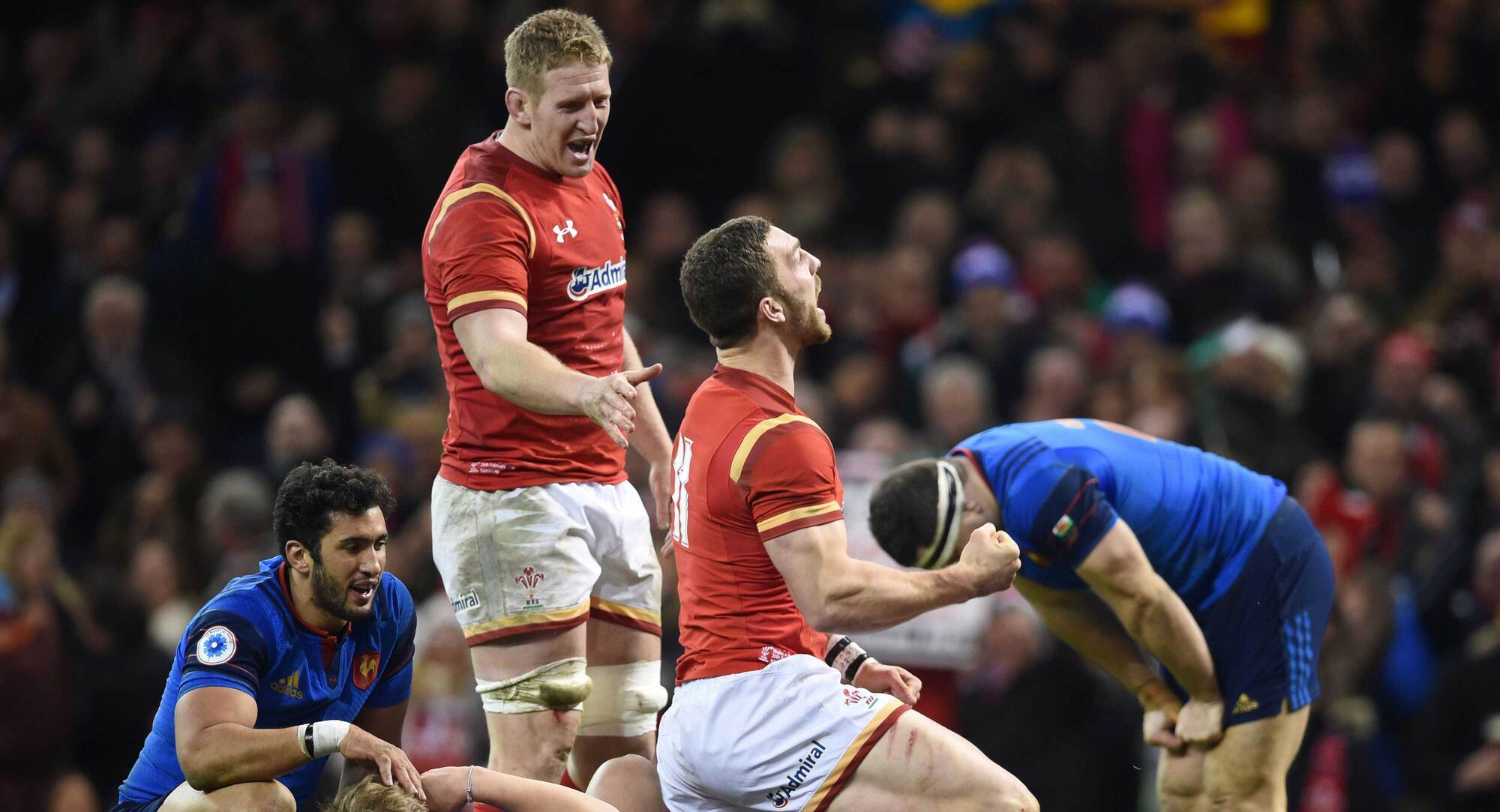
Guy Noves (above) lost a Grand Slam on his Five Nations debut against Wales in Cardiff and now, almost four decades later, he’s lost another to the same opposition in the same city. But how was he to know that his team would succumb to a chain of comic events reminiscent of a bumbling Paris detective? The Inspector Clouseau moment, with the hapless Jules Plisson in the title role, gave an embarrassed George North the luckiest try of his life — an own goal that cost France seven points.