Schooling starts for class of 2019
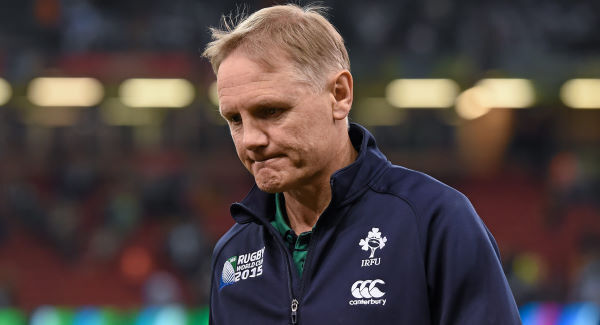
Amid the doom and gloom that followed the crushing 43-20 defeat to Argentina at the Millennium Stadium and the debate about the relative merits of northern and southern hemisphere rugby after South Africa, New Zealand, and Australia joined the Pumas in the last four for this weekend’s semi-finals, the Irish Examiner looks at where Irish rugby goes from here, what problems need addressing and who will be flying the flag for Ireland when the next World Cup comes around at Japan 2019.
While a second Rugby Championship of the year is played out at Twickenham over the next two weekends, those involved with the Ireland camp will take time out to lick their wounds after their heaviest quarter-final defeat at a World Cup, eclipsing the 43-21 defeat to France in 2003.
When the dust has settled, though, head coach Joe Schmidt has promised to get the Ireland team up and running again. There’s a Six Nations title to defend and a demanding summer tour to South Africa next June and those challenges take planning.
That’s just in the short-term. Four years seems a long way out to be worrying about Ireland’s next bid to reach a first ever semi-finals but preparations have to start now if the class of ’19 are not simply going to emulate all their predecessors and fall short at the quarter-final stage.
Countdown has commenced.
The need to develop a deeper pool
As Joe Schmidt lamented on Sunday night, losing players of the calibre of Paul O’Connell creates a considerable vacuum in terms of leadership. Throw in further injuries to Peter O’Mahony, Johnny Sexton, Jared Payne, and suspension to Sean O’Brien and Ireland got sucked into the rugby equivalent of a black hole.
Those who stepped into the breach positionally for each of the above performed admirably against Argentina but after weeks of seeing other nations lose key players to injury, when Ireland’s own casualties began to mount, it inflicted startling devastation on the fragile balance of Joe Schmidt’s squad.
Ireland struggled without key players in key positions and the coaching staff have to find a way to avoid such calamitous losses in future championships and tournaments. Our list below highlights some up and coming young players who could force their way in to Ireland’s thinking for the squad to go to the 2019 World Cup in Japan. However, look carefully at the list and see that it highlights a familiar strength in depth in some positions such as the back row and worrying paucity in others such as scrum-half and second row.
The clock is already ticking.
Running with the big boys
Under Joe Schmidt, Ireland have found a successful formula for beating their Six Nations brethren, winning the championship title back-to-back in 2014 and 2015: High pressure multi-phase play, exploiting contact by executing super-efficient breakdown work that brings quick, clean ball, an excellent kicking game that piles on more pressure to opposition backfields, and a watertight defence.
All of which id fine and well proven against our friends in the north, yet, like Ireland, they are all on their way home from the World Cup, leaving the southern hemisphere quartet to fight it out for the biggest prize in the sport.
As we all saw at the weekend during the quarter-finals, try the same thing against opposition less likely merely to return kicks — preferring to keep ball in hand backed by the skills to move it on quickly, attempt line-breaks and offload in contact — and the result on Sunday in Cardiff made for painful viewing.
All the caveats around defeat to Argentina are understood, not least the inexperience resulting from the absence of players with more than 230 caps between them. Schmidt rightly cites victories over Australia and South Africa in the past year as proof that his players can live with the big beasts from south of the equator, but perhaps their skillsets and mindsets need to be nurtured to give Ireland the ability to employ more variety in their gameplan and a better chance of beating them consistently.
Adieu, adieu to you and you and you...
A worrying thing for the Irish management now is how to replace the senior members of the leadership group who will not be around in 2019.
As the accompanying panel speculating on the destiny of the current squad shows, O’Connell definitely, and possibly Sexton, Heaslip, and a few others will not be around come the next World Cup. Ireland have four years to hone the leadership skills of those next in line, future seniors like Conor Murray, Robbie Henshaw, and Iain Henderson.
Ireland 2015... where will they be in four years?
Paul O’Connell (40).
Rory Best, hooker (37); Eoin Reddan, scrum half (38); Mike Ross, tighthead prop (38); Nathan White, tighthead prop (38).
Tommy Bowe, wing (35); Darren Cave, centre (33); Keith Earls, wing (33); Luke Fitzgerald, wing (33); Jamie Heaslip, No 8 (35); Chris Henry, flanker (35); Rob Kearney, full-back (33); Jared Payne (35); Donnacha Ryan, lock (35).
Sean Cronin, hooker (33); Cian Healy, loosehead prop (32); David Kearney, wing (30); Sean O’Brien, flanker (32); Johnny Sexton, fly-half (34); Richardt Strauss, hooker (33); Devin Toner, lock (33); Simon Zebo, wing (30).
Tadhg Furlong, tighthead prop (26); Iain Henderson, lock (27); Robbie Henshaw, centre (26); Paddy Jackson, fly-half (27); Ian Madigan, fly-half (30); Jack McGrath loosehead prop (30); Jordi Murphy, flanker (28); Conor Murray, scrum-half (30).
Peter O’Mahony, flanker (30).

CONNECT WITH US TODAY



Be the first to know the latest news and updates